Fri Oct 23, 2026 Lecture (L23) Stewart Section 4.3 Derivatives and the Shapes of Graphs, Part 1
 Watch on YouTube →
Overview
The lecture introduces the increasing/decreasing test and the first derivative test, showing how the sign of f′ identifies intervals of growth or decline and detects local extrema. Examples clarify that a zero derivative does not necessarily mark an extremum, using f(x)=x³, then apply a sign chart to f(x)=x⁴e⁻ˣ to find its increasing and decreasing intervals and local extrema.
Key takeaways
- For f(x)=x³, f′(0)=0 but the function is increasing on the entire real line, so a zero derivative alone does not establish a local maximum or minimum.
- The increasing-decreasing test gives guaranteed intervals based on the sign of f′, but its intervals may need to be joined after checking behavior at points where f′=0.
- A critical number c requires f(c) to exist and either f′(c)=0 or f′(c) to be undefined.
- A sign change in f′ classifies a local extremum: positive to negative means a local maximum, while negative to positive means a local minimum.
- For f(x)=x⁴e⁻ˣ, factoring f′ as x³(4-x)e⁻ˣ makes the sign analysis straightforward because e⁻ˣ is positive for every real x.
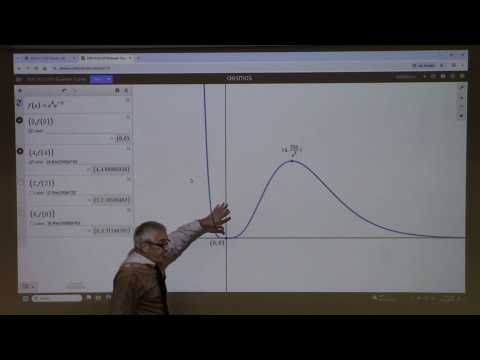
- The function x⁴e⁻ˣ decreases on (-∞,0), increases on (0,4), and decreases on (4,∞), with a local minimum of 0 at x=0 and a local maximum of 256/e⁴ at x=4.
Chapters
- The announced quiz covers sections 3.7, 4.1, and 4.2.
- Section 3.7 was covered before the previous exam and is included on exam three.
- The lecture begins section 4.3, derivatives and the shapes of graphs, with the first derivative test.
- A function is increasing on an interval when x₁ < x₂ implies f(x₁) < f(x₂).
- For f(x)=x³, y-values rise as x moves left to right, including across x=0.
- The horizontal tangent at x=0 does not interrupt the function's increase across the real line.
- If f′ is positive throughout an interval, f is increasing there; if f′ is negative, f is decreasing there.
- If f′ is zero throughout an interval, f is constant on that interval.
- For f(x)=x³, f′(x)=3x² is positive on (-∞,0) and (0,∞), so the test guarantees increase on those separate intervals.
- The test may split an interval at a point where f′=0, even when the function is increasing across that point, as x³ is across x=0.
- A critical number c must be in the domain of f, with f′(c)=0 or f′(c) undefined.
- A change in f′ from positive to negative indicates a local maximum; a change from negative to positive indicates a local minimum.
- If f′ changes from positive to zero and back to positive, as in a horizontal tangent without a direction change, there is no local extremum.
- A cusp or vertical tangent can yield a critical number when f(c) exists but f′(c) does not.
- For f(x)=x⁴e⁻ˣ, the product rule gives f′(x)=4x³e⁻ˣ - x⁴e⁻ˣ.
- Factoring yields f′(x)=x³(4-x)e⁻ˣ; the exponential factor is always positive.
- The derivative exists for every real x, and its zeros at x=0 and x=4 partition the number line.
- The sign of f′ is negative on (-∞,0), positive on (0,4), and negative on (4,∞).
- The sign chart shows f increases on (0,4) and decreases on (-∞,0) and (4,∞).
- At x=0, f′ changes from negative to positive, giving a local minimum with f(0)=0.
- At x=4, f′ changes from positive to negative, giving a local maximum with f(4)=4⁴e⁻⁴=256/e⁴.
- The lecture plots the extrema points (0,0) and (4,256/e⁴) before transitioning to the quiz.
Transcript excerpt
0:00 buddy. >> [clears throat] >> Uh as I mentioned before, there are some graded exams up there if you weren't here on Wednesday to pick up your graded exam. Uh we're marching through chapter 4. We're discussing section 4.3 today and tomorrow. And then I would today and Monday. And then uh Wednesday we'll be doing section 4.4. So as my uh announcement on It's what When When I put an announcement on Canvas, do you all get an email saying that there's been an announcement? Okay, so as the announcement said, today's quiz covers section 3.7, 4.1, and 4.2. Those are um you know, remember that 3.7 was covered in class
0:48 before the exam, but was not on the exam. And I said it would be on exam three. So it's on today's quiz. And then these two sections, 4.1 and 4.2 that we discussed Monday and Wednesday are on today's quiz. And then uh This is This is one interval where we actually have three quizzes before we have the next exam. Uh our our for our first two exams each covered material from two quizzes. Okay. Well, uh I want to start by So we're discussing um derivatives and the shapes of graphs. Let me get my notes so you don't forget what I'm doing. So meeting part one
1:52 is um Well, actually this is going to be a one-part meeting cuz we have a quiz. So, meeting part one is about the first derivative test. So, there's a lot of terminology. And rather than have you write it all down, which is actually a productive thing to do, but it takes a lot of class time. I want to just project it. So, So, remember the the definition of an increasing function. This is from chapter one.
This is the start of the transcript. Save this video free for the whole transcript, searchable and time-coded.
Related notes
Summary, takeaways, and chapters were generated by AI from the video's transcript and may contain errors. The video belongs to its creator, Barsamian's Math Videos.