Wed Oct 21, 2026 Lecture (L22) Stewart Section 4.2 Rolle’s Theorem & Mean Value Theorem (MVT)
 Watch on YouTube →
Overview
Stewart Section 4.2 develops Rolle’s Theorem and the Mean Value Theorem through examples that connect derivative slopes to secant-line slopes. Examples include finding c = 9/4 for f(x) = √x − x/3 on [0, 9], c = 2 for f(x) = 1/x on [1, 4], and a proof that x³ + eˣ = 0 has exactly one root using the Intermediate Value Theorem and Rolle’s Theorem.
Key takeaways
- Rolle’s Theorem requires continuity on [a, b], differentiability on (a, b), and equal endpoint values; it then guarantees a point where the tangent is horizontal.
- For f(x) = √x − x/3 on [0, 9], the derivative fails to exist at the left endpoint, but that does not violate Rolle’s Theorem because differentiability is required only on (0, 9).
- The Mean Value Theorem equates an interior tangent slope with the endpoint secant slope; for f(x) = 1/x on [1, 4], both slopes equal −1/4 at c = 2.
- A failed equation for c can reveal that a theorem was applied outside its conditions: 1/x on [−1, 1] is discontinuous at zero, so the Mean Value Theorem does not guarantee a matching tangent slope.
- The equation x³ + eˣ = 0 has at least one root in (−1, 0) because f(−1) < 0 < f(0), and at most one because f′(x) = 3x² + eˣ is always positive.
Chapters
0:00
Rolle’s Theorem: Checking the Hypotheses for √x − x/3
- For f(x) = √x − x/3 on [0, 9], continuity holds on the closed interval.
- The derivative f′(x) = 1/(2√x) − 1/3 is undefined at x = 0, but exists throughout the required open interval (0, 9).
- Both endpoint values match: f(0) = 0 and f(9) = 0, satisfying Rolle’s endpoint condition.
6:34
Finding and Illustrating the Rolle Point c = 9/4
- Rolle’s conclusion guarantees at least one c in (0, 9) such that f′(c) = 0.
- Solving 1/(2√c) − 1/3 = 0 gives √c = 3/2 and c = 9/4.
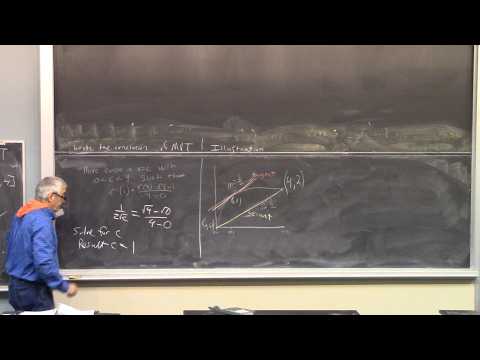
- The graph illustrates the result with a horizontal tangent at x = 9/4; the vertical tangent at x = 0 explains why differentiability is only required inside the interval.
12:59
Mean Value Theorem: Matching Tangent and Secant Slopes
- The Mean Value Theorem requires continuity on [a, b] and differentiability on (a, b).
- It guarantees a c in (a, b) where f′(c) = [f(b) − f(a)]/(b − a).
- Geometrically, the tangent line at x = c has the same slope as the secant line joining the graph’s endpoint values.
14:54
Applying the Mean Value Theorem to f(x) = 1/x
- On [1, 4], f(x) = 1/x is continuous and differentiable, with f′(x) = −1/x².
- The endpoint secant slope is [(1/4) − 1]/(4 − 1) = −1/4.
- Setting −1/c² = −1/4 yields c = 2, the value inside (1, 4) where the tangent is parallel to the endpoint secant.
21:16
Class Exercise: Mean Value Theorem for √x on [0, 4]
- For f(x) = √x, continuity holds on [0, 4], while f′(x) = 1/(2√x) exists on (0, 4).
- The endpoint secant slope is (√4 − √0)/(4 − 0) = 1/2.
- Equating 1/(2√c) with 1/2 gives c = 1; the illustration should show the endpoint secant and the parallel tangent at (1, 1).
27:42
Why 1/x on [−1, 1] Cannot Use the Mean Value Theorem
- Although f(x) = 1/x has endpoint values −1 and 1 and a secant slope of 1, it is discontinuous at x = 0.
- The equation −1/c² = 1 has no real solution, consistent with every tangent slope on either branch being negative.
- Because continuity on [−1, 1] fails, the Mean Value Theorem makes no claim that a suitable c exists.
32:40
Using the Intermediate Value Theorem to Establish a Root
- Define f(x) = x³ + eˣ, a continuous function whose zeros solve x³ + eˣ = 0.
- At the interval endpoints, f(−1) = −1 + 1/e < 0 and f(0) = 1 > 0.
- The Intermediate Value Theorem guarantees at least one root c in (−1, 0).
38:00
Rolle’s Theorem Proves the Root Is Unique
- If f(x) = x³ + eˣ had two distinct roots, Rolle’s Theorem would require f′(c) = 0 at some point between them.
- The derivative is f′(x) = 3x² + eˣ, which is strictly positive for every real x.
- Since f′ never vanishes, a second root is impossible; combined with the Intermediate Value Theorem, this proves exactly one root exists.
Summary, takeaways, and chapters were generated by AI from the video's transcript and may contain errors. The video belongs to its creator, Barsamian's Math Videos.