Mon Oct 19, 2026 Lecture (L21) Stewart Section 41. Max and Min Values
 Watch on YouTube →
Overview
The lecture develops an analytic way to locate extrema by defining absolute and local maxima and minima, then identifying critical numbers where a function's derivative is zero or undefined. It applies Fermat's theorem and the Extreme Value Theorem to build the closed interval method: for a continuous function on a closed interval, compare function values at the endpoints and critical numbers. Examples include a rational function, x²e⁻ˣ, and −x⁴ + 6x² + 27 on [−2, 3].
Key takeaways
- A critical number c must belong to the function's domain and satisfy f′(c) = 0 or have an undefined derivative; derivative zeros outside the domain do not qualify.
- Fermat's theorem provides a necessary test for local extrema at interior points, not a sufficient test: a horizontal tangent can occur without a maximum or minimum.
- With the textbook convention used in class, local extrema occur only at interior domain points, while absolute extrema may occur at endpoints.
- For a function continuous on a closed interval, the Extreme Value Theorem guarantees absolute extrema, and the closed interval method finds them by comparing endpoint and in-interval critical-number values.
- For −x⁴ + 6x² + 27 on [−2, 3], checking all critical numbers and endpoints yields an absolute maximum of 36 at x = ±√3 and an absolute minimum of 0 at x = 3.
Chapters
0:00
Graphing the Search for Maximum and Minimum Values
- The example graph includes points (2, 3), (4, 5), (7, 2), (9, 4), and (15, 3), with a vertical asymptote at x = 10.
- The graph illustrates that a local high or low point need not be the highest or lowest value on the entire domain.
- The central goal is to find an analytic method for locating extrema from a function formula rather than by inspecting a graph.
5:20
Absolute and Local Extrema Depend on the Domain
- An absolute maximum f(c) is at least as large as f(x) for every x in the domain; an absolute minimum is defined with the inequality reversed.
- A local maximum or minimum must be the greatest or least value within a small interval around c that lies inside the domain.
- On the example graph, y = 2 at x = 7 is both a local minimum and the absolute minimum, while y = 5 at x = 4 is a local maximum but not an absolute maximum.
- Under the textbook's definition used in class, endpoints such as x = 2 and x = 15 cannot be local extrema because no open interval around them stays within the domain.
12:15
Endpoints, Critical Numbers, and Fermat's Theorem
- Absolute extrema can occur at endpoints, but the local extrema convention used here only allows them at interior points of the domain.
- Local extrema can occur where the tangent is horizontal, so f′(c) = 0, or where the derivative does not exist.
- A horizontal tangent does not guarantee an extremum: the example graph has a horizontal tangent at x = 9 without a local maximum or minimum.
- A critical number c must be in the domain, so f(c) exists, and must satisfy f′(c) = 0 or have f′(c) undefined.
- Fermat's theorem states that a local maximum or minimum at an interior point requires f′(c) = 0 or an undefined derivative; this is a necessary condition, not a guarantee.
20:01
Rational Function: Find Critical Numbers Before Classifying Extrema
- For f(x) = (x − 2)/(x² − 3x + 3), completing the square gives (x − 3/2)² + 3/4 in the denominator, so the denominator never vanishes and the domain is all real numbers.
- The quotient rule gives f′(x) = (−x² + 4x − 3)/(x² − 3x + 3)²; the derivative has no undefined points because its denominator is never zero.
- Factoring the derivative numerator gives critical numbers x = 1 and x = 3.
- The graph confirms a local and absolute minimum at x = 1 with value −1, and a local and absolute maximum at x = 3 with value 1/3.
28:07
Use the Derivative Graph to Interpret Critical Numbers
- The rational function has horizontal tangents at x = 1 and x = 3, matching the zeros of f′(x).
- The factor x − 2 in the original numerator explains the function's x-intercept at x = 2.
- A critical number gives an x-coordinate to investigate; the corresponding maximum or minimum value is the y-coordinate found by evaluating the original function.
32:12
Exponential Example: Differentiate x²e⁻ˣ with the Product Rule
- For y = x²e⁻ˣ, the domain is all real numbers because the exponential function is defined everywhere and eˣ is never zero.
- The product rule gives y′ = x(2 − x)e⁻ˣ; omitting the product rule is a common differentiation error.
- The critical numbers are x = 0 and x = 2, where the derivative is zero.
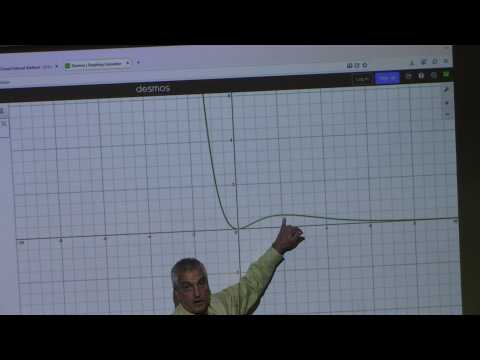
- The function has an absolute minimum y = 0 at x = 0 and a local maximum at x = 2 with value 4/e², but no absolute maximum because the function grows without bound as x approaches negative infinity.
37:26
Extreme Value Theorem and the Closed Interval Method
- The Extreme Value Theorem guarantees an absolute maximum and minimum when a function is continuous on a closed interval [a, b].
- Absolute extrema on such an interval can occur only at its endpoints or at critical numbers within the interval.
- The closed interval method lists those x-values, evaluates the original function at each one, and compares the resulting y-values.
- The method applies specifically when continuity on a closed interval is established; it does not claim every function on every domain has absolute extrema.
43:56
Closed Interval Example: −x⁴ + 6x² + 27 on [−2, 3]
- For f(x) = −x⁴ + 6x² + 27, a polynomial continuous on [−2, 3], the derivative is −4x³ + 12x = −4x(x² − 3).
- The critical numbers are x = −√3, 0, and √3; the complete candidate list also includes the endpoints −2 and 3.
- Evaluating f at −2, −√3, 0, √3, and 3 gives 35, 36, 27, 36, and 0, respectively.
- The absolute maximum is 36 at both x = −√3 and x = √3; the absolute minimum is 0 at the endpoint x = 3.
- Checking only integer inputs would miss the maximum, and skipping endpoints would miss the minimum.
Summary, takeaways, and chapters were generated by AI from the video's transcript and may contain errors. The video belongs to its creator, Barsamian's Math Videos.