Fri Oct 30, 2026 Lecture (L26) Stewart Section 4.5 Optimization, Part 1
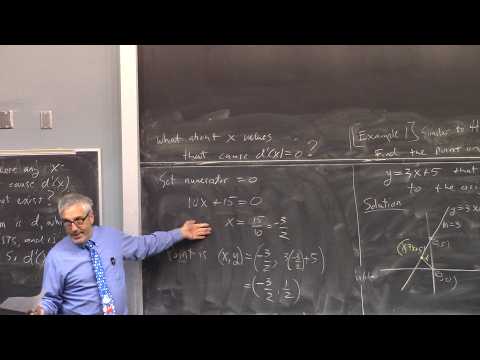 Watch on YouTube →
Overview
Section 4.5 introduces optimization as finding absolute maxima or minima from word problems, where the objective function, variables, and domain may need to be constructed. Two geometry examples apply derivative methods: the point on y = 3x + 5 closest to the origin is (-3/2, 1/2), and the largest rectangle in a 5-12-13 right triangle has area 15.
Key takeaways
- Optimization word problems require constructing an objective function and identifying its domain, rather than simply differentiating a function supplied in the question.
- For a point (x, 3x + 5) on the line y = 3x + 5, distance to the origin is D(x) = √(10x² + 30x + 25), whose unique critical number is x = -3/2.
- The closest point on y = 3x + 5 to the origin is (-3/2, 1/2); the connecting segment has slope -1/3 and is perpendicular to the line's slope of 3.
- For a rectangle placed in a 5-12-13 right triangle with width x along the 12-unit leg, its area function is A(x) = -5x²/12 + 5x.
- The maximum-area rectangle has width 6, height 5/2, and area 15 square units; the downward-opening area parabola confirms a maximum.
Chapters
- Section 4.1's closed interval method finds absolute maxima and minima for continuous functions on closed intervals.
- The first and second derivative tests from Section 4.3 identify local maxima and minima.
- Section 4.5 applies these analytical tools to optimization problems, which seek absolute extrema.
- Unlike standard exercises, optimization problems usually do not provide the function that must be maximized or minimized.
- Problems may involve multiple variables, requiring an equation relating them before reducing the objective to one variable.
- The domain is often unstated and must be inferred from the problem's geometry or context.
- The first example asks for the point on y = 3x + 5 closest to the origin.
- Represent any point on the line as (x, 3x + 5), then use the distance formula to define D(x) = √(x² + (3x + 5)²).
- Because the line extends indefinitely in both directions, distance has no absolute maximum, but the geometry indicates a closest point and therefore an absolute minimum.
- The distance function simplifies to D(x) = √(10x² + 30x + 25), which is defined and positive for every real x.
- Differentiating gives D′(x) = (10x + 15) / √(10x² + 30x + 25); its denominator never vanishes.
- Setting the numerator to zero gives x = -3/2, and substitution into y = 3x + 5 gives the closest point (-3/2, 1/2).
- The segment from the origin to (-3/2, 1/2) has slope -1/3, the negative reciprocal of the line's slope 3, confirming the perpendicular geometry.
- The second example seeks the largest rectangle inside a 5-12-13 right triangle, with two rectangle sides lying along the triangle's legs.
- Let x be the rectangle's width along the 12-unit leg; the hypotenuse boundary has equation y = -5x/12 + 5.
- The rectangle's area is A(x) = x(-5x/12 + 5), a downward-opening quadratic that therefore has a maximum.
- Differentiating A(x) = -5x²/12 + 5x and setting A′(x) = 0 gives the optimal width x = 6.
- At x = 6, the height is -5(6)/12 + 5 = 5/2, so the maximum area is 6 × 5/2 = 15 square units.
- The lecture concludes by emphasizing that recognizing whether a maximum or minimum should exist can simplify the derivative-based search.
Transcript excerpt
0:00 Morning everybody. Uh this is lecture 26 October 30th. We're starting section 4.5 today which is optimization. Uh we'll be discussing optimization today and again on Monday. Before we start that let me uh recall what we've done so far in chapter 4. We've had this quest to find analytic tools that is tools for looking at formulas not graphs to detect where there would be maxes and mins. So in section 4.1 we had we had um the closed interval method and that was a method to um find
0:53 absolute maxes and mins for a function that's continuous on a closed interval. And then we had uh so this finds absolute max and min for uh continuous function on a closed interval. And then in section 4.3, we had the first derivative test. And we also had, was that section 4.3? Let me Oh, yeah. Mhm. Section 4.3. We had the
1:44 first derivative test and also the second derivative test. And what those do is those find local maxes in men's. All right. So, section 4.5 optimization. Well, um what is this about? Um
2:44 optimization problems are just um maxmin problems. They're just absolute maxmin problems. But there may be complications. the in their absolute max bin. But they have complications. So what are the complications?
3:35 Well, first of all, um they're presented as word problems in general. Now uh of course [clears throat] any problem you get in a math book involves words whether it's symbols or or actually pros words but uh more you know more specifically the the function that you're going to need to use to crack the problem is not given to you. You've got to figure out the function and um
4:32 often there are often there's more than one variable. You know, we've had
This is the start of the transcript. Save this video free for the whole transcript, searchable and time-coded.
Related notes
Summary, takeaways, and chapters were generated by AI from the video's transcript and may contain errors. The video belongs to its creator, Barsamian's Math Videos.