Mon Oct 26, 2026 Lecture (L24) Stewart Section 4.3 Derivatives and the Shapes of Graphs, Part 2
 Watch on YouTube →
Overview
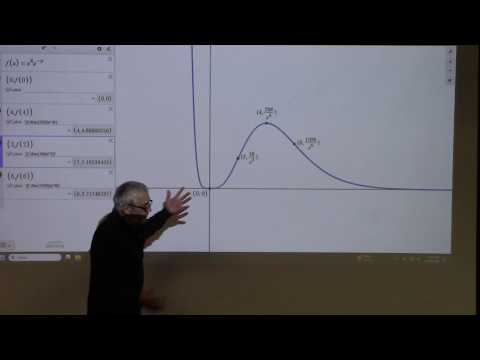
Stewart Section 4.3 connects the sign of the second derivative, f'', to graph concavity, then applies that test to f(x) = x^4e^-x. Its second derivative factors as x^2(x-2)(x-6)e^-x, giving concavity changes at x = 2 and x = 6, while the zero at x = 0 does not change concavity; the lecture then practices interpreting graphs of f and f' to infer signs, monotonicity, extrema, and concavity.
Key takeaways
- For f(x) = x⁴e⁻ˣ, f''(x) = x²(x-2)(x-6)e⁻ˣ, so f is concave down on (2, 6) and concave up on (-∞, 2) and (6, ∞).
- A zero of f'' is only a candidate inflection location: at x = 0, the x² factor makes f'' zero without changing sign, so no inflection point occurs.
- An inflection point requires a continuous graph point and a change in concavity; a concavity change across a hole or at a missing graph point does not qualify.
- When a graph represents f', its position relative to the x-axis gives whether f increases or decreases, and a positive-to-negative crossing identifies a local maximum of f.
- A sign chart for f'' can divide concavity intervals at a zero even when concavity does not change there; neighboring intervals can sometimes be combined after checking behavior at that location.
Chapters
- The closed interval method finds absolute extrema by comparing f-values at critical numbers and interval endpoints.
- For local extrema, the first derivative test checks whether f' changes from positive to negative or negative to positive at a critical number.
- Quiz six is scheduled for Friday, and exam three includes quizzes five, six, and seven.
- A function is concave up on an interval when its graph lies above its tangent lines there; concave down is the analogous opposite shape.
- An inflection point must be a point on the graph where the function is continuous and concavity changes from up to down or down to up.
- A bowl-shaped curve is a visual cue for concave up, while an S-shaped transition can mark a concavity change.
- For f(x) = 1/x, concavity changes across x = 0, but there is no graph point at x = 0, so there is no inflection point there.
- A discontinuity at a concavity change disqualifies the location as an inflection point, even if the graph has a point drawn there.
- A cusp can be continuous and change concavity, but the lecture notes the definition’s subtlety when a tangent line or derivative does not exist.
- The worked example resumes f(x) = x⁴e⁻ˣ, previously used to study increasing and decreasing intervals.
- The concavity test examines the sign of f'', not f': positive f'' guarantees concave up, while negative f'' guarantees concave down.
- Starting from f'(x) = -x³(x-4)e⁻ˣ, differentiate again using the product rule to obtain f''(x) = x²(x-2)(x-6)e⁻ˣ.
- The factors of f'' give critical sign-chart values x = 0, 2, and 6; e⁻ˣ is always positive and never creates a zero.
- The x² factor is nonnegative and does not change sign as x crosses 0, so f'' stays positive on both sides of zero.
- The full sign pattern is positive on (-∞, 0), positive on (0, 2), negative on (2, 6), and positive on (6, ∞).
- The sign chart guarantees concave down on (2, 6) and concave up on (-∞, 2) and (6, ∞).
- Although f''(0) = 0, concavity remains up across x = 0, so zero is not an inflection point.
- Concavity changes at x = 2 and x = 6, giving inflection points (2, 16/e²) and (6, 1296/e⁶) for f(x) = x⁴e⁻ˣ.
- The class activity combines continuity, function signs, limits at infinity, f', and f'' to constrain a possible graph of f.
- If f' exists at every x, then f is continuous everywhere; limits of 5 as x approaches positive infinity and 2 as x approaches negative infinity imply corresponding horizontal asymptotes.
- The sign of f' determines increasing or decreasing behavior, while the sign of f'' determines concavity; their changes guide the placement of horizontal tangents and inflection points.
- For the activity’s graph of f, the function is positive on (-∞, -1) and (7, ∞), and negative between its x-intercepts at -1 and 7.
- The graph increases on (2, 4) and (6, ∞), and decreases on (-∞, 2) and (4, 6).
- The graph has local minima at x = 2 and x = 6, and a local maximum at x = 4.
- When the displayed curve represents f', f increases where that curve is above the x-axis: (-∞, 1) and (7, ∞).
- Because f' is negative between 1 and 7, f decreases throughout (1, 7), including across x = 4.
- At x = 1, f' changes from positive through zero to negative, so f has a local maximum; a negative-to-positive change at x = 7 indicates a local minimum.
Transcript excerpt
0:00 Um, happy Monday. I have your I think your quizzes are graded, but I will return them on Wednesday. There um there were a couple of people that needed to do a makeup quiz. Uh, this is lecture 24. We're discussing Steuart section 4.3, which we started on Friday. So, we're going to resume that today. Note that um on Wednesday we cover section 4.4 which is curve sketching. So Friday and today was derivatives and shapes of graphs. Those are basically the tools that we'll use on Wednesday when we do curve sketching. We're going to be using tools that we've learned about about the shapes of graphs from uh from Friday and today.
0:48 This coming Friday is quiz six. Next Friday is quiz seven. This is a remember I mentioned last week that this is an this coming exam three is one for which see if I can do this without seeing the screen. So exam three has uh quizzes five, six, and seven included on it. All right. Well, I'm start by projecting some definitions. We discussed these uh let me let me turn down the lights. So, we discussed these definitions that
1:46 are from the book on Friday. Okay, we discussed the the definition of an increasing function. Remember that means if you move from left to right in the interval a comma b then the y values increase go up. So that's the definition of increasing. And decreasing is if you move from left to right in the interval and then the y values go down. And we learned about uh the increasing decreasing test which is a test where you scrutinize the derivative of f. You scrutinize fprime and more specifically you you scrutinize the sign. You study the sign of frime whether fprime is positive, negative or
This is the start of the transcript. Save this video free for the whole transcript, searchable and time-coded.
Related notes
Summary, takeaways, and chapters were generated by AI from the video's transcript and may contain errors. The video belongs to its creator, Barsamian's Math Videos.