Wed Nov 18, 2026 Lecture (L32) Stewart Section 5.2 Area and Distance
Overview
Mark Barsamian develops the definite integral as the limit of rectangle-based Riemann sums and interprets its value as signed area between a function and the x-axis. He reviews left and right sums for f(x) = 1/x on [1, 7], whose area is estimated at 1.95, then practices signed-area calculations with triangles, a semicircle, a line, and a quarter-circle.
Key takeaways
- For a continuous function on [a, b], the definite integral is the common limit of increasingly fine Riemann sums and represents signed area.
- Left and right sums for 1/x on [1, 7] approach the same area, estimated in class at about 1.95.
- Regions below the x-axis contribute negative area, so a definite integral can be negative or zero even when the geometric regions have positive ordinary area.
- Changing the order of integration bounds reverses the sign, and integrating from a number to itself gives zero.
- Geometric shapes make some integrals directly computable: the class examples produced 8 + 2π for a rectangle plus semicircle and 25π/4 for a quarter-circle.
- Evaluating integrals directly from the Riemann-sum definition is mathematically valid but cumbersome, motivating a more practical method introduced in the next lecture.
Chapters
- The example from Monday is the region between f(x) = 1/x and the x-axis from x = 1 to x = 7.
- Signed area counts regions above the x-axis as positive and regions below it as negative.
- Because 1/x stays above the axis on [1, 7], the whole region contributes positively.
- With n equal-width rectangles, the interval endpoints are x₀ = 1 and xₙ = 7.
- Each rectangle has width Δx = (7 − 1)/n = 6/n, and successive partition points differ by Δx.
- The left sum uses the graph height at each rectangle's left edge, from f(x₀) through f(xₙ₋₁).
- Sigma notation abbreviates the left sum as Σ from i = 0 to n − 1 of f(xᵢ)Δx.
- The right sum uses each rectangle's right-edge height, written as Σ from i = 1 to n of f(xᵢ)Δx.
- Both sums contain n rectangle areas, each formed from a function height times Δx.
- For the decreasing function 1/x on [1, 7], the left and right rectangle sums bound the signed area from opposite sides.
- As n increases, the left and right sums approach a common value, which defines the area through a limit.
- Using more rectangles, the area under 1/x from 1 to 7 was estimated at approximately 1.95.
- The notation ∫ from a to b f(x) dx names the definite integral of f from a to b.
- For this course, the definition is used for functions continuous on [a, b], and the integral is the common limit of Riemann sums.
- The integral represents signed area between the graph of f and the x-axis; left, right, midpoint, and trapezoid sums converge to the same value for continuous functions.
- The integral sign resembles a curved S for sum, while dx recalls the shrinking width Δx.
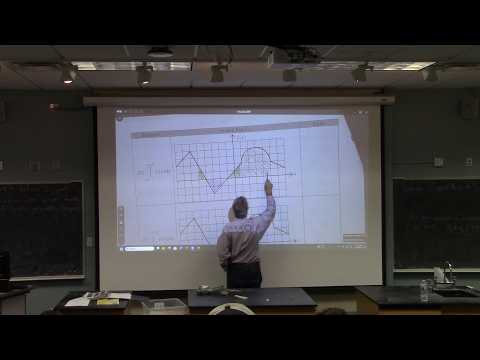
- A handout example integrates a piecewise geometric graph from x = −6 to x = 1.
- The positive triangle areas are 4 and 2, while the region below the axis has area 3, giving signed area 4 − 3 + 2 = 3.
- Changing the endpoint changes which parts of the graph are included, so signed area can be zero or negative as well as positive.
- For the graph on [−5, 5], the earlier positive and negative regions cancel, leaving a rectangle of area 8 and a semicircle of area 2π.
- The resulting definite integral is 8 + 2π; the integral from 5 to 5 is 0 because the interval has zero width.
- Reversing the bounds changes the sign: the integral from 5 to 1 is defined as the negative of the integral from 1 to 5.
- For the integrand f(x) = ½x − 2 on [2, 8], the graph crosses the x-axis at x = 4.
- The region below the axis from x = 2 to 4 is a triangle with base 2 and height 1, so its signed contribution is −1.
- The region above the axis from x = 4 to 8 has base 4 and height 2, contributing 4; the integral is −1 + 4 = 3.
- The expression √(25 − (x − 6)²) is the upper half of a circle centered at (6, 0) with radius 5.
- The interval [6, 11] selects one quarter of that circle, since it runs from the center's x-coordinate to the rightmost endpoint.
- Its signed area, and therefore the definite integral, is ¼π(5²) = 25π/4.
- Exact areas on the handout came from familiar geometric formulas, not from evaluating the defining limits of Riemann sums.
- Computing an exact integral directly from its limit definition requires complicated sum formulas and limit calculations, like deriving derivatives from first principles.
- Barsamian previews Friday's lecture, which will introduce a simpler method for evaluating definite integrals at the level of first-year calculus.
Transcript excerpt
0:01 Hi everybody. Um, if you just came in, make sure you pick up a handout up there. There's also graded uh quizzes and exams for some of you who have not picked them up. Uh, this is we're near the end of the semester. We have just a few more weeks and only one more full week after this week. So we're we're marching through chapter five and um today we're going to be discussing something called the definite integral. Uh I want to start by reviewing what we did on Monday and introduc introducing some notation from uh that sort of helps us abbreviate the messy calculations that we did on Monday. And then that abbreviation will
0:50 be handy today when we're talking about this so-called definite integral. So Monday. Um remember we were talking about area and our our um the project that we ended with was this. We were thinking about the area between the graph of uh y = 1 /x So the area between
1:45 f ofx = 1 /x and the x-axis from x = 1 to x= >> [snorts] >> And so and this was this what I called the signed area but it didn't really the the idea that it signed as in remember that means that regions that are below the x-axis get negative signs regions that are above the x-axis get positive signs. In this example all the region was above the x-axis. So this um signed area aspect of it didn't come up. But here's what the region looked like. So this is f ofx
2:35 = 1 /x. Here's x= 1. Here's x= 7. This is the x-axis. And the region that we're interested in is this region. >> [snorts] >> Now remember that on Monday I discussed that your experience with area in in your
This is the start of the transcript. Save this video free for the whole transcript, searchable and time-coded.
In this course
Related notes
Summary, takeaways, and chapters were generated by AI from the video's transcript and may contain errors. The video belongs to its creator, Barsamian's Math Videos.