Mon Nov 16, 2026 Lecture (L31) Stewart Section 5.1 Area and Distance
Overview
Mark Barsamian introduces Stewart Section 5.1 by framing the area problem: define and estimate the area between a continuous function and the x-axis. He builds estimates from equal-width left and right Riemann sums, distinguishes signed from unsigned area, and defines signed area as the common limit of those sums as the number of rectangles approaches infinity.
Key takeaways
- For a continuous function on a closed interval, the left and right Riemann sums converge to the same limit, which defines the signed area.
- A left or right Riemann sum estimates area by adding n equal-width rectangles, using function values at the corresponding left or right endpoints.
- For a decreasing function such as f(x) = 1/x on [1, 7], left sums overestimate signed area and right sums underestimate it.
- For f(x) = 1/x on [1, 7], three rectangles produce L₃ ≈ 3.0667 and R₃ ≈ 1.3524; using 100 rectangles narrows the estimates to about 1.972 and 1.920.
- Signed area counts regions below the x-axis negatively, while unsigned area adds their positive magnitudes.
- Preparing recitation problems before class matters because exams can reuse homework and recitation techniques, including multi-step optimization problems such as the Norman window.
Chapters
- Mark Barsamian says exam results were mixed, with clusters of satisfactory and low grades.
- He advises students to review homework and read all five or six recitation problems before the 55-minute session.
- Exam questions draw on textbook examples and recitation problems, including the Norman window area-maximization problem.
- The section begins by asking what area means between a continuous function's graph and the x-axis from x = a to x = b.
- Unlike rectangles or circles, a general curve may not form a familiar geometric shape with a ready-made area formula.
- The goal is both to define this area and to find a way to compute it.
- A curved region can be bounded below and above by regions made from rectangles whose areas are computable.
- The inner red region is contained in the unknown region, which is in turn contained in the outer yellow region.
- These containment relationships provide a lower and upper bound, called an area sandwich, for the unknown area.
- Unsigned area adds the magnitudes of all regions; the example labels three regions with total 1 + 2 + 3.
- Signed area gives regions below the x-axis negative contributions, producing 1 - 2 + 3 in the example.
- A left rectangle uses the function value at its left edge, while a right rectangle uses the value at its right edge.
- For an interval of width Δx, a rectangle's signed area is its sampled height, f(x), multiplied by Δx.
- For a continuous function on [a, b], Lₙ is the sum of the signed areas of n equal-width left rectangles.
- Rₙ sums n equal-width right rectangles over the same interval.
- In the left-sum diagram, the first rectangle begins at a; in the right-sum diagram, the final rectangle ends at b.
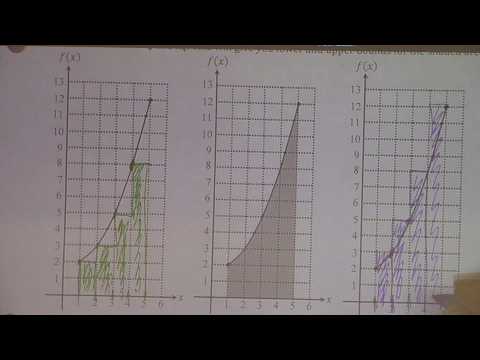
- Students begin worksheet practice by drawing and calculating L₄ and R₄ from a graph with no formula.
- The worksheet considers an unknown function over x = 1 to x = 5, divided into four intervals of width 1.
- The left endpoint heights are 2, 3, 5, and 8, so L₄ = 18.
- The right endpoint heights are 3, 5, 8, and 12, so R₄ = 28.
- The unknown area is bounded between 18 and 28 by the two rectangle estimates.
- For f(x) = 1/x on [1, 7], three rectangles have width Δx = (7 - 1)/3 = 2.
- The left sum uses heights at x = 1, 3, and 5: L₃ = 2(1 + 1/3 + 1/5) = 46/15, approximately 3.0667.
- The right sum uses heights at x = 3, 5, and 7: R₃ = 2(1/3 + 1/5 + 1/7) = 142/105, approximately 1.3524.
- Because 1/x is decreasing on [1, 7], the left sum is an upper estimate and the right sum is a lower estimate.
- A calculator comparison for 10 subintervals gives approximately R₁₀ = 1.717 and L₁₀ = 2.23.
- With 100 subintervals, the estimates tighten to roughly R₁₀₀ = 1.920 and L₁₀₀ = 1.972.
- For 200 subintervals, the class estimates are approximately 1.933 and 1.959, placing the area near 1.95.
- Increasing the number of rectangles narrows the gap between the lower and upper estimates.
- For a continuous function on a closed interval, Mark Barsamian states that the limits of Lₙ and Rₙ as n approaches infinity exist and are equal.
- Signed area is defined as this common limit: limₙ→∞ Lₙ = limₙ→∞ Rₙ.
- If a function value is negative, the corresponding rectangle extends below the x-axis and contributes negative height times width.
- The lecture ends before introducing the notation for these limits, which is scheduled for the next class.
Transcript excerpt
0:02 Morning everybody. Um this is uh lecture 31. Uh, as I've mentioned before, make sure you pick up your graded exams and your uh and the handout for today. [clears throat] Um, the exam results were were were mixed as is often the case as the semester goes on. There was there's a pretty goodized cluster of grades that were fine and then there was a pretty good sized cluster of grades that were that were low. One thing I'll I'll point out is [snorts]
0:51 you need to uh do whatever you can to to work on recitation problems before going to recitation. Uh Alexander has been telling me that often uh the group struggles to get through just one or two problems when I've posted five or six in recitation. Remember that those are all homework problems and recitation is 55 minutes long [snorts] and exams and quizzes are based on homework problems. So if if your speed is such that you can only get through a couple of those problems in a whole hour that doesn't bode well for for an exam, you need to you need to not show up for recitation cold as in like you know just figure that you're going to start from nothing
1:37 and have to learn everything having to do with these problems during recitation. Recitation has to be that you you know you've have have worked on your homework some have looked at some of these problems so you can can get through them w with some with some speed. Uh you know I've been I've been mentioning that every exam has at least one problem that's just like a book example but in fact I usually try to also make at least one problem that's just like a recitation problem. And um you know so
This is the start of the transcript. Save this video free for the whole transcript, searchable and time-coded.
In this course
Related notes
Summary, takeaways, and chapters were generated by AI from the video's transcript and may contain errors. The video belongs to its creator, Barsamian's Math Videos.