Fri Nov 6, 2026 Lecture (L29) Stewart Section 4.7 Antiderivatives (Part 2)
Overview
Stewart Section 4.7 introduces antiderivatives as functions whose derivatives recover a given function, distinguishing particular answers such as x³/3 from the general family x³/3 + C. The lecture builds an antiderivative toolkit from familiar derivatives, including exponential and power rules, explains why 1/x requires ln|x|, and uses e^(-x²) to illustrate that guessing can fail.
Key takeaways
- An antiderivative reverses differentiation: for f(x) = x², x³/3 is one answer, while x³/3 + C represents the full family.
- For k ≠ 0, an antiderivative of e^(kx) is e^(kx)/k, because differentiation introduces and then cancels the factor k.
- The power-rule antiderivative of xⁿ is x^(n+1)/(n+1), but only when n ≠ -1.
- The power rule gives -1/x as an antiderivative of 1/x², while the exceptional function 1/x has antiderivative ln|x|.
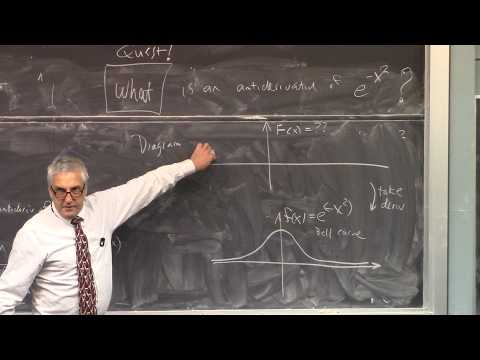
- Guessing an antiderivative requires checking by differentiation: e^(-x²) is not its own antiderivative because its derivative includes the extra factor -2x.
Chapters
- An antiderivative F of f satisfies F′(x) = f(x).
- For f(x) = x², both x³/3 and x³/3 + 17 are particular antiderivatives.
- The general antiderivative of x² is x³/3 + C, accounting for the constant lost through differentiation.
- Because the derivative of eˣ is eˣ, eˣ is an antiderivative of itself.
- The chain rule gives d/dx(e^(kx)) = k e^(kx), so e^(kx)/k is an antiderivative when k is nonzero.
- The guess-and-check method verifies the formula by differentiating e^(kx)/k and canceling the factor k.
- Guessing e^(-x²) fails because its derivative is -2x e^(-x²), not e^(-x²).
- Dividing the guess by -2x introduces a quotient-rule expression with extra terms rather than removing the mismatch.
- The lecture compares the bell-shaped graph of e^(-x²) with derivatives of arctan(x) and tanh(x): 1/(1 + x²) and sech²(x), respectively.
- Reversing d/dx(xⁿ) = n x^(n−1) gives x^(n+1)/(n+1) as an antiderivative of xⁿ when n ≠ -1.
- The restriction n ≠ -1 is necessary because the formula would divide by zero.
- For x², the rule produces x³/3, matching the earlier example.
- For 1/x² = x⁻², the power rule gives x⁻¹/(-1), or -1/x; differentiating confirms the result.
- For f(x) = x, the antiderivative is x²/2.
- For f(x) = 1 = x⁰, the power rule gives x, and differentiating x returns 1.
- The power rule cannot handle 1/x = x⁻¹ because n = -1 makes its denominator zero.
- The derivative of ln|x| is 1/x for every x ≠ 0, covering both positive and negative inputs.
- Using ln(x) alone would restrict the formula to x > 0, so ln|x| is the broader antiderivative formula.
Transcript excerpt
0:01 Hi everybody. Uh happy Friday. This is lecture 29. I'm I don't have my write notes. I'm trying to get them downloaded, but I can't figure out how in OneDrive to download. So I'll just hopefully Well, they're there, but they're not displaying fully. So we'll just see what happens. Maybe they'll display soon enough. All right. So we're we're discussing section 4.7 which we started on Wednesday. Uh remember that the definition of these words capital F is an antiderivative of F,
0:57 little F mean this capital F prime equals little F. So in other words, little F is a is the derivative of capital F. And we had uh a couple of examples. Capital F of X equals X cubed over three uh is uh an antiderivative
1:48 of little F equals X squared. And so is capital G of X which is X cubed over three plus 17. And so those two functions we called particular antiderivatives. So these are what are called particular antiderivatives. So we don't say the capital F is the antiderivative. We say we say that it is an antiderivative. On the other hand, we have this that capital F of x
2:39 equals x cubed over three plus C is the general antiderivative of little f of x equals x squared. Okay, so um let's make a list of antiderivative formulas. Well, so um
3:36 let's start by thinking about derivative that we know and corresponding antiderivative formula. >> So how about this? The derivative of e to the x is e to the x. So we would get that um e to the x is an antiderivative of e to the x.
4:32 Uh how about the derivative of e to the kx? Anybody remember what that derivative is? Don't want to get derailed here. So
This is the start of the transcript. Save this video free for the whole transcript, searchable and time-coded.
In this course
Related notes
Summary, takeaways, and chapters were generated by AI from the video's transcript and may contain errors. The video belongs to its creator, Barsamian's Math Videos.