Mon Nov 9, 2026 Lecture (L30) Stewart Section 4.7 Antiderivatives (Part 3)
Overview
The lecture develops Stewart Section 4.7 antiderivative techniques, including the power rule, the special 1/x rule, basic trigonometric and exponential antiderivatives, and linearity. It then uses initial conditions to select particular antiderivatives and applies successive integration to one-dimensional motion, ending with a dropped-stone model under gravity of 32 ft/s².
Key takeaways
- The power rule for antiderivatives excludes n = −1; integrating 1/x requires ln|x|.
- Linearity makes sums manageable by integrating each term separately, but quotients should first be rewritten using exponent rules rather than treated with an unavailable quotient rule.
- An initial condition determines the constant in a general antiderivative; for F(1) = 5 in the example, C = 2 and the final answer must include that value.
- In one-dimensional motion, integrating acceleration gives velocity and integrating velocity gives position, with each integration introducing a constant fixed by initial data.
- For a stone dropped from 400 ft with upward positive and gravity −32 ft/s², v(t) = −32t and s(t) = 400 − 16t²; impact occurs when s(t) = 0.
Chapters
- Exam 3 covers Chapter 4 and Section 3.7 on L’Hôpital’s rule.
- F is an antiderivative of f when F′(x) = f(x).
- The lecture recaps core antiderivative rules before applying them to motion.
- For n ≠ −1, an antiderivative of xⁿ is xⁿ⁺¹/(n + 1).
- The x⁻¹ case uses ln|x| rather than the power rule.
- An antiderivative of eᵏˣ is eᵏˣ/k when k ≠ 0, while eˣ is its own antiderivative.
- Basic pairs include sin x → −cos x, cos x → sin x, sec²x → tan x, and sec x tan x → sec x.
- If F′ = f and G′ = g, then aF + bG is an antiderivative of af + bg.
- Linearity lets a complicated sum be integrated term by term.
- The example rewrites a polynomial-like numerator over x⁴ into separate powers of x.
- Dividing each term by x⁴ exposes terms such as 17x³, a constant, 11/x, and negative powers.
- The 11/x term must use ln|x|; the power rule applies to the other eligible terms.
- The worked antiderivative includes 17x⁴/4, 13x, and 11 ln|x|.
- Negative powers require careful arithmetic: integrating 7x⁻² gives −7/x.
- The lecture emphasizes writing intermediate steps rather than doing exponent and coefficient arithmetic mentally.
- For f(x) = 7x − 3x⁵, the general antiderivative is F(x) = (7/2)x² − (1/2)x⁶ + C.
- Applying F(1) = 5 gives 5 = 3 + C, so C = 2.
- The particular answer is F(x) = (7/2)x² − (1/2)x⁶ + 2, not merely the value of C.
- For straight-line motion, position is s(t), velocity is v(t) = s′(t), and acceleration is a(t) = v′(t).
- Consequently, position is an antiderivative of velocity, and velocity is an antiderivative of acceleration.
- For v(t) = 9√t ft/s, the general position function is s(t) = 6t³ᐟ² + C; the condition s(0) = 13 sets C = 13.
- Near Earth, free-fall acceleration is 32 ft/s² downward, or about 9.81 m/s².
- With upward chosen as positive, the acceleration is a(t) = −32 ft/s².
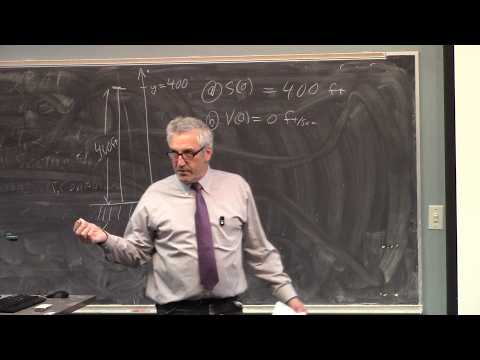
- A stone dropped from a 400 ft tower starts at position s(0) = 400 ft with initial velocity v(0) = 0.
- Integrating a(t) = −32 gives v(t) = −32t + C; the dropped-stone condition v(0) = 0 makes v(t) = −32t ft/s.
- Integrating velocity gives s(t) = −16t² + D; the initial height s(0) = 400 sets D = 400 ft.
- The height is s(t) = −16t² + 400, and the time of impact is found by setting s(t) = 0; the lecture ends before calculating the impact speed.
Transcript excerpt
0:00 Happy Monday. Um this is our last lecture before Friday's exam. Uh exam three Friday covers most well covers all the sections that we have covered in chapter 4 and remember that it also covers one chapter from the end one section from the end of [snorts] chapter 3 which is uh 3.7 lops rule. Um, make sure that you pick up a handout at the back of the room. All right. Um, well, let me recap where we were on Friday. So, we've talked about the the I the idea of anti-derivatives. So, we're discussing section 4.7 anti-derivatives.
0:55 We have the definition of an anti-derivative to say that capital f is an anti-derivative of little f. Remember the capital letters and the small letters mean something here means simply that capital f prime equals f. So in other words little f is the derivative of of capital f. And we have we have discussed some um some common anti-derivatives. Now, um, some of these we've discussed,
2:07 some of them we haven't, but I I'm going to go ahead and dump a bunch out. So for instance we have um the power rule for anti-derivatives which says that um um x to the n +1 / n + 1 is an anti-derivative of x to the n when n is not equal to -1. And then on Friday we discussed uh the 1
3:00 /x rule. Uh it says that ln of absolute value of x is an anti-derivative of 1 /x. So that's the case where you you know something that looks like a power function and it is that's x to the minus1. But you can't use the power rule to find an anti-derivative. You use the the 1 /x rule. [snorts] uh we had this rule that uh an anti-derivative
This is the start of the transcript. Save this video free for the whole transcript, searchable and time-coded.
In this course
Related notes
Summary, takeaways, and chapters were generated by AI from the video's transcript and may contain errors. The video belongs to its creator, Barsamian's Math Videos.