PHYS/OCSC 2300 - Fall 2026 - Lecture 19
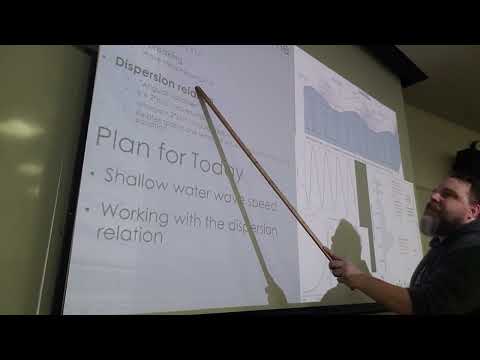
Overview
The lecture derives shallow-water wave speed, c = √(gd), from the surface-wave dispersion relation and contrasts it with deep-water speed, c = √(gλ/2π). These relationships explain tsunami speeds and periods, wave refraction that turns crests parallel to shore and concentrates energy on headlands, and satellite observations from the 2022 SWOT mission showing longer storm-generated waves farther from their source.
Key takeaways
- The shallow-water approximation tanh(kd) ≈ kd reduces the dispersion relation to C = √(gd), making wave speed depend on depth rather than wavelength.
- A tsunami in 4,000 m of water travels at about 200 m/s; a 200 km wavelength at that speed corresponds to a 1,000-second period, so successive waves may arrive roughly 17 minutes apart.
- Deep-water waves follow C = √(gλ/2π), which lets longer wavelengths outrun shorter ones and explains why longer storm-generated waves are observed farther from a storm.
- Nearshore depth decreases slow the portions of an angled wave crest that reach shallow water first, rotating crests until they become approximately parallel to the beach.
- Refraction focuses wave energy on headlands and disperses it in bays, contributing to headland erosion and sediment deposition in bays.
- The 2022 SWOT satellite operates at about 850 km altitude and makes around 14 orbits daily; its high-resolution observations show storm-wave wavelengths increasing with distance in agreement with the dispersion relation.
Chapters
- The second midterm is next Friday, covers material after the first midterm through this lecture, and is not cumulative.
- The exam is expected to include about half multiple-choice questions, diagrams or short answers, and numerical calculations similar to Assignments 3 and 4.
- A formula sheet will be provided, but students must recognize what its symbols mean; a Brightspace post will list covered lectures and key topics.
- Wavelength is crest-to-crest distance, while oceanographic wave height H spans crest to trough and is twice the amplitude measured from still water.
- Surface-water particles move in orbital paths that weaken with depth; the wave base is approximately L/2, so a 10 m wave has little activity below about 5 m.
- Wave speed is C = L/T = ω/k, with k = 2π/L and ω = 2π/T; the dispersion relation links frequency, wavenumber, water depth d, and gravity g.
- Breaking is associated with steepness H/L above roughly 1/7; periodograms can distinguish sharp tidal peaks near 24 and 12 hours from broader wind-wave energy.
- For deep-water waves, C = √(gλ/2π), so longer-wavelength waves travel faster, with speed increasing as the square root of wavelength.
- For shallow water, kd is small and tanh(kd) ≈ kd; substituting this approximation into ω² = gk tanh(kd) gives C = √(gd).
- Shallow-water wave speed depends on water depth rather than wavelength, whereas deep-water speed depends on wavelength.
- A tsunami with a wavelength hundreds of kilometres long behaves as a shallow-water wave even in the roughly 4,000 m-deep open ocean.
- Using g = 9.8 m/s² and d = 4,000 m gives a tsunami speed of about 200 m/s, consistent with observed propagation.
- For a deep-water wave travelling at 20 m/s, the deep-water formula gives λ ≈ 256 m; using T = λ/C then gives a period of 12.8 s.
- A 200 km tsunami travelling at 200 m/s has a period of 1,000 s, about 16.7 minutes, so dangerous follow-up waves can arrive after the initial inundation recedes.
- Shallow-water waves travel at C = √(gd), so they slow as water depth decreases toward the shoreline.
- This depth-dependent speed bends wave paths and rotates crests toward an orientation parallel to the beach, rather than leaving them at their offshore angle.
- The alignment results from wave propagation physics near shore, not simply from storms generating waves in a particular direction.
- The classroom construction compares depth contours such as 5 m, 3 m, 1 m, and 0 m at the beach, with greater depth farther offshore.
- Over the same time interval Δt, a crest segment in deeper water moves farther because Δx = CΔt and C increases with depth.
- Unequal motion along an angled crest changes its orientation; continued refraction turns the crest parallel to the shore, where the rotation stops if depth contours also parallel the beach.
- For exam questions, students may be asked to identify faster and slower sections or complete parts of the diagram rather than redraw the full construction.
- Wave refraction bends paths toward headlands and spreads wave energy across bays.
- Concentrated wave energy increases erosion on headlands, while nearby bays receive transported sediment over geological timescales.
- Examples and photographs show waves turning near irregular coastlines so they approach local shorelines more nearly perpendicular to the coast.
- The Surface Water and Ocean Topography (SWOT) satellite launched in 2022 and measures sea-surface height as well as rivers, lakes, and other inland water.
- At about 850 km altitude, SWOT makes roughly 14 orbits per day, with each orbit taking around 100 minutes.
- Its observations follow orbital tracks rather than covering Earth continuously; gaps between tracks require data processing and can introduce uncertainty.
- Higher spatial resolution lets oceanographers examine finer-scale surface features, including waves generated by storms.
- Deep-water storm waves of different wavelengths separate as they travel: longer waves move faster and get farther from the storm, while shorter waves remain closer.
- SWOT observations show wavelength increasing with distance from a storm, matching the deep-water prediction that speed increases with √λ.
- The observed wavelength data align with a curve based on ω² = gk tanh(kd), providing a satellite-based test of the dispersion relation.
- The lecture ends with a Monday review reminder and a request to check Brightspace for review materials.
Transcript excerpt
0:02 Okay. Uh, welcome back everybody. Um, I just wanted to make some comments um about the midterm um at the beginning. So, uh, just as a reminder, the second midterm is next Friday, so one week from today. Uh, so what's going to work is we're going to have a regular lecture today. Today's material is covered on the midterm. Then, uh, Monday we're going to do a review class. Uh, Wednesday is a um, uh, Wednesday, Wednesday there's no class. uh and then Friday is the midterm. So the same uh basic structure uh is going to be in place from the first midterm. So there's going to be about half the marks are going to be multiple choice uh and then some um different kinds of diagram or short answer uh questions. Um and then some kind of calculation for the last part um and the calculations will be similar to any of the numerical calculations that you had um on the
0:50 third and fourth assignments. Um I got asked a question. I think somebody emailed me this um and the the question was whether the second midterm is cumulative. So it is not cumulative. So so it so it just covers the material from after the first midterm to uh to including today's class. So um I'll make a post on Brightpace uh delineating exactly what lectures um are covered. Uh and then also like the first midterm um I will put up a just a bullet point list um of all of the uh most important topics. And so it's still true that anything that was discussed either in the slides or in lectures is quote unquote fair game for the exam. But if you uh focus on what's on that bullet point list, that will be a very good uh
This is the start of the transcript. Save this video free for the whole transcript, searchable and time-coded.
In this course
Related notes
Summary, takeaways, and chapters were generated by AI from the video's transcript and may contain errors. The video belongs to its creator, JoeFitzgeraldPhysics.