PHYS/OCSC 2300 - Fall 2026 - Lecture 17
 Watch on YouTube →
Overview
The lecture connects density-driven ocean circulation with sea-ice formation, glacier behavior, and the physics of waves. It explains how freshwater input can destabilize the Atlantic Meridional Overturning Circulation, how sea ice and glaciers affect ocean conditions, and how surface and internal waves arise from disturbances acting across density contrasts.
Key takeaways
- AMOC depends on dense water sinking near Greenland and Antarctica; in simplified models, added Greenland meltwater can trigger abrupt collapse and hysteretic recovery.
- Antarctic Bottom Water is denser than North Atlantic Deep Water, so it occupies the deepest ocean layer beneath NADW.
- Sea-ice growth both insulates the ocean and rejects salt: the resulting dense brine can sink and drive convection beneath the ice.
- Meltwater draining through glacier crevasses can lubricate the bed and change glacier sliding, while glacial mélange can buttress the terminus.
- Ocean waves are not only surface features: internal waves can displace temperature-defined layers by nearly 100 meters.
- Surface-wave water parcels move in orbital paths, and their incomplete loops create a net drift known as Stokes drift.
Chapters
- Deep water forms when cold, dense surface water sinks near Greenland and Antarctica, driving north-south overturning.
- North Atlantic Deep Water (NADW) occupies a layer above the denser Antarctic Bottom Water (AABW), which fills the ocean abyss.
- The Atlantic Meridional Overturning Circulation (AMOC), also called thermohaline circulation, is driven by density differences related to temperature and salinity.
- Mooring observations show substantial AMOC variability: transport changed from about 10 to more than 25 sverdrups over roughly six months in 2015.
- Melting Greenland ice adds freshwater to the North Atlantic surface, lowering salinity and density and potentially inhibiting NADW formation.
- In a simplified climate model, increasing freshwater forcing gradually weakens overturning before it abruptly collapses to zero.
- The model’s abrupt transitions are bifurcations; hysteresis describes the different path taken when freshwater forcing is reduced after collapse.
- Recovery may require freshwater forcing to be reduced far below the collapse threshold, showing why the modeled transition can be difficult to reverse.
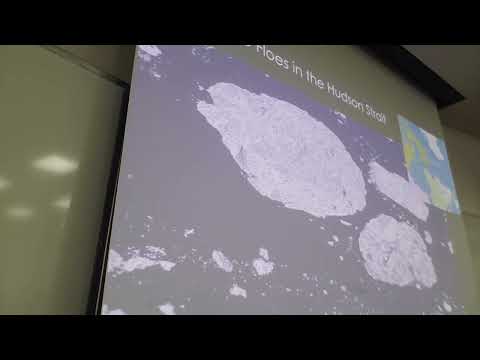
- Sea ice forms when a cold atmosphere removes heat from surface seawater; early ice develops from slushy crystals into pancake ice and then larger floating floes.
- Floes are pieces of floating sea ice more than about 20 meters across, and collisions between them can create stacked pressure ridges.
- Growing sea ice insulates the ocean beneath it, so ice thickening slows as the insulating layer becomes thicker.
- During brine rejection, salt is excluded from the ice crystal structure, leaving dense, salty water beneath the ice that can sink and drive convection.
- A glacier is land-based ice; at a marine-terminating glacier, the grounded ice reaches the ocean at its terminus.
- Crevasses allow surface meltwater to drain through the glacier to its bed, where subglacial hydrology can lubricate the base and alter sliding speed.
- Glaciers move slowly from their interiors toward outlet glaciers, and their motion can be tracked over time using fixed markers or aerial imagery.
- Meltwater flowing from a glacier adds freshwater to nearby ocean water, while glacial mélange, a mix of ice debris near the terminus, can push back against the glacier.
- Calving is the breaking off of icebergs from glaciers; ocean erosion can undercut a glacier and create cracks that let gravity topple ice away.
- Buoyancy can force cracked ice upward from below, providing another mechanism for iceberg calving.
- Icebergs reaching Newfoundland commonly originate from Greenland and travel south through the Labrador Sea in the Labrador Current.
- The East Greenland Current also carries icebergs around Greenland toward the Labrador Current, creating hazards for offshore activities such as oil exploration.
- An ice shelf is a floating extension of a glacier that remains connected to grounded ice, with ocean water beneath its seaward portion.
- Floating ice shelves can be less stable than fully grounded glacier ice and can calve exceptionally large, broad icebergs.
- The 2017 calving event from the Larsen C Ice Shelf produced iceberg A-68, a slab tens of kilometers across.
- The lecture contrasts ice shelves with sea ice, which freezes directly from seawater, and icebergs, which originate as glacier ice.
- Waves require a disturbance, such as wind or flow over topography, and a density contrast that supports oscillations.
- Surface gravity waves occur at the air-ocean boundary, while internal waves form at interfaces between ocean layers or within atmospheric layers.
- Wind blowing across the ocean generates surface waves; flow over Guadalupe Island produces atmospheric waves visible as alternating cloud bands.
- Internal ocean waves can be driven by tides, wind, or flow over underwater topography such as mid-ocean ridges.
- Internal waves move the boundary between denser deep water and lighter water above, and their amplitudes can greatly exceed those of typical surface waves.
- Temperature contours in ocean observations show internal-wave motion as water layers bobbing up and down over several days.
- One observed temperature surface shifted by nearly 100 meters, with tides, winds, and large-scale turbulence among the possible drivers.
- Internal-wave motion tends to diminish below the depth where the oscillations are strongest, an important consideration for submarines.
- Longitudinal sound waves involve compressions and rarefactions, with air moving back and forth along the direction the wave travels.
- In transverse waves on a rope or guitar string, the material moves perpendicular to the direction of propagation; the wave pattern travels while individual elements mostly oscillate locally.
- Ocean surface waves are orbital waves: water parcels move in roughly circular paths rather than purely parallel or perpendicular motion.
- The paths do not quite close, producing a small net movement in the wave’s direction called Stokes drift.
Transcript excerpt
0:02 Okay. Uh welcome back um everybody. Um so uh we've been discussing last time um the circulation of of of of deep water. So when we say deep water in oceanography, what we mean is um water that started at the surface and then for some reason, usually because it becomes very cold, um it increases in density and then sinks down um to the deeper levels of the ocean. Um and as this uh schematic up up at the top um is showing here. So the whole depth of the ocean, you can remember the characteristic uh depth of the open ocean is about 4 kilometers um 4,000 m um in the Atlantic Ocean for example. Um and so we have waters that are sinking from the surface and this happens in the North Pole up by Greenland um and near the South Pole
0:49 down by Antarctica. And they sink from the surface down basically to the bottom or to several thousand meters depth. And so when we talk about deep water cycling or deep water formation, it's that process of density increase of surface waters um causing them to sink down. Um and this uh this phenomenon of of surface waters becoming dense and sinking drives this this large scale circulation uh which we call the overturning circulation. Um and specifically I mean the Atlantic is is called the Atlantic meridianal overturning circulation or amoch. So meridional means it's a north south um circulation rather than um east west. East west is called zonal. Um north south is called meridional. And it's also called the thermo halaline circulation. It's called that because um density changes have to do with um salinity and temperature changes. And so
1:36 it's those density changes um that are driving the circulation. and so
This is the start of the transcript. Save this video free for the whole transcript, searchable and time-coded.
Related notes
Summary, takeaways, and chapters were generated by AI from the video's transcript and may contain errors. The video belongs to its creator, JoeFitzgeraldPhysics.