PHYS/OCSC 2300 - Fall 2026 - Lecture 15
Overview
The lecture connects large-scale ocean circulation to observable currents and climate patterns, reviewing how sea-surface-height differences estimate geostrophic velocity and explaining how seasonal monsoon winds reverse the Somali Current and alter weather and phytoplankton productivity. It then traces ENSO from the Pacific’s normal Walker circulation through El Niño and La Niña, covering temperature anomalies of roughly 3 to 4°C, global impacts, and monitoring efforts such as the TAO mooring array.
Key takeaways
- Large-scale sea-surface-height differences reveal geostrophic currents: applying ρgH to a 30 cm height contrast supported a Loop Current eddy speed estimate of about 15 cm/s.
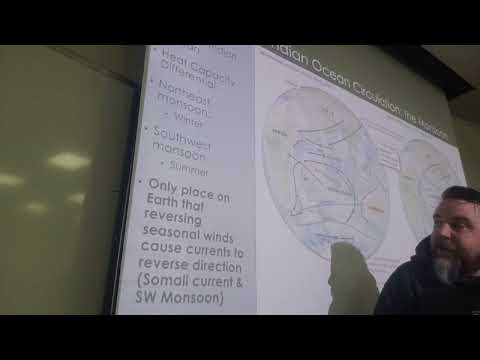
- Seasonal land-sea heating contrasts reverse South Asian monsoon winds, which in turn reverse the Somali Current and shift India between a moist summer rainy season and a generally drier winter.
- Summer monsoon winds drive offshore Ekman transport near the Arabian Peninsula, causing nutrient-rich upwelling and higher phytoplankton productivity; winter winds favor onshore transport and downwelling.
- El Niño weakens or reverses the Walker circulation, spreads warm water into the central Pacific, suppresses coastal upwelling off Peru, and can harm the region’s anchovy fishery.
- La Niña strengthens trade winds and upwelling, pushing colder water across the central Pacific and often increasing the nutrient supply that supports fisheries.
- ENSO has global consequences despite its central Pacific dynamics, and TAO moorings provide continuous equatorial observations to improve understanding and prediction.
Chapters
- A 30 cm sea-surface-height difference produces a pressure difference estimated with ΔP = ρgH, using seawater density near 1025 kg/m³.
- At large scales, pressure-gradient and Coriolis forces approximately balance, allowing geostrophic velocity to be inferred from sea-surface-height observations.
- A worked Loop Current eddy estimate gave about 15 cm/s, within roughly a factor of two of the mapped velocity.
- Satellite altimetry measures sea-surface domes and bowls; their slopes help oceanographers estimate currents.
- The Indian Ocean subtropical gyre includes the westward South Equatorial Current, southward Agulhas Current, Antarctic Circumpolar Current, and West Australian Current.
- The Somali Current reverses seasonally: it flows southward during the winter monsoon and northward during the summer monsoon.
- Reversing monsoon winds exert surface drag that can reverse this large-scale current, an unusual seasonal change in ocean circulation.
- Land heats and cools faster than the ocean because it has a lower heat capacity, creating seasonal differences in air temperature and pressure.
- In summer, rising air over the heated South Asian continent draws moist air inland from the Indian Ocean; this is the southwest monsoon.
- In winter, air flows from the continent toward the ocean in the northeast monsoon, bringing generally drier conditions to India.
- The lecture compares the continental-scale monsoon circulation to local sea-breeze and land-breeze cycles.
- During the summer southwest monsoon, Northern Hemisphere Ekman transport moves surface water offshore near the Arabian Peninsula, inducing coastal upwelling.
- Upwelling brings cold, nutrient-rich water to the surface and supports elevated phytoplankton productivity visible in satellite observations.
- During the winter northeast monsoon, Ekman transport is directed onshore, favoring downwelling and lower productivity.
- The Pacific contains North and South subtropical gyres, with boundary currents including the Kuroshio, California, East Australian, and Peru currents.
- The Kuroshio is the North Pacific’s powerful western boundary current and is a Pacific counterpart to the Gulf Stream.
- ENSO develops in the equatorial Pacific on top of this broader gyre circulation; most individual current names are presented for context rather than memorization.
- Under normal conditions, the equatorial Pacific has relatively high pressure in the east and lower pressure in the west, with east-to-west trade winds near the surface.
- Rising air over the western low-pressure region and sinking air nearer the eastern high form the Walker circulation cell.
- Coastal winds and Ekman transport drive upwelling off South America, cooling the eastern Pacific and forming the cold tongue.
- Warm surface water accumulates in the western Pacific as the Walker circulation and trade winds help maintain the east-west temperature contrast.
- During El Niño, the Walker circulation weakens, collapses, or can reverse, allowing warm western Pacific water to spread eastward into the central and eastern equatorial Pacific.
- Weaker coastal winds reduce upwelling off Peru, flatten the thermocline, and limit the supply of nutrient-rich deep water.
- Reduced nutrient input can weaken the important Peruvian anchovy fishery and lower biological productivity.
- The 1998 El Niño map shows broad equatorial Pacific warming of roughly 3 to 4°C across thousands of kilometers.
- La Niña intensifies the Walker circulation and trade winds, extending the cold tongue farther into the central Pacific.
- Stronger upwelling brings colder, nutrient-rich water toward the surface, while the western warm pool becomes more compressed.
- Central Pacific temperature anomalies can reach roughly 2 to 4°C of cooling, and enhanced nutrient supply can benefit fisheries.
- The Multivariate ENSO Index combines multiple observations to characterize ENSO conditions; positive values indicate El Niño and negative values indicate La Niña.
- ENSO events occur irregularly, often within a broad interval of about 2 to 10 years, rather than following a precise clockwork cycle.
- Pacific temperature and circulation changes can shift weather patterns worldwide, affecting drought, agriculture, fisheries, and tropical storms.
- French Polynesia recorded six hurricanes in 1982 to 83 during a major El Niño after no recorded hurricanes there for the preceding 75 years.
- The 1982 El Niño helped motivate the TOGA observational program, later continued through the TAO Tropical Atmosphere Ocean array.
- TAO moorings across the equatorial Pacific measure variables such as temperature, pressure, and currents to track ENSO’s evolution.
- ENSO remains an active research problem; equatorial waves and chaotic dynamics complicate physical understanding and prediction.
- Recent deep-learning research explores El Niño prediction, but the lecture notes that current AI models still struggle to reproduce the butterfly effect.
Transcript excerpt
0:02 Okay, welcome back everybody. Um So, uh we've been working on our our tour um of the main circulations that are in all the ocean basins. Um and so we started off uh with the Southern Ocean and and we said that there's really these two currents, uh the Antarctic Circumpolar Current um and then the uh East Wind Drift, which is so the Antarctic Circumpolar Current, which we often call the ACC, um is the very very strong current that circulates from west to east um around the Antarctic continent. Um and then the East Wind Drift is closer uh closer to Antarctica. Um and then we started looking at the Atlantic uh and we talked about a few a few different um uh really important features in the Atlantic. One of them is the Gulf Stream. Uh
0:47 we looked at the cold core and warm core eddies in the Gulf Stream. Uh and then last time um we uh you know, really got serious and we looked at the uh the Loop Current, um which is sort of the the precursor to the Gulf Stream. Uh the Gulf Stream uh flows up the uh East Coast of North America here. Uh but before it does that, it loops in uh to the Gulf of Mexico um and there are all these um eddies that are produced uh in the Gulf of Mexico uh by the turbulent dynamics uh of of that Loop Current. Basically, the Loop Current is just intrinsically unstable um and so it creates all these whirls and vortices um that are uh very large, hundreds of kilometers across. Um and last time what we did is we looked in detail uh at these at these Loop Current eddies as they're called um and uh applied the
This is the start of the transcript. Save this video free for the whole transcript, searchable and time-coded.
In this course
Related notes
Summary, takeaways, and chapters were generated by AI from the video's transcript and may contain errors. The video belongs to its creator, JoeFitzgeraldPhysics.