PHYS/OCSC 2300 - Fall 2026 - Lecture 18
Overview
The lecture develops a quantitative framework for ocean waves, from orbital particle motion and wave measurements to spectra, breaking, and the dispersion relation. It distinguishes deep-water waves, where speed increases with wavelength, from shallow-water waves, where speed depends on depth, and derives the deep-water formula c = √(gλ/2π), including a 100 m wavelength example that travels at about 12.49 m/s.
Key takeaways
- For surface gravity waves, motion becomes negligible below a wave base of about half the wavelength; a 10 m wave therefore has little influence below roughly 5 m.
- A wave steepness H/λ greater than approximately 1/7 signals breaking, which converts organized wave motion into turbulence and mixing.
- Deep-water waves satisfy D > λ/2 and are dispersive: their longer-wavelength components travel faster than their shorter-wavelength components.
- Shallow-water waves satisfy approximately D < λ/20 and travel at c = √(gD), so reducing water depth slows them regardless of wavelength.
- The relation ω² = gk tanh(kD) connects frequency, wavenumber, and water depth; its deep-water limit yields c = √(gλ/2π).
- Power spectra identify physical processes in ocean records: sharp peaks can reveal tidal periods near 24 and 12 hours, while broad bands commonly represent waves with varied periods.
Chapters
- The fourth assignment is due the following Wednesday; the second midterm is scheduled for the next Friday, with a review class on Monday.
- Sea ice forms from frozen seawater, progressing from needle crystals to pancake ice, floes, and pressure ridges.
- Icebergs calve from land-based glaciers or ice shelves, while ice shelves are partially floating extensions of grounded glaciers.
- Meltwater can drain through glacier crevasses to the bed, where basal hydrology can soften the ground, speed glacier flow, and deliver freshwater to the ocean.
- Ocean waves require a density difference, such as warm, less-dense water over colder, denser water, and a disturbing force such as wind, tides, or currents.
- Waves occur at the ocean surface, between internal density layers, and in the atmosphere, where airflow over islands can create cloud-visible oscillations.
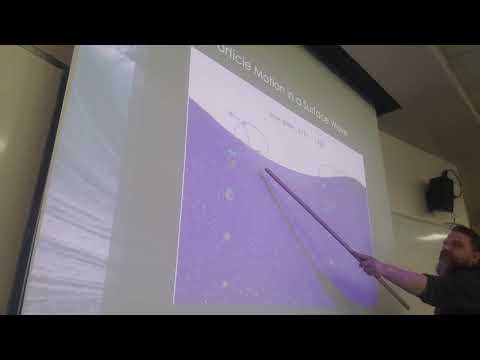
- Ocean gravity waves combine transverse and longitudinal motion: water particles follow roughly circular orbits rather than moving only up and down or back and forth.
- Particles can drift slightly in the direction of propagation through Stokes drift, producing looping paths rather than perfectly closed circles.
- A crest is a wave's highest point, a trough is its lowest, and wavelength λ is the horizontal distance between successive crests or troughs.
- Wave height is the crest-to-trough distance; conventional amplitude is half that height, measured from the still-water level.
- Orbital motion weakens with depth, a pattern called surface intensification; wave base is the depth below which surface-wave motion becomes very small.
- For surface gravity waves, wave base is approximately λ/2, so a 10 m wavelength has little motion below roughly 5 m; even storm-wave bases rarely extend below about 150 m.
- The period T is the time between successive crests passing a fixed point, while frequency is 1/T.
- Wave phase speed c describes how quickly crests propagate and equals wavelength divided by period: c = λ/T.
- The lecture distinguishes spatial properties such as wavelength from temporal properties such as period and frequency.
- A wave breaks when its crest overruns and tips past the lower part of the wave, disrupting the wave structure and producing turbulence and mixing.
- The key measure is steepness, defined as wave height H divided by wavelength λ.
- Breaking occurs when H/λ exceeds approximately 1/7, a threshold that can be understood from mathematical wave analysis.
- Breaking internal waves over mid-ocean ridges can generate turbulence that mixes deep water upward, helping explain a pathway for returning deep water toward the surface.
- A wave is deep-water when ocean depth D exceeds half its wavelength, D > λ/2, so its wave base does not reach the seafloor.
- Most wind-generated waves in the open ocean are deep-water waves because their wavelengths are small relative to ocean depth.
- Deep-water waves are dispersive: longer wavelengths travel faster, causing wave components to spread apart over time.
- Unlike deep-water waves, sound waves in air travel at essentially the same speed across different frequencies, preserving the order of speech and music components.
- A wave behaves as a shallow-water wave when depth D is less than about 5% of wavelength, or λ/20; a 200 m wavelength qualifies in water shallower than 10 m.
- Near the seafloor, water particles cannot complete circular orbits, so their motion becomes more like sliding back and forth.
- Shallow-water wave speed is c = √(gD), making speed dependent on water depth rather than wavelength.
- Shallow-water waves are non-dispersive because different wavelengths travel at the same speed; tsunamis can fall into this category even in the open ocean because their wavelengths are extremely large.
- The general surface-wave dispersion relation is ω² = gk tanh(kD), where ω = 2π/T, k = 2π/λ, g is gravitational acceleration, and D is water depth.
- The relation links wavelength, frequency, and depth, so a wave cannot have arbitrary spatial and temporal properties.
- In deep water, tanh(kD) approaches 1, reducing the relation to ω² = gk; phase speed can also be written c = ω/k.
- Substituting k = 2π/λ gives c = √(gλ/2π); for λ = 100 m and g = 9.8 m/s², the calculated speed is about 12.49 m/s.
- The lecture closes by previewing shallow-water wave derivations, dispersion, and refraction for the next class.
Transcript excerpt
0:01 Okay. Welcome back everybody. Um we are well into November so we're we're making our our way through the semester. Um so last time we we we talked about two sort of smaller topics and we're going to continue with with one of those today which which is waves. Um so oh I'll I'll mention that the the fourth assignment is now is now out. So so you have about a week to do that I think it's due on on on Wednesday so a week from today. Um and in terms of bookkeeping so so the second midterm is next Friday. So what's going to happen is we're going to have lecture material today and lecture material Friday. Then Monday is going to be a review class. Wednesday is there's no classes on Wednesday. And then on Friday we have the the
0:48 midterm so um I will so just like the the first midterm I'm going to make some posts on Brightspace about giving the structure so it'll be similar. Um multiple choice diagrams and short answer questions and then some calculations. And so by Friday we should have covered all the material that is going to be required for that. And then I'll post a list of the most important topics on Brightspace and then we'll go over it on Monday as a review. Um does anyone have any any questions about bookkeeping or or the schedule or anything like that? Okay. All right. Um so last time we talked about ice and we talked about waves. And so um with ice really the one of the key concepts was that was that the ice that we
1:35 encounter in oceanography comes in several forms. Um so there's sea ice and sea ice I actually don't have here but um sea
This is the start of the transcript. Save this video free for the whole transcript, searchable and time-coded.
In this course
Related notes
Summary, takeaways, and chapters were generated by AI from the video's transcript and may contain errors. The video belongs to its creator, JoeFitzgeraldPhysics.