PHYS/OCSC 2300 - Fall 2026 - Lecture 16
 Watch on YouTube →
Overview
The lecture connects seasonal monsoons and Pacific ENSO to the slower, density-driven deep circulation of the oceans, explaining how temperature and salinity create water masses such as North Atlantic Deep Water (NADW) and Antarctic Bottom Water (AABW). It then traces how sinking, internal-wave mixing, and Southern Ocean wind-driven upwelling sustain the global overturning circulation, and examines OSNAP measurements showing AMOC variability from about 10 to 25 Sverdrups and Stefan Rahmstorf’s model results on freshwater-driven tipping points and hysteresis.
Key takeaways
- The South Asian summer monsoon behaves like a continental-scale sea breeze: faster summer heating over land draws moist air from the Indian Ocean, while winter cooling reverses the flow and favors dry offshore winds.
- Normal equatorial Pacific conditions pair eastern upwelling and a cold tongue with a western warm pool; El Niño weakens the Walker circulation and can warm the central Pacific by about 2 to 4°C.
- NADW and AABW occupy different deep layers because AABW is denser and sinks to the abyss, while NADW flows above it; their temperature-salinity signatures help trace their origins.
- Deep ocean water returns toward the surface through internal-wave and tidal mixing over mid-ocean ridges and wind-driven upwelling in the Southern Ocean.
- OSNAP measurements recorded AMOC transport varying from roughly 10 to 25 Sverdrups over the mid-to-late 2010s, showing that a basin-scale circulation can vary substantially over months.
- Rahmstorf’s freshwater-hosing experiments produced AMOC bifurcations and hysteresis, meaning a modest additional freshwater forcing could cause an abrupt decline that does not reverse simply when the forcing is removed.
Chapters
- Summer heating warms the Indian subcontinent faster than the Indian Ocean, drawing moist southwest monsoon winds inland and bringing rain.
- In winter, the land cools faster than the ocean, reversing the winds into a dry northeast monsoon blowing offshore.
- Summer offshore Ekman transport near Saudi Arabia drives upwelling of cold, nutrient-rich water and higher chlorophyll; winter onshore transport favors downwelling.
- Under normal conditions, eastern Pacific coastal upwelling maintains a cold tongue while the western Pacific holds a warm pool.
- The Walker circulation features descending air over the eastern Pacific and rising, cloud-forming air in the west; its surface winds help push cold water westward.
- During El Niño, the Walker circulation weakens or reverses and warm water spreads into the central equatorial Pacific, raising sea-surface temperatures by roughly 2 to 4°C.
- La Niña strengthens the Walker circulation and intensifies the westward influence of the cold tongue.
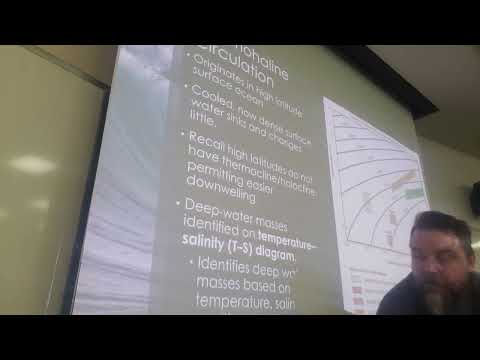
- Unlike wind-driven surface currents, deep currents are driven by pressure differences created by seawater density variations.
- Temperature and salinity determine density, which is why deep circulation is also called thermohaline circulation.
- Deep water generally lies below the thermocline or pycnocline, roughly 800 to 1,000 meters down, and constitutes about 90% of ocean water.
- Deep currents can move at only about 0.05 centimeters per second, far slower than surface currents such as the Gulf Stream.
- Cold atmospheric conditions cool surface water in the Labrador Sea near Newfoundland and Greenland until it becomes dense enough to sink, helping drive overturning.
- A temperature-salinity, or T-S, diagram plots salinity on the horizontal axis and temperature on the vertical axis, with density shown by contours.
- North Atlantic Deep Water (NADW) forms in the North Atlantic; a representative T-S range is about 35 parts per thousand salinity and 4°C.
- Because deep-water T-S properties remain relatively distinctive, oceanographers use them to infer where water formed and how it traveled.
- NADW forms in the North Atlantic, including the Labrador Sea, while Antarctic Bottom Water (AABW) forms near Antarctica.
- AABW is the densest water mass in the ocean and spreads along the seafloor, filling the abyss.
- NADW is less dense than AABW, so it flows at intermediate deep levels above the Antarctic bottom layer.
- Deep-water formation and circulation through the ocean can take thousands of years.
- Despite cold conditions near Alaska, the North Pacific is less saline than the Atlantic, so its surface water does not become dense enough to form North Pacific Deep Water.
- The deep Pacific is supplied by water masses formed elsewhere, including NADW and AABW, connected through the Southern Ocean.
- The Indian Ocean does not form comparable deep water because it lacks the necessary polar-cold conditions.
- Sinking alone cannot sustain overturning: conservation of volume requires water to return toward the surface elsewhere.
- Tidal flow over rugged mid-ocean ridges generates turbulence and internal waves at density interfaces; when these waves break, they mix deep water upward.
- The other major return pathway is in the Southern Ocean, where winds and Ekman dynamics bring deep water toward the surface.
- The global thermohaline circulation combines localized deep-water formation, surface currents such as the Gulf Stream, deep return flows, and gradual upwelling.
- The conveyor-belt diagram is a simplification: sinking is concentrated in formation regions, while upwelling is more diffuse and occurs through multiple mechanisms.
- The Overturning in the Subpolar North Atlantic Program (OSNAP) uses moored instrument arrays with current meters and conductivity-temperature-depth measurements.
- OSNAP observations from the mid-to-late 2010s show substantial AMOC variation, with transport ranging roughly from 10 to 25 Sverdrups.
- One Sverdrup is 1 million cubic meters of water per second; observed changes over months challenge the idea that the large-scale circulation is nearly steady.
- The variability motivates concern that the Atlantic Meridional Overturning Circulation (AMOC) could respond sharply to additional forcing.
- Greenland meltwater enters the North Atlantic and freshens surface waters, reducing their density and making sinking in deep-water formation regions less likely.
- Since 2002, Greenland has lost about 4,000 gigatons of ice mass, despite seasonal winter gains and larger summer losses.
- The 2004 film The Day After Tomorrow dramatized an AMOC shutdown; climate scientist Stefan Rahmstorf distinguished its fictional speed and impacts from the real scientific risk.
- Rahmstorf cautioned that major circulation changes were considered extremely unlikely over the following decades, but potentially serious and partly unpredictable.
- In 1995, Stefan Rahmstorf used climate-model freshwater hosing experiments to test how added Greenland meltwater could affect North Atlantic circulation.
- Increasing freshwater initially weakened NADW flow gradually, but the model also showed abrupt drops at bifurcation points and a possible collapse of the circulation.
- The model displayed hysteresis: after the AMOC collapsed, removing the freshwater forcing did not immediately restore it.
- Rahmstorf and other climate scientists continued to warn in a 2024 open letter that abrupt circulation changes remain plausible in modern models.
Transcript excerpt
0:02 Okay. All right, welcome back everybody. Um Let's see what we're doing. Okay. Um so so last time we spent the whole class basically on these two special topics which were part of this tour um that I've been talking about about going around all the different major ocean basins. I'm I'm looking at what are the sort of special circulations, special features um that happen um in those different parts of the world. Um and last time we talked about two examples. So one in the Indian Ocean which was the South Asian Monsoon um and the other one um was El Niño um La Niña um which are collectively called the El Niño Southern Oscillation or ENSO. Um and that's sort of what we spent most of our time on. So um the South Asian Monsoon um it's it's not uh it's not too complicated. There's not There's not too many conceptual
0:49 things uh to remember. Um but basically the idea is that if you know the the the idea of the land breeze and the sea breeze, um that will really help your your understanding of of of the monsoon because um the uh the basis of the of the monsoon is that um in the summer season versus the winter season um in the area of the Indian Ocean, Indian subcontinent, uh and South Asia, uh the the the winds or the the the seasonal winds reverse um they're strong winds and they reverse seasonally. So in the summer, um they blow from the southwest towards the northeast and this is called the southwest monsoon. We call it the southwest monsoon because the monsoon is labeled by the direction that the winds blow from. So the southwest monsoon in the summer um and then the winter uh the
This is the start of the transcript. Save this video free for the whole transcript, searchable and time-coded.
Related notes
Summary, takeaways, and chapters were generated by AI from the video's transcript and may contain errors. The video belongs to its creator, JoeFitzgeraldPhysics.