PHYS/OCSC 2300 - Fall 2026 - Lecture 11
 Watch on YouTube →
Overview
Joe Fitzgerald reviews atmospheric chaos and hurricane dynamics, then introduces how ocean currents are observed. The lecture explains hurricane tracks, storm surge, and climate influences, and compares current meters, Lagrangian floats, acoustic Doppler current profilers (ADCPs), and satellite radar altimetry, which uses radar travel time and sea-surface height to infer ocean flow.
Key takeaways
- Atmospheric chaos limits detailed weather prediction to short time horizons, but statistical climate patterns remain more predictable because climate concerns longer-lived averages rather than the weather on a specific day.
- Hurricane development depends on three linked conditions: warm sea-surface temperatures, low vertical wind shear, and pre-existing disturbances; El Niño and La Niña influence storm counts partly by changing wind shear.
- Hurricane storm surge is caused mainly by winds pushing water toward shore, and its impact can be amplified by coastal geometry and coincident high tide, as occurred with Hurricane Sandy in 2012.
- Lagrangian floats measure average displacement along a route, whereas moored current meters and ADCPs can provide current measurements at fixed locations or through the water column.
- The 1990 spill of about 31,000 sneakers and a bottle released in Newfoundland in 1984 and found in the Bahamas in 1996 demonstrate that ocean transport is turbulent, indirect, and capable of spreading objects over long distances.
- Satellite radar altimetry measures sea-surface height from radar travel time; because height differences imply pressure gradients, geostrophic balance lets oceanographers infer large-scale currents from space.
Chapters
- Test marks are expected online and returned physically on Wednesday; first-assignment marks are published, with students asked to check totals and missed questions.
- The Lorenz equations illustrate why small observational errors can make weather forecasts diverge after roughly one or two weeks, while statistical climate patterns such as El Niño remain more predictable.
- The Lorenz strange attractor forms a double-sheet structure in three-dimensional state space, and sea breezes arise because land heats faster than the ocean during daytime.
- Hurricanes are intense low-pressure systems with cyclonic circulation; pressure forces point inward while Coriolis forces oppose them in approximate geostrophic balance.
- North Atlantic storms often move west with the trade winds before curving north around the Bermuda High, whose size and strength influence whether tracks approach the Gulf of Mexico, Florida, or the eastern seaboard.
- Hurricane formation favors warm sea-surface temperatures, weak vertical wind shear, and pre-existing atmospheric disturbances; strong wind shear helps explain why storms are rare in the southern tropical Atlantic.
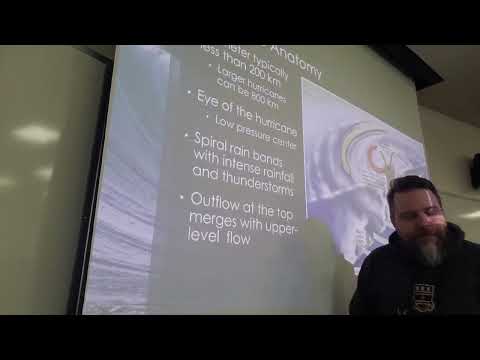
- Hurricanes commonly span hundreds of kilometers, often under 200 km; their Saffir-Simpson category is based on wind speed rather than storm diameter.
- Air converges into the low-pressure center, rises around the eye wall, and flows outward aloft; spiral rain bands produce heavy precipitation.
- El Niño tends to suppress Atlantic hurricanes through increased wind shear while favoring Pacific storms; La Niña tends toward the opposite pattern.
- Rising Atlantic ocean temperatures can favor hurricanes, but future storm statistics also depend on wind shear and atmospheric disturbances.
- Storm-surge flooding is driven primarily by hurricane winds pushing water onshore; the pressure-related rise in sea level is a much smaller effect.
- Surge severity also depends on coastal shape and shallow offshore slopes; Hurricane Sandy's 2012 surge coincided with high tide, amplifying flooding around New York and New Jersey.
- The 1900 Galveston hurricane was the deadliest natural disaster in U.S. history, while Hurricane Katrina caused about $75 billion in damage to New Orleans.
- Hurricane Fiona in 2022 damaged Newfoundland's coast, including a widely seen image of a destroyed coastal house.
- Surface currents are predominantly horizontal and wind-driven, while deep-ocean currents have stronger overturning components and are driven mainly by density differences.
- Density changes alter water weight and pressure, creating pressure gradients that exert forces on the ocean.
- A drifting object with a GPS can estimate average velocity from distance divided by elapsed time, while an anchored instrument can measure flow at a particular location.
- Lagrangian floats travel with the current and can transmit or store position data, but their displacement gives an average over a trajectory rather than a local velocity.
- A moored current meter is held by an anchor and cable; propellers spin as water flows past, and calibration converts rotation rate into current speed.
- Long-term ocean instruments need electronics, ballast or buoyancy control, and batteries because they cannot draw power from a grid; biofouling from algae and other organisms can compromise measurements.
- Researchers are exploring energy harvesting from currents and waves to power instruments, but weak-flow conditions and available energy remain practical constraints.
- About 31,000 pairs of floating sneakers spilled from a cargo ship in 1990 and later washed ashore from British Columbia to near California, revealing both current pathways and turbulent diffusion.
- The wide spread of the sneakers shows that currents are variable rather than uniform arrows: fluctuations disperse objects around the average flow.
- A bottle released in Trinity Bay, Newfoundland, in 1984 by Joe Fitzgerald's father-in-law was found in the Bahamas in 1996, illustrating long and indirect transport through the North Atlantic gyre.
- The bottle may have made multiple Atlantic loops or spent time on shore before discovery; the third assignment asks students to analyze its possible path.
- Pressure sensors can reveal pressure gradients; combining those measurements with geostrophic balance allows oceanographers to infer currents from the balancing Coriolis force.
- Doppler shifting changes a reflected sound wave's frequency: motion toward the source raises frequency, while motion away lowers it.
- Acoustic instruments transmit sound that reflects from suspended particles, algae, or sediment moving with the water; the returned frequency shift estimates current velocity.
- The acoustic Doppler current profiler (ADCP) is a widely used instrument for measuring ocean currents.
- Remote sensing uses satellite measurements to cover broad regions, avoiding the sparse locations and maintenance demands of moored instruments and floats.
- Radar altimeters send electromagnetic pulses toward the ocean and measure round-trip travel time; using the speed of light, sea-surface distance is calculated from the travel time and the two-way path.
- Satellite altimetry maps large-scale sea-surface height differences, not individual wave crests; global variations can reach roughly plus or minus one meter.
- Higher sea surface means a thicker water column and greater pressure; geostrophic balance connects these pressure gradients to current velocity, with clockwise flow around highs and counterclockwise flow around lows in the Northern Hemisphere.
Transcript excerpt
0:02 Okay. Welcome Welcome back everybody. I hope everyone had a had a nice weekend. Um, so just an update on the marking. So, I was hoping to get the marking done for the for the test over the weekend, but I didn't quite manage to get it finished. So, they'll be back on Wednesday. Um, you can keep an eye on Brightspace because I'll post the marks as soon as I get them done. So, I'll post the marks online and then you'll get your physical tests back on Wednesday, but you can just keep for your own review for the final exam. The other thing I want to mention is that the marks for the first assignment have now been published. Um, most people did really well, so I don't think there's probably going to be a lot of problems. But, I will just mention that um the way the grading works is that the TA for this course, whose name is Basil Sanu, he's my graduate student. Um, I sort of tell him, you know, like do it pretty efficiently. So, go through try
0:50 cuz he's got a lot of other things. So, I tell him, you know, do it efficiently, do a good job, but do it efficiently. Um, and so there's a possibility that a mistake can happen. So, the most common kind of mistake is the marks get added up improperly or if your work is a little bit disorganized, it's sometimes a question is missed. Like maybe he just can't find question D or whatever. And if you if you get a zero or things are for a question that you did answer or it was added up improperly, please just check that. If you have any problems, just email me and I will fix it. So,
This is the start of the transcript. Save this video free for the whole transcript, searchable and time-coded.
Related notes
Summary, takeaways, and chapters were generated by AI from the video's transcript and may contain errors. The video belongs to its creator, JoeFitzgeraldPhysics.