L'Hospital's rule (Calc 1; Lecture 3-1; Fall 26)
 Watch on YouTube →
Overview
The lecture introduces L'Hôpital's rule for limits in the indeterminate forms 0/0 and infinity/infinity, explains its tangent-line intuition, and demonstrates repeated differentiation on trigonometric, exponential, and logarithmic limits. It also reviews exponential substitution, a calculus optimization problem whose minimum occurs at a = 3, and how a symmetric difference quotient approaches the second derivative.
Key takeaways
- L'Hôpital's rule is a conditional method for quotient limits in the forms 0/0 and infinity/infinity; check the form before differentiating.
- When using L'Hôpital's rule, differentiate the numerator and denominator independently, and repeat only if the new limit remains indeterminate.
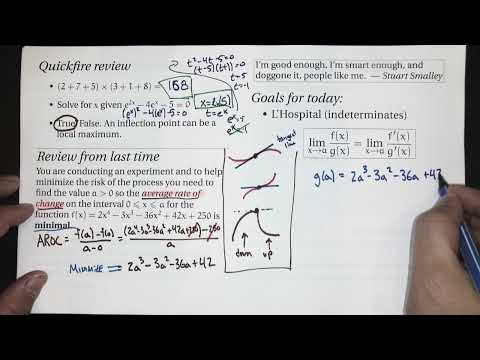
- The positive constraint on a matters in optimization: for the average-rate function g(a) = 2a^3 - 3a^2 - 36a + 42, its feasible minimum occurs at a = 3.
- The symmetric quotient [f(x + h) - 2f(x) + f(x - h)]/h^2 approaches f''(x), connecting calculus limits to numerical estimates from sampled data.
- An indeterminate product such as y ln(y) can be converted into a quotient; choosing ln(y)/(1/y) makes the derivatives straightforward and yields the limit 0.
Chapters
- The opening arithmetic check evaluates (2 + 7 + 5)(3 + 1 + 8) as 168.
- For an equation involving e^(2x) and e^x, setting t = e^x turns the equation into a quadratic in t.
- Because e^x is always positive for real x, only positive roots for t can yield real solutions for x.
- Concavity describes how a curve lies relative to its tangent line, while an inflection point marks a change from concave up to concave down or vice versa.
- An inflection point can also be a local maximum if the curve has a cusp there and no tangent line.
- A local maximum with a horizontal tangent cannot simultaneously be an inflection point in the situation discussed.
- For f(x) = 2x^4 - 3x^3 - 36x^2 + 42x + 250, the average rate of change from 0 to a simplifies to g(a) = 2a^3 - 3a^2 - 36a + 42.
- Differentiating gives g'(a) = 6(a - 3)(a + 2), so the critical candidates are a = 3 and a = -2.
- Since a must be positive, a = 3 is the feasible candidate; checking the derivative's sign change confirms it gives a minimum.
- The lecture places L'Hôpital's rule among the remaining derivative topics, alongside Newton's method and the Mean Value Theorem.
- Integration is presented as the next major phase of the course, with November designated as the integration month.
- The class is encouraged to pair confidence with sustained practice after an exam.
- The rule applies to a quotient limit that produces 0/0 or infinity/infinity, provided the functions are differentiable near the point and the derivative quotient has a limit.
- It replaces lim f(x)/g(x) with lim f'(x)/g'(x), differentiating the numerator and denominator separately rather than applying the quotient rule.
- A tangent-line approximation near a point where f(a) = g(a) = 0 explains why the shared factor x - a cancels, leaving a ratio of derivatives.
- Other indeterminate forms, including 0 times infinity and infinity minus infinity, must first be rewritten into a quotient of the permitted forms.
- For lim as θ approaches 0 of (3θ - sin θ)/θ, direct substitution gives 0/0; differentiating yields (3 - cos θ)/1 and the limit is 2.
- For lim as t approaches 0 of sin(5t)/(e^(2t) - 1), both parts initially approach zero.
- Differentiating gives 5 cos(5t)/(2e^(2t)); substituting t = 0 produces 5/2.
- The limit of [x - (1/2)sin(2x)]/[tan(x) - x] initially has the indeterminate form 0/0.
- After differentiating numerator and denominator, the expression remains 0/0, so the rule is applied again, and then once more.
- After three differentiations, substitution at x = 0 gives 4/2, so the original limit is 2.
- Repeated use is appropriate while the form remains 0/0 or infinity/infinity and the required derivatives exist.
- For twice-differentiable f, the limit as h approaches 0 of [f(x + h) - 2f(x) + f(x - h)]/h^2 is evaluated using L'Hôpital's rule.
- The first differentiation is with respect to h, because h is the variable approaching zero; it produces f'(x + h) - f'(x - h) over 2h.
- A second differentiation gives [f''(x + h) + f''(x - h)]/2, which approaches f''(x).
- The symmetric formula also motivates numerical differentiation when computers estimate curvature from nearby data points.
- As y approaches 0 from above, y tends to 0 while ln(y) tends to negative infinity, creating the indeterminate product 0 times negative infinity.
- Rewriting y ln(y) as ln(y)/(1/y) produces an infinity-over-infinity quotient suitable for L'Hôpital's rule.
- Differentiating gives (1/y)/(-1/y^2), which simplifies to -y and tends to 0.
Transcript excerpt
0:00 As we often do, we'll start with our quick fire review. Yay. All right. So, first problem. If you take 2 + 7 + 5 and you times that by 3 + 1 + 8, what do you get? What do you get? >> 158. That sounds pretty convincing to me. >> 168. >> Oh, 168. That sounds even more convincing. Yes. All right. The next one. Solve for x. So in other words, for which value of x is the following true because we have an equation e 2x - 4 e to x - 5 = z. >> What?
0:51 >> Ln5 is correct. Is there any other answer? >> No. Is also correct. Now, why did I ask if there were any other answers? Well, let's think about how we would solve for this. Now, we see e to the x and we see e 2x. I'm like, ah, this feels like apples and other kinds of apples. We'd like them to look more similar. What's another way we could write e to the power 2x? >> Sorry, what? t like say e to the x equals variable. >> Okay. So e x equals something. So what would e 2x be if >> oh sorry like t². >> Yeah. So so the the moral here is you
1:38 have like e 2x is e to the x^2. And then we're like ah now we have things that look the same. We like things that look the same. So if you set t= e to x you get t ^2 - 4 t - 5 = 0 and uh lo and behold this factors t - 5 t + 1 = 0 and you get t = 5 and t =1. Now that's not our answer because we made a substitution. We changed a name.
This is the start of the transcript. Save this video free for the whole transcript, searchable and time-coded.
Related notes
Summary, takeaways, and chapters were generated by AI from the video's transcript and may contain errors. The video belongs to its creator, Beard Meets Calculus.