Calc 1 -- Practice for Quiz 7 (Fall 2026)
 Watch on YouTube →
Overview
Steve works through ten Calc 1 Quiz 7 practice problems, connecting the signs of first and second derivatives to critical-point classification, intervals of increase and decrease, concavity, and inflection points. He also demonstrates one-variable optimization for a two-pen enclosure, a cost-minimizing box, and the nearest point on a line, emphasizing algebraic setup, sign charts, and checking that candidate extrema are genuinely maxima or minima.
Key takeaways
- Critical numbers come from points in the function’s domain where f′ is zero or undefined; classify them by checking whether f′ changes sign across each point.
- Concavity can be read from the first derivative’s behavior: an increasing f′ means f″ is positive and the original function is concave up, while a decreasing f′ means concave down.
- A zero of f″ is only a candidate inflection point; concavity must actually change, as G″(x) = 4(x - 8)²(x - 5) changes sign at 5 but not at 8.
- For constrained optimization, write the quantity to optimize, use the constraint to eliminate one variable, and then find and verify critical points; the 120-foot enclosure is maximized at 20 by 60 feet.
- For the square-base box, combining C = 3x² + 4xy with x²y = 96 gives C(x) = 3x² + 384/x, minimized at a 4-foot base side, 6-foot height, and $144 cost.
- Minimizing a nonnegative distance is equivalent to minimizing its square; for the line y = 3x + 7 and point (6, 0), calculus gives the nearest point (-3/2, 5/2).
Chapters
0:00
Reading the Graph of f′ Before Analyzing f
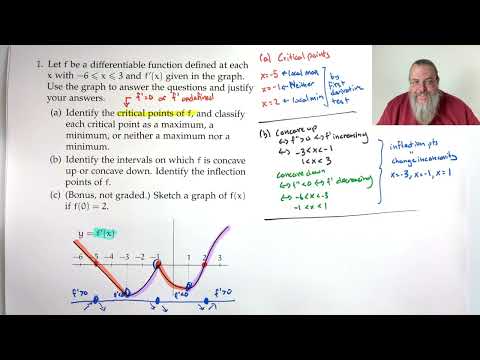
- The first problem gives a graph of f′ on the interval from -6 to 3, not a graph of f itself.
- The practice set asks students to try each problem independently before following Steve's worked solutions.
1:03
Classifying f’s Critical Points with the First Derivative Test
- The graph of f′ is zero at x = -5, -1, and 2, giving the critical points of f.
- The derivative signs are positive before -5, negative from -5 to -1 and -1 to 2, then positive after 2.
- The sign changes classify -5 as a local maximum and 2 as a local minimum; no sign change at -1 means neither.
5:25
Finding Concavity and Inflection Points from f′
- Where f′ increases, f″ is positive and f is concave up: (-3, -1) and (1, 3).
- Where f′ decreases, f″ is negative and f is concave down: (-6, -3) and (-1, 1).
- Concavity changes at x = -3, -1, and 1, so each is an inflection-point location.
10:12
Sketching f by Combining Increasing, Decreasing, and Concavity
- Steve marks the significant x-values -5, -3, -1, 1, and 2 on sign charts for f′ and f″.
- The sign pairs determine the local curve shapes: f′ controls whether the curve rises or falls, while f″ controls its bend.
- Using the given anchor f(0) = 2, he assembles the interval shapes into a rough sketch of f.
16:12
Factoring a Polynomial Derivative to Find Critical Points
- For f(x) = x⁵ - 5x⁴ + 5x³ - 1, the derivative is 5x⁴ - 20x³ + 15x².
- Factoring gives f′(x) = 5x²(x - 1)(x - 3), so the critical numbers are 0, 1, and 3.
- Testing intervals gives derivative signs +, +, -, +; thus 0 is neither an extremum, 1 is a local maximum, and 3 is a local minimum.
23:58
Solving h′(x) = 0 with a Substitution for x²
- For h(x) = x² - 5 ln(9 + x⁴), differentiation gives h′(x) = 2x - 20x³/(9 + x⁴).
- The denominator 9 + x⁴ is always positive, so critical numbers come from setting the numerator equal to zero.
- After clearing the denominator, factoring, and treating x² as a temporary variable, the critical numbers are -3, -1, 0, 1, and 3.
31:17
Using Five Critical Numbers to Map h’s Increasing Intervals
- The factored derivative is 2x(x - 1)(x + 1)(x - 3)(x + 3), with a denominator that stays positive.
- Each root has multiplicity one, so the derivative sign changes across every critical number; test values confirm the alternating signs.
- h increases on (-3, -1), (0, 1), and (3, ∞), and decreases on (-∞, -3), (-1, 0), and (1, 3).
37:42
Choosing c So a Logarithmic Function Has a Minimum at x = 3
- For g(x) = ln(x² + cx + 25), g′(x) = (2x + c)/(x² + cx + 25).
- Requiring x = 3 to be a critical point gives two algebraic possibilities, c = -6 or c = -34/3.
- The value c = -34/3 makes the logarithm’s argument zero at x = 3, excluding 3 from the domain; therefore c = -6.
43:27
Finding the Logarithmic Function’s Inflection Points
- With c = -6, the second derivative simplifies to g″(x) = -2(x - 7)(x + 1)/(x² - 6x + 25)².
- Completing the square gives x² - 6x + 25 = (x - 3)² + 16, so the denominator never vanishes.
- The sign of g″ changes at both roots, giving inflection points at x = -1 and x = 7.
49:20
Setting Up the 120-Foot Two-Pen Enclosure Optimization
- The divider must run perpendicular to the barn so each of the two equal rectangular pens uses the barn as a side.
- If x is the depth and y is the total length along the barn, the fencing constraint is 3x + y = 120.
- The total area is A = xy; substituting y = 120 - 3x gives the one-variable function A(x) = 120x - 3x².
58:09
Maximizing the Two-Pen Area with a Critical Point
- Differentiating A(x) = 120x - 3x² gives A′(x) = 120 - 6x.
- Setting A′(x) = 0 yields x = 20 feet, and the constraint then gives y = 60 feet.
- The full enclosure’s maximizing dimensions are 20 by 60 feet; A″(x) = -6 confirms a maximum.
1:05:54
Finding Increase and Decrease Intervals for a Logarithmic Function
- The function’s logarithm requires x > 0, and its derivative simplifies to g′(x) = (ln x)² + 2 ln x - 15.
- Setting z = ln x factors the derivative equation as (z + 5)(z - 3) = 0, producing critical numbers x = e⁻⁵ and x = e³.
- The derivative signs show that g increases on (0, e⁻⁵) and (e³, ∞), and decreases on (e⁻⁵, e³).
1:13:41
Using the Second Derivative to Analyze an Exponential Curve
- For y = e^(-2x² + 10x), differentiation and the product rule give y″ = 16e^(-2x² + 10x)(x - 2)(x - 3).
- The exponential factor is always positive, so the concavity is determined by (x - 2)(x - 3).
- The curve is concave up for x < 2 and x > 3, concave down for 2 < x < 3, and has inflection points at x = 2 and x = 3.
1:19:20
Modeling the Cost of a Square-Base Box
- The box has square base side x and height y; the bottom costs $2 per square foot while the four sides and lid cost $1 per square foot.
- Adding the bottom, sides, and lid gives C = 2x² + 4xy + x² = 3x² + 4xy.
- The 96-cubic-foot volume constraint is x²y = 96, allowing the problem to be reduced to one variable.
1:23:28
Reducing Box Cost to One Variable and Finding Its Critical Point
- Solving the volume constraint for height gives y = 96/x².
- Substitution produces C(x) = 3x² + 384/x, with derivative C′(x) = 6x - 384/x².
- Setting C′(x) to zero gives x³ = 64 and the physically valid base side x = 4 feet.
1:26:06
Verifying the Box’s Minimum Cost
- At x = 4, the height is y = 96/16 = 6 feet and the cost is 3(4²) + 384/4 = $144.
- The first derivative is negative for a test value below 4 and positive for a value above 4, confirming a local minimum.
- Because cost decreases up to x = 4 and increases afterward for positive x, $144 is also the absolute minimum cost.
1:30:30
Using Perpendicular Slopes to Preview the Nearest Point
- The target point is (6, 0), and the line is y = 3x + 7, whose slope is 3.
- The shortest segment from a point to a line is perpendicular to the line, so the perpendicular slope is -1/3.
- Intersecting the line through (6, 0) with slope -1/3 gives the candidate nearest point (-3/2, 5/2).
1:37:07
Minimizing Squared Distance to a Line with Calculus
- A point on y = 3x + 7 has coordinates (x, 3x + 7), so its squared distance from (6, 0) is D(x) = (x - 6)² + (3x + 7)².
- Minimizing squared distance is equivalent to minimizing distance because squaring is increasing for nonnegative values.
- Differentiation gives D′(x) = 20x + 30, so x = -3/2 and y = 5/2; D″(x) = 20 confirms a minimum.
1:40:08
Differentiating G′ to Prepare for Extrema and Inflection Analysis
- The final problem supplies G′(x) = (x - 8)³(x - 4), so no antiderivative or explicit formula for G is needed.
- The product rule gives G″(x) = 4(x - 8)²(x - 5).
- The critical numbers from G′ are x = 4 and x = 8; possible inflection locations from G″ are x = 5 and x = 8.
1:42:12
Classifying G’s Critical Points with First-Derivative Signs
- Testing G′ on the intervals split by 4 and 8 gives signs positive, negative, and positive.
- At x = 4, G′ changes from positive to negative, so G has a local maximum.
- At x = 8, G′ changes from negative to positive, so G has a local minimum; the second derivative test is inconclusive there because G″(8) = 0.
1:44:12
Rejecting a False Inflection Candidate at x = 8
- For G″(x) = 4(x - 8)²(x - 5), the concavity is down before 5 and up after 5.
- Although G″ is zero at both 5 and 8, its sign does not change at 8 because (x - 8)² has even multiplicity.
- Only x = 5 is an inflection point; the worked set closes by reviewing derivative tests, concavity, and optimization.
Summary, takeaways, and chapters were generated by AI from the video's transcript and may contain errors. The video belongs to its creator, Beard Meets Calculus.