More with L'Hospital's rule and introduction to Newton's method (Calc 1; Lecture 3-2; Fall 26)
 Watch on YouTube →
Overview
The lecture reviews derivative sign testing and develops L'Hôpital's rule through repeated differentiation, continuity, growth comparisons, and an indeterminate power limit. It then derives Newton's method as a tangent-line iteration for approximating roots and connects its convergence behavior to Newton fractals for z^3 - 1.
Key takeaways
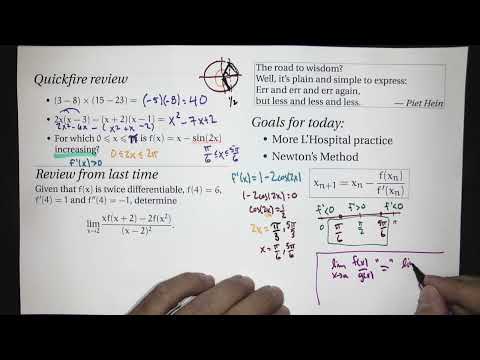
- For x - sin(2x) on [0, π], the derivative 1 - 2 cos(2x) changes sign at π/6 and 5π/6, producing an increasing interval of (π/6, 5π/6).
- Repeated applications of L'Hôpital's rule can resolve a limit only when its required conditions hold; an oscillating derivative ratio such as 1 + cos x does not establish a limit.
- The limit t^314/e^t is 0 because 314 differentiations leave a finite numerator while the exponential denominator still grows without bound.
- For a 1^infinity form such as sec(t)^(1/t²), taking a logarithm turns the exponent into a quotient; the resulting logarithmic limit is 1/2, giving the original limit √e.
- Newton's iteration x_(n+1) = x_n - f(x_n)/f'(x_n) uses tangent-line x-intercepts to improve a root estimate, but its success depends on the starting value.
- Newton fractals visualize which root an iterative method reaches from each complex starting point, with complicated boundaries between the convergence regions.
Chapters
- The opening arithmetic and expansion exercises review order of operations, distribution, and keeping track of negative signs.
- For f(x) = x - sin(2x), the derivative is 1 - 2 cos(2x), using the chain rule.
- Solving f'(x) = 0 on 0 ≤ x ≤ π gives x = π/6 and 5π/6; sign tests show f increases on (π/6, 5π/6).
- The example uses f(4) = 6, f'(4) = 1, and f''(4) = -1 to evaluate a limit with numerator x f(x + 2) - 2f(x²) and denominator (x - 2)².
- Substitution gives 0/0, and applying L'Hôpital's rule once still gives 0/0, so both numerator and denominator are differentiated again.
- The second derivatives evaluate to 28 upstairs and 2 downstairs at x = 2, giving the limit 14.
- A poem by Piet Hein frames learning as making errors repeatedly, but making fewer of them over time.
- The practical advice is to inspect mistakes, identify their cause, and develop a way to avoid repeating them.
- The lecture transitions from more L'Hôpital practice to Newton's method, emphasizing that unfamiliar recurrence notation will make sense through examples.
- Continuity at x = 0 requires the function's limit there to equal its defined value, a, described as avoiding a surprise.
- For the nonzero branch (e^(3x) - e^(2x) - x)/x², substitution gives 0/0.
- Applying L'Hôpital's rule twice gives (9 - 4)/2 = 5/2, so a must equal 5/2.
- The limit of t^314/e^t as t approaches infinity is initially an infinity-over-infinity form.
- L'Hôpital's rule can be applied repeatedly; after 314 differentiations, the numerator is the fixed constant 314! while e^t still tends to infinity.
- The resulting limit is 0, illustrating that exponential growth eventually outpaces every fixed-degree polynomial.
- Differentiating the numerator and denominator gives (1 + cos x)/1, which has no limit as x approaches infinity because cosine continues oscillating.
- The derivative ratio must have a limit for L'Hôpital's rule to establish the original limit, so the rule cannot resolve this example.
- Rewriting the expression as 1 + sin(x)/x shows the actual limit is 1, since sine is bounded between -1 and 1 while x grows without bound.
- As t approaches 0, sec(t)^(1/t²) has the indeterminate form 1^infinity, so direct substitution cannot determine its limit.
- Taking the natural logarithm converts the problem to the limit of log(sec t)/t²; two applications of L'Hôpital's rule reduce it to sec²(t)/2.
- The logarithm of the original limit is 1/2, so exponentiating gives the answer e^(1/2), or √e.
- Newton's method seeks values x where f(x) = 0, using the tangent line at a current approximation to generate a new one.
- Setting the tangent-line equation to y = 0 yields the iteration x_(n+1) = x_n - f(x_n)/f'(x_n).
- The method approximates rather than exactly finds a root, and a poor initial guess can send iterations far away or toward an unintended root.
- For the complex function z^3 - 1, Newton's method has three roots, and different starting points can converge to different roots.
- A Newton fractal colors starting points by their destination root; boundaries between regions can have intricate structure.
- Zooming into those boundaries reveals increasing complexity, illustrating how a numerical root-finding method can generate mathematical art.
Transcript excerpt
0:00 But let's start with our quick fire review. All right. If you have three, subtract 8, and you times that by 15, subtract 23, what do you get? >> 40. >> 40. And it's a positive 40 because really what's happening? You get -5 *8, which is 40. Good. Now, the next one didn't explicitly say what to do, but there's sort of an implied statement, which is we want to have you expand and gather. Enter your hunter gatherer phase. So, we have the expression 2x * x - 3 subtract x + 2 * x -1. If you expand and gather, what does this become? Okay, I heard x squ.
0:57 >> What else? >> 7 x >> - 7 x >> and plus two. >> I actually haven't done it. Anybody else get that? Yes. Yes. Okay, I see a few yeses. Good. You know, it's you just practice your distribution. 2x^2 - 6x minus. Then you get to do your foiling here. x^2 - x + 2x makes plus x - 2. And don't forget that this minus comes through every single term. A lot of people lose a minus sign. And of course, that's a classic way to lose a point. We don't want to lose that. We want all our points. And oh my goodness, I see that for the
1:45 next one. I wrote the word pi. I meant the symbol pi. For which x from 0 to pi is f ofx = x - sin of 2x increasing >> between 6 and 5 pi over 6. >> Pi over 6 and 5 pi over 6. All right, sounds good to me. But let's go through and talk about it. And it's good to do problems like this just to keep our skills up because we do have that final
This is the start of the transcript. Save this video free for the whole transcript, searchable and time-coded.
Related notes
Summary, takeaways, and chapters were generated by AI from the video's transcript and may contain errors. The video belongs to its creator, Beard Meets Calculus.