More optimization (Calc 1; Lecture 2-10; Fall 26)
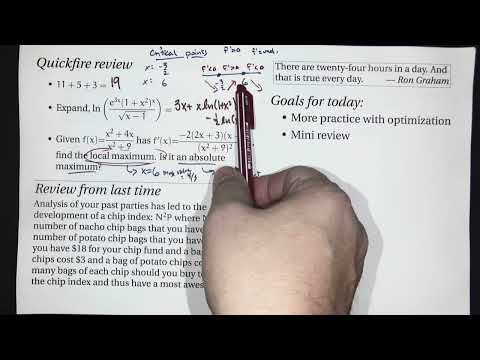 Watch on YouTube →
Overview
The lecture develops a repeatable method for calculus optimization: translate a word problem into a one-variable function, find and test critical points, then interpret the result in the requested units or dimensions. Worked examples maximize a chip index under an $18 budget, find the largest axis-aligned rectangle on a curve, minimize the material cost of a cylinder with volume 192π, and begin finding the point on y = x² nearest to (0, a).
Key takeaways
- A reliable optimization workflow is to identify the objective, use a constraint to express it with one variable, apply derivative tests, and then translate the result back into the requested form and units.
- With an $18 chip budget and index n²p, the constraint p = 18 - 3n produces the maximum at 4 nacho bags and 6 potato chip bags.
- For the rectangle on y = 6/(x² + 2x + 9), comparing the candidates x = ±3 by physical dimensions selects a 3-by-1/2 rectangle.
- Weighting the cylinder’s bottom cost by three and using volume 192π yields a least-cost design with radius 4 inches and height 12 inches.
- For the point on y = x² nearest to (0, a), the nearest point is the origin when a ≤ 1/2; when a > 1/2, two symmetric nearest points occur at x = ±√(a - 1/2).
- When minimizing a nonnegative distance, minimizing its square gives the same minimizing point and can simplify differentiation by removing the square root.
Chapters
0:00
Logarithm Rules Prepare for Logarithmic Differentiation
- The quick review expands a logarithmic expression using product, quotient, and power rules.
- The example becomes 3x + x ln(1 + x²) - 1/2 ln(x - 1).
- Comfort with logarithm properties is identified as preparation for logarithmic differentiation.
2:02
Critical Points, Local Extrema, and an Absolute Maximum
- For f(x) = (x² + 4x)/(x² + 9), the derivative has critical points x = -3/2 and x = 6; the denominator is never zero.
- A sign chart shows the function decreases, increases, then decreases, so x = 6 is a local maximum with value 4/3.
- The horizontal asymptote is y = 1, which helps support that 4/3 is the absolute maximum despite the domain not being closed and bounded.
9:01
Maximizing the Nacho and Potato Chip Index
- The party index is I = n²p, with nacho bags costing $3, potato chip bags costing $1, and an $18 budget.
- The budget constraint gives p = 18 - 3n, reducing the objective to I(n) = 18n² - 3n³.
- Solving I'(n) = 9n(4 - n) gives candidates n = 0 and n = 4; the zero-nacho option has index zero.
- The maximizing purchase is 4 nacho bags and 6 potato chip bags.
16:43
Three Stages of Optimization and Ron Graham’s Time Advice
- The lecture separates optimization into pre-processing, calculus processing, and post-processing.
- Pre-processing translates a word problem into a one-variable objective; processing finds and tests critical points and relevant endpoints.
- Post-processing checks whether the answer needs to be a parameter, an optimized value, or a quantity with units.
- Ron Graham’s advice is to make good use of the 24 hours available each day without overworking to the point of burnout.
20:29
Modeling the Largest Rectangle on a Rational Curve
- The rectangle has one corner at the origin, sides parallel to the axes, and an opposite corner on y = 6/(x² + 2x + 9).
- Its signed area model is A(x) = xy = 6x/(x² + 2x + 9), reducing the problem to one variable.
- Negative x values are allowed, so the signed expression can be negative even though physical area depends on the magnitude of the base.
- As |x| grows, the area approaches zero, supporting the expectation of a finite maximum.
26:03
Finding the Rectangle Dimensions at x = ±3
- The quotient rule simplifies the derivative to A'(x) = -6(x² - 9)/(x² + 2x + 9)².
- The only critical points are x = 3 and x = -3 because the denominator does not vanish.
- At x = 3, the height is 1/4; at x = -3, the height is 1/2.
- Comparing physical dimensions gives the largest rectangle as 3 by 1/2.
31:03
Building a Cost Function for an Open-Topped Cylinder
- The container has radius r, height h, no top, and required volume 192π cubic inches.
- The bottom material costs three times as much as the side material, so the relative cost is C = 3πr² + 2πrh.
- The side area is circumference 2πr multiplied by height h; the bottom area is πr².
- Using πr²h = 192π gives h = 192/r² and reduces cost to C(r) = 3πr² + 384π/r.
38:02
Minimizing Cylinder Cost Gives a 4-by-12-Inch Design
- Differentiating gives C'(r) = 6πr - 384π/r².
- Setting C'(r) = 0 and multiplying by r² yields r³ = 64, so the positive radius is 4 inches.
- Substituting r = 4 into h = 192/r² gives a height of 12 inches.
- The least-cost cylinder under the stated material pricing and volume constraint has radius 4 inches and height 12 inches.
42:01
Converting Nearest-Point Distance to a One-Variable Objective
- A point on the parabola y = x² can be written as (x, x²), while the fixed target is (0, a).
- The distance is √[x² + (x² - a)²], which is minimized by minimizing its square instead.
- The squared-distance objective is f(x) = x² + (x² - a)², avoiding a square root while preserving the minimizing point.
- The derivative is f'(x) = 2x[1 + 2x² - 2a], producing candidates x = 0 and, when a ≥ 1/2, x = ±√(a - 1/2).
46:42
Nearest Points Depend on Whether a Exceeds One-Half
- When a < 1/2, the nonzero critical-point formula has no real solutions, leaving (0, 0) as the nearest point on the parabola.
- At a = 1/2, the nonzero candidates merge with x = 0; for a > 1/2, two symmetric candidates appear.
- For a > 1/2, the squared-distance derivative has the correct sign pattern negative, positive, negative, positive across the ordered critical points.
- The two minima are at x = ±√(a - 1/2), giving nearest points (±√(a - 1/2), a - 1/2); the lecture cuts off during the sign-chart discussion.
Summary, takeaways, and chapters were generated by AI from the video's transcript and may contain errors. The video belongs to its creator, Beard Meets Calculus.