Wed Oct 14, 2026 Lecture (L20) Stewart Section 3.7 L’Hospital’s Rule
 Watch on YouTube →
Overview
The lecture introduces L’Hospital’s Rule for limits of the indeterminate forms 0/0 and ∞/∞, showing how to verify those forms, differentiate the numerator and denominator, and repeat the process when needed. Examples cover polynomial and trigonometric limits, an ∞·0 product converted to a quotient, and a 1^∞ limit transformed with logarithms and continuity; the lecture also warns that applying the rule without checking the form can give a wrong answer.
Key takeaways
- L’Hospital’s Rule is valid only after verifying that the original quotient is 0/0 or ∞/∞; differentiating a quotient in another form can produce a false result.
- If applying L’Hospital’s Rule leaves the quotient in 0/0 or ∞/∞ form, the process may be repeated, as in the three differentiations required to evaluate (eˣ − e⁻ˣ − 2x)/(x − sin(x)) at 0.
- An indeterminate product such as x⁴e⁻ˣ can be rewritten as x⁴/eˣ, allowing repeated applications of L’Hospital’s Rule to show that its limit is 0.
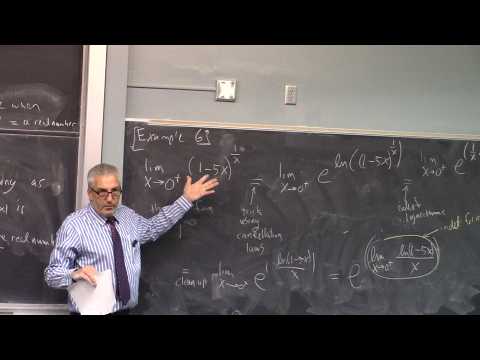
- For a 1^∞ limit, taking logarithms can expose a 0/0 quotient; specifically, (1 − 5x)^(1/x) approaches e⁻⁵ as x approaches 0 from the right.
- Continuity permits moving a limit inside e^(f(x)) when f(x) has a finite real limit, and inside ln(f(x)) when that limit is positive.
Chapters
0:00
Exam Scope and the Move from Limit Techniques to L’Hospital’s Rule
- The upcoming Friday exam covers 10 textbook sections, with Sections 3.1 and 3.2 focused on calculus applications of exponential and logarithmic functions.
- Section 3.4 is not covered, and Section 3.7 on L’Hospital’s Rule is deferred to Exam 3.
- The lecture frames indeterminate forms as limits whose values still need to be determined, not as limits that are automatically undefined.
2:00
Recognizing 0/0 and ∞/∞ Before Applying L’Hospital’s Rule
- A quotient is in 0/0 form when the numerator and denominator separately approach 0; 0/0 itself is not a real number.
- A quotient is in ∞/∞ form when both parts grow without bound; infinity is not a number, so the quotient’s limit cannot be inferred by ordinary arithmetic.
- For these forms, L’Hospital’s Rule replaces the original quotient with the quotient of the derivatives, subject to the rule’s conditions.
- The rule can also apply to one-sided limits and limits as x approaches positive or negative infinity.
7:00
Polynomial Cancellation and the Fundamental Limit sin(x)/x
- For (x² + 3x − 10)/(x − 2) as x approaches 2, factoring gives (x − 2)(x + 5)/(x − 2), so the limit is 7.
- The same polynomial limit is confirmed with L’Hospital’s Rule: (2x + 3)/1 approaches 7 at x = 2.
- For sin(x)/x as x approaches 0, the known limit is 1; the lecture recalls its geometric and squeeze-theorem proof.
- L’Hospital’s Rule also gives 1 by differentiating to cos(x)/1, though the earlier proof uses less calculus machinery.
11:00
Repeated Differentiation Resolves a 0/0 Exponential-Trigonometric Limit
- The limit of (eˣ − e⁻ˣ − 2x)/(x − sin(x)) as x approaches 0 begins in 0/0 form.
- After one differentiation, the quotient (eˣ + e⁻ˣ − 2)/(1 − cos(x)) is still 0/0, so the rule must be applied again.
- A second differentiation still gives 0/0; a third produces (eˣ + e⁻ˣ)/cos(x), which is no longer indeterminate.
- Substitution at x = 0 then gives (1 + 1)/1 = 2.
15:00
A Non-Indeterminate Limit Shows Why the Form Must Be Checked
- An example at x = 3 produces an incorrect result when the numerator and denominator are differentiated without first confirming an indeterminate form.
- The lecture contrasts the naive derivative-ratio result of 1 with the stated actual limit of 2.
- The central procedural rule is to evaluate the original numerator and denominator limits first and verify 0/0 or ∞/∞ before using L’Hospital’s Rule.
20:00
Turning an ∞·0 Product into an ∞/∞ Quotient
- For x⁴e⁻ˣ as x approaches infinity, x⁴ approaches infinity while e⁻ˣ approaches 0, creating the indeterminate product ∞·0.
- Using e⁻ˣ = 1/eˣ rewrites the product as x⁴/eˣ, which is an ∞/∞ quotient.
- Repeated applications of L’Hospital’s Rule reduce the quotient through 4x³/eˣ, 12x²/eˣ, and 24x/eˣ to 24/eˣ.
- Since eˣ grows without bound, the limit is 0; other ∞·0 products can have different outcomes.
24:00
Inverse-Function Identities and Continuity for Exponential Limits
- The cancellation identity e^(ln x) = x requires x > 0 because ln(x) is undefined for nonpositive real inputs.
- The identity ln(eˣ) = x holds for all real x because eˣ is always positive.
- Continuity allows a limit to move inside an exponential when the inner limit is a finite real number.
- For ln(f(x)), the inner limit must be positive so that the logarithm is defined and continuous there.
29:00
Preparing the 1^∞ Limit with Logarithms and Continuity
- The limit of (1 − 5x)^(1/x) as x approaches 0 from the right has indeterminate form 1^∞.
- Because 1 − 5x is positive near 0 from the right, it can be rewritten as e^(ln(1 − 5x)/x) using e^(ln u) = u.
- The exponent ln(1 − 5x)/x is now a 0/0 quotient, suitable for L’Hospital’s Rule.
- This transformation shows how logarithms convert an indeterminate power into a limit that can be evaluated with differentiation.
39:00
Evaluating (1 − 5x)^(1/x) and Introducing Indeterminate Differences
- Differentiating ln(1 − 5x)/x gives −5/(1 − 5x), whose limit as x approaches 0 from the right is −5.
- The original power limit is therefore e⁻⁵; retaining the negative sign from the chain rule is essential.
- The lecture emphasizes that 1^∞ can yield values other than 1 or infinity, making it genuinely indeterminate.
- At about 47:30, a new section on indeterminate differences begins, but the lecture ends before its first preliminary limit is worked out.
Summary, takeaways, and chapters were generated by AI from the video's transcript and may contain errors. The video belongs to its creator, Barsamian's Math Videos.