ME2120 - Dynamics
 Watch on YouTube →
Overview
Ryan C. Cooper develops an elevator emergency-braking case study by modeling constant-friction stopping with kinematics, then extends the analysis to a falling counterweight stopped by a spring and damper. The class connects free-body and kinetic diagrams to Hooke's law, velocity-dependent damping, energy removal through work, and the second-order differential equation called the equation of motion.
Key takeaways
- For constant braking force and gravity, elevator stopping distance can be estimated with v_f² = v_0² + 2aΔh, provided acceleration and displacement use a consistent sign convention.
- A braking force that merely balances the elevator's weight creates zero net acceleration, so the constant-acceleration stopping-distance formula becomes undefined and the elevator will not stop over a finite distance.
- Spring force is displacement-dependent and follows Hooke's law, F = kx, whereas a linear damper force is velocity-dependent and opposes the direction of motion.
- A damper removes mechanical energy by doing negative work; it does not store that energy as spring potential energy.
- Combining a spring with a damper helps both stop a falling counterweight and prevent the support mechanism from slowly bottoming out before impact.
- Setting the free-body diagram's net force equal to ma produces the counterweight's equation of motion, a second-order differential equation.
Chapters
- Ryan C. Cooper corrected a duplicate assignment in the semester calendar and said later case-study details and readings would be added as modules take shape.
- Project one, a final-project proposal, was removed to save time; project two is planned as the first Jupyter Notebook assignment.
- Case study one was moved from Friday to Tuesday so students could use class and Monday to ask questions and practice communicating technical results.
- Cooper starts the elevator analysis with a free-body diagram and treats braking friction and gravity as constant forces.
- With upward defined as positive, he relates braking acceleration to friction force per unit mass and gravity.
- He applies the constant-acceleration relation v_f² = v_0² + 2aΔh, noting that the sign convention for acceleration and displacement must remain consistent.
- If braking force balances gravity, net acceleration is zero and the stopping-distance calculation becomes undefined because it requires division by zero.
- Cooper explains that braking just below the balance point would produce a very long stopping distance, rather than a practical emergency stop.
- Using a one-second free-fall interval as an estimate gives a speed near 10 m/s, illustrating why the braking distance needs a numerical design check.
- The class explores how increasing friction reduces stopping distance, with Cooper estimating that a tenfold increase in braking force can reduce distance by roughly a factor of ten under the simplified assumptions.
- A rough example gives a stopping distance around 0.56 m, compared with an earlier estimate of several meters.
- Cooper distinguishes emergency braking from normal elevator operation and says typical operating accelerations of about 1 to 2 m/s² can be researched for comparison.
- The second case-study scenario considers a counterweight in free fall that must be caught without damaging the elevator shaft.
- Cooper says an empty elevator and counterweight can reasonably be assumed to have similar masses, while passenger capacity and motor design affect the actual counterweight.
- The analysis begins by estimating fall distance and impact speed, then designing a spring-and-damper mechanism to stop the counterweight.
- Cooper emphasizes starting with a free-body diagram for the counterweight while it contacts the braking mechanism.
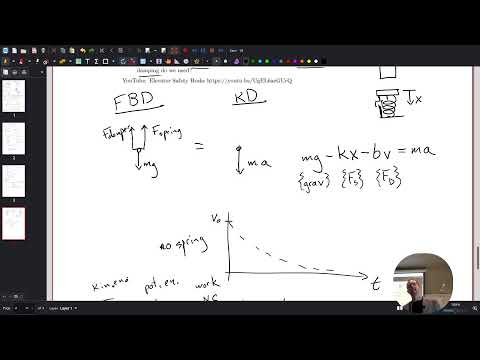
- Gravity continues acting during braking, while the spring and damper exert upward forces against the counterweight's downward motion.
- He chooses downward displacement and velocity as positive in this part of the analysis so the diagram and motion signs align.
- A spring force depends on displacement, while a linear damper force depends on velocity and opposes motion.
- Examples include oil dampers on doors and shock absorbers in vehicle suspension; failed shocks can leave a car rocking after a bump.
- A damper alone can slow motion toward a terminal constant velocity under gravity, while combining a spring and damper can stop the counterweight and limit rebound.
- The energy discussion focuses on kinetic energy, gravitational potential energy, and work, while internal energy and enthalpy are set aside for this rigid-body model.
- A damper does not store the counterweight's energy as spring potential energy; its opposing force performs negative work and removes mechanical energy.
- Cooper explains why a spring is paired with a damper in practice: the spring supports the mechanism so a damper does not slowly bottom out before an impact.
- The spring follows Hooke's law, with force proportional to deflection: F_spring = kx.
- A linear damper contributes a force proportional to velocity, represented with a damping constant B.
- With downward positive, the force balance includes gravity, spring force, and damper force and is set equal to mass times acceleration.
- The class considers whether the counterweight's contact with the brake requires an additional normal force in the force balance.
- Cooper explains that contact forces occur in equal-and-opposite pairs and need not be added as a separate unknown to derive the counterweight's governing equation.
- The resulting force-acceleration relation becomes a second-order differential equation, called the equation of motion; the case study continues in the next class.
Transcript excerpt
0:09 There you go. Hallelujah. Yeah,
1:12 >> we're here. We're back. >> Okay, welcome back. Another exciting adventure in applied Mechanics 2. Uh, so this week I started trying to lay out the schedule for the semester. For some reason, one of the assignments got double put in there. So, there was something due today. It's gone. I just fixed it. But, um, now when we look at calendar, not everything has like uh has stuff in there. Like case study one we're
1:59 currently working on. Case study two is coming up next over the next like couple weeks. So I'll add information about how what we're looking at there. And then project two will be our first like Jupiter notebook assignment. So that has some details there if you want to look ahead. So now we've got like structure of the semester laid out all the way till that week before Thanksgiving when we'll be done with like the assign the the assignments where I tell you like here's the problem that you have to work on. >> Yeah. >> What happened to project one? >> Oh, why does it go straight to two? Project one was uh like a proposal for your final project, but I was like skip
2:52 it. Um just in the interest of time. Yeah, it was the chopping block. Budget cuts. No project ones. Yeah. Cuts. >> Cut two and three. Cut four. Just everybody coast into Thanksgiving and then namaste our way into the holidays. Yeah, that's a good point. I was just going through like the structure that I had. Project one just I don't know. It's just more logistics of like getting stuff done. Let's just get into some work. Let's do some fun stuff together. So, just remove one of the projects and
This is the start of the transcript. Save this video free for the whole transcript, searchable and time-coded.
Related notes
Summary, takeaways, and chapters were generated by AI from the video's transcript and may contain errors. The video belongs to its creator, Professor Ryan C. Cooper.