ME2120 - Dynamics
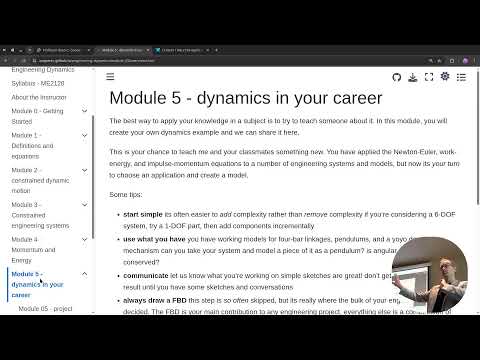 Watch on YouTube →
Overview
Professor Ryan C. Cooper introduces ME2120 Dynamics as a study of rigid-body motion grounded in Newton's second law, F = ma, and as a foundation for fluid mechanics, vibrations, aerodynamics, finite element analysis, and propulsion. He outlines a hybrid, collaborative course with five case problems, three Python-based projects, flexible HuskyCT submissions, no exams or quizzes, and a final independent research project connecting dynamics to students’ careers or interests.
Key takeaways
- Dynamics extends static mechanics by treating time-dependent motion and forces, with F = ma serving as the starting point for rigid-body, fluid, and deformable-solid analysis.
- Choosing the system boundary matters: a car dynamics study may need to include its suspension, seats, and passengers to evaluate comfort and transmitted forces.
- ME2120's planned coursework includes five collaborative case problems and three Python projects, where students modify working code and interpret physical results rather than needing advanced programming skills.
- HuskyCT assignments permit unlimited resubmissions, and students can request extensions without penalties when they explain the timeline and support they need.
- The course assigns 80 percent of the grade to case problems and projects and 20 percent to participation, peer review, and contributions to the learning community.
- The final two weeks are reserved for an independent project that turns dynamics into a concrete career or personal-interest example, such as submersible stability or forces in a climbing injury.
Chapters
- Ryan C. Cooper resolves a playback issue caused by a browser video-speed extension running at 2x.
- Students can book Professor Cooper's office hours through the course website and meet either in person or online.
- The class is near the room's stated capacity of about 120 students.
- Students describe dynamics as the study of systems in motion and as a deeper continuation of mechanics.
- Unlike a static snapshot, a dynamics problem accounts for how motion or forces change over time.
- A speedometer provides a live measure of wheel rotation, illustrating that measured motion depends on the system and its reference.
- A system can be any selected object or collection of objects, from a person to an entire classroom.
- For car design, the relevant dynamic system can include the suspension, seats, and passengers, not just the wheels and road.
- Engineers can use dynamics to understand passenger forces and improve behavior on rough roads, smooth roads, and Formula One circuits.
- ME2120 focuses on rigid-body dynamics, treating bodies as nondeforming unless elements such as springs or strings are specifically considered.
- Fluid mechanics and deformable-solid mechanics branch from this foundation, with aerodynamics drawing on both fluids and solid structures.
- F = ma underpins the later subjects, while fluid or solid mechanics also requires a constitutive model describing material behavior.
- Students read and think independently before class, then use class meetings to solve problems together.
- The semester plan includes five case problems and three projects, with Python projects in modules two, three, and four.
- Students are not expected to be expert Python programmers: they will run and modify existing code and interpret how changes affect modeled system behavior.
- Cooper streams lectures on YouTube to provide a discussion archive and auto-captions for accessibility.
- Cooper proposes meeting Mondays and Wednesdays, using two 50-minute sessions each week and leaving Fridays open for independent work.
- The schedule can be revisited after a few weeks if the learning community finds the format ineffective.
- For the first Wednesday discussion, students should read a short philosophy of Newtonian mechanics text and consider free will as the first case problem.
- HuskyCT will host module materials, readings, assignments, course updates, and a calendar of due dates.
- Assignments allow unlimited resubmissions so students can use feedback from Cooper and three teaching assistants to revise work and recover points.
- Students who need more time should submit a note explaining the requested extension and what support they need; Cooper says communicated extensions incur no penalty.
- The first case study is due the following week and also lets students practice navigating the course and submitting work.
- Case problems and projects make up 80 percent of the grade, while discussions and peer review account for the remaining 20 percent.
- Class collaboration involves forming groups, comparing approaches, offering alternatives, and reviewing engineering design work.
- There are no exams or quizzes; students self-assess their contributions, including preparation, note-taking, and participation in group work.
- Cooper encourages students to communicate early about absences or obstacles rather than letting participation problems go unaddressed.
- The final two weeks replace a final exam with a modest independent research project on motion that interests each student.
- A project can build a career-relevant story, such as analyzing buoyancy, ballast, and center of mass for a submersible to prepare for an Electric Boat interview.
- Other possible topics connect mechanics to personal interests, such as estimating the moment and bone strength involved in a rock-climbing ankle fracture.
- Cooper suggests roughly six two-hour work sessions and a written report or presentation; exploring a field and deciding against it also counts as a useful outcome.
Transcript excerpt
1:58 I'm looking for used to used to be able to jack right in It's really lagging.
3:18 I do have I have good internet connection. >> All right. Give it a shot. Oh, I see. >> It auto installed my screen, my video
4:07 player. I have like a video player that changes the speed. It auto installed it and it was playing it at double speed. I'm like, why is it >> Yeah. So, back to one one X is better. Now, it can keep up with live. It's hard to travel at two seconds per second in real time. >> That makes sense. >> Okay, cool. So, we are here in Applied Mechanics 2, Newton's Revenge, and I'm Professor Cooper. Let's pull that one up. So, anywhere you see my name in blue on the the course website, you can get back to my homepage. Uh there's a big blue link, like the first link on this page
4:57 is for office hours. So, it's by appointment. Um, I try to keep it in sync with my calendar so that you can try to match your calendar with mine and we can book time there. Once in a while, like something come like if it's 10:00 a.m. and you book an 11:00 a.m. appointment, I might have already made plans, but we'll try to make things work, especially if I'm on campus anyway. And then we can meet online, either in person or online, whichever you prefer whenever you book that. Cool. question so far. You're in the right class with a packed house. Standing room only. Now, are we at cap? We must be at capacity because like this room, there's no way 120 is like the recommended room size.
5:48 This looks pretty full. Here we go. We're doing it anyway. It's
This is the start of the transcript. Save this video free for the whole transcript, searchable and time-coded.
Related notes
Summary, takeaways, and chapters were generated by AI from the video's transcript and may contain errors. The video belongs to its creator, Professor Ryan C. Cooper.