ME2120-002
 Watch on YouTube →
Overview
Ryan C. Cooper develops a method for designing yo-yo despinning systems by estimating a payload’s moment of inertia, modeling the yo-yos and their starting radius, and testing the design in Python. Examples include approximating seven bananas as cylinders and a hollow van as a solid cuboid minus its interior, then using a 7.2-million-kg submarine simulation to show how yo-yo mass and simulation duration affect cord length and stopping time.
Key takeaways
- A payload’s moment of inertia must be calculated about its actual spin axis, so selecting a shape approximation and identifying that axis are essential first steps.
- Composite payloads can be modeled by adding component inertias with parallel-axis terms; the seven-banana example uses one central cylinder and six offset cylinders.
- A hollow object such as a van can be approximated by subtracting the inertia of an interior cuboid from that of a solid outer cuboid, assuming uniform density.
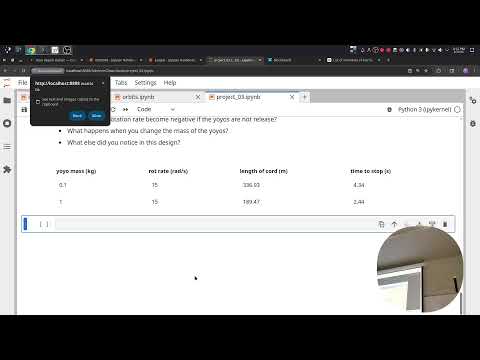
- For the 7.2-million-kg submarine at 15 rad/s, increasing yo-yo mass from 0.1 kg to 1 kg reduces modeled cord length from 336.93 m to 189.47 m and stopping time from 4.34 s to 2.44 s.
- Simulation duration and time-step resolution must be sufficient to capture the entire unspooling process; a 1-second run may not reach zero angular velocity, while a 5-second run with 1,000 points can show the full stop.
Chapters
- The class reviews earlier experiments on how yo-yo mass and cord length affect rotation rate and despinning time.
- Once a payload design and its moment of inertia are set, the model can predict how long despinning takes.
- A Tesla Roadster in space serves as the motivating payload example for the despinning project.
- The first design step is to specify the payload’s shape, dimensions, mass, and moment of inertia.
- The rotation axis matters because the moment of inertia depends on how the object spins.
- Example payloads range from a phone to the Moon, with the Moon requiring an impractically large yo-yo radius and posing additional gravitational complications.
- A student group models a bundle of seven bananas with a total mass of about 0.5 kg.
- The group considers representing the bananas as cylinders and estimates dimensions such as side length and radius.
- The example highlights that a usable inertia estimate begins with an explicit geometric approximation of the payload.
- Individual banana-shaped cylinders can be treated as components and their moments of inertia combined about a shared rotation axis.
- For the seven-banana model, one cylinder is placed at the center and six are arranged around it.
- The calculation combines each cylinder’s own rotational inertia, such as ½mr², with the parallel-axis contribution mR² for its offset from the bundle’s center.
- A hollow steel van can be approximated as a full solid cuboid with a smaller cuboid removed from its center.
- For uniform density, the outer and inner masses can be estimated from density times length, width, and height.
- Subtracting the inner cuboid’s moment of inertia from the outer cuboid’s produces an estimate for the hollow structure.
- The simulation’s key inputs include payload moment of inertia I, the mass m of each yo-yo, initial radius R, and initial angular velocity ω₀.
- The model assumes two yo-yos arranged symmetrically so they do not significantly shift the payload’s center of mass.
- Cooper clarifies that R is the yo-yo’s initial distance from the payload’s center of mass; a vehicle-side mounting might use roughly half its width rather than a full width.
- The example assigns a 7.2-million-kg submarine a radius of 5.18 m and examines how its yo-yos unspool as it despin.
- With 0.1-kg yo-yos and an initial spin rate of 15 rad/s, the model requires about 336.93 m of cord and 4.34 seconds to stop.
- A short or low-resolution simulation can show an incomplete or sporadic yo-yo path instead of the full despinning process.
- From about 24:00 to 38:08, class time shifts largely to student work, and the transcript provides few clear technical results.
- Around 26:33, a student asks for help with a rocket-related design, but the discussion does not establish readable parameter values or conclusions.
- A question around 29:31 asks why the object starts spinning; the surrounding exchange is too fragmented to recover a technical explanation.
- Cooper records results in a table: increasing each yo-yo’s mass from 0.1 kg to 1 kg at 15 rad/s reduces cord length from 336.93 m to 189.47 m and stopping time from 4.34 s to 2.44 s.
- The comparison shows that a tenfold increase in yo-yo mass does not produce a tenfold change in stopping time or cord length, so design trends should be documented rather than assumed linear.
- For the submarine, a 1-second simulation may end before angular velocity reaches zero; increasing the duration and using more time steps, such as 1,000 points over 5 seconds, reveals the full curve.
- The class closes by preparing the final project, with Monday, Wednesday, and Friday set aside for applying course concepts to a career interest or hobby.
Transcript excerpt
0:09 Guess what the weather is like today? Oh, dude, this is this thing we're working on. Yes. So, we have banana Well, no, we have six bananas which together makes a brick. Okay. Okay, so you multiply the mass by six. Yeah. It's easy. Actually, can you get your bananas out? What? Cuz I need to measure them. What? Can you measure my bananas? Cuz we're using your bananas for What? Because it's funny like Oh. Dude, this guy I said this is like 7 in. Okay. Welcome back. Why do you have a banana? I have a ruler in my jacket. And you lie. So, on Wednesday, if whether you're here or need a refresher, Wednesday we did a lot
0:59 of the background information about like doing some experiments to figure out why does rotation rate become negative if the length is too long, what happens as we're changing mass of the yo-yos, and then even some other things that that you can notice about rotation rate, how the the yo-yo masses and the length, they don't change depending on rotation rate at this time. The time changes like how long it takes, but overall once we pick one design once our design is kind of set and our and we know our moment of inertia for the payload, then it works really well. Okay. So, today
1:49 on Wednes- All right, so going back, still on Wednesday. On Wednesday, we're just looking at a Tesla Roadster. There's one up in space, so we were trying to de-spin it, make sure that we could get satellite radio. Um today, first step is deciding on a payload, and then approximating that moment of inertia and its mass so that you can de-spin your own payload, your own space load, whatever you're sending
This is the start of the transcript. Save this video free for the whole transcript, searchable and time-coded.
Related notes
Summary, takeaways, and chapters were generated by AI from the video's transcript and may contain errors. The video belongs to its creator, Professor Ryan C. Cooper.