ME2120-002
 Watch on YouTube →
Overview
Ryan Cooper introduces Project 4, designing a yo-yo despin mechanism for a spacecraft payload, and uses a Tesla Roadster example to connect moment of inertia, torque, and angular momentum. Simulations show how changing yo-yo mass and initial spin rate affects cord length and deployment time, while conservation of angular momentum explains why an overlong cord makes the payload rotate in reverse.
Key takeaways
- A yo-yo despin mechanism uses internal forces to transfer angular momentum from a rotating spacecraft to outward-moving tethered masses, then discards those masses to leave the payload nearly stationary.
- Moment of inertia depends on both mass and distance from the rotation axis, so the payload’s spin axis must be specified before designing its despin system.
- In the demonstrated simulation, raising each yo-yo mass from 10 g to 100 g changed the stopping point from about 6 seconds and 17 m to about 0.3 seconds and 9.6 m.
- Increasing initial spin from 15 to 150 rad/s reduced stopping time from about 0.3 seconds to 30 milliseconds while leaving the required cord length unchanged.
- An overlong tether does not remove angular momentum from the combined system; it transfers too much to the yo-yos, forcing the payload to rotate in reverse.
- A well-designed yo-yo despin system is mechanically passive: it can bring a payload to a stop without a PID controller or computer-based feedback.
Chapters
- JupyterHub was unavailable until the following night, so the class began Project 4 with its physics rather than running Python simulations.
- The Project 4 due date was moved to Tuesday, with simulations planned for Friday.
- Next week’s class time will revisit how students can apply course concepts to a personal, career, or portfolio project.
- A spacecraft can accumulate rotation from a small thruster misalignment because space provides no drag or friction to slow it down.
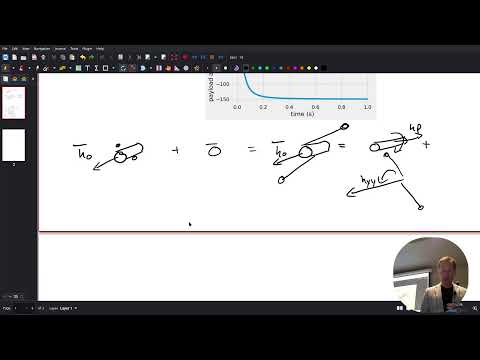
- A yo-yo despin system releases two tethered masses on opposite sides of the probe; as they move outward, the probe’s rotation slows.
- At the designed cord length, the tethers are released so the masses carry angular momentum away from the probe.
- The Roadster example estimates a moment of inertia of 492.6 kg·m² using a simplified brick-shaped vehicle model.
- The example uses a 1,200 kg payload and approximate dimensions of 1.8 m by 1.1 m, while noting that depth was not included.
- Moment of inertia describes resistance to rotational acceleration, analogous to how mass describes resistance to linear acceleration under F = ma.
- A rigid payload has different moments of inertia for rotation about its x, y, and z axes.
- The x-axis moment of inertia describes resistance to changes in rotation specifically around the x-axis.
- Angular velocity and torque are treated as vectors, with the right-hand rule indicating the positive direction of rotation.
- Project 4 asks students to choose a payload, determine its moment of inertia and spin axis, then design its despin mechanism.
- Suggested payloads range from an actual NASA mission to a Death Star or a World War II ship imagined in space.
- The Roadster simulation starts at 15 rad/s, about two rotations per second, with two 10 g yo-yo masses.
- The initial simulation plots how the yo-yo masses unspool relative to a fixed payload reference frame.
- For the 10 g masses, the simulation identifies a stopping point at roughly 6 seconds and 17 m of cord.
- Students predict how increasing each mass to 100 g will change deployment time and cord length before testing the model.
- Increasing yo-yo mass from 10 g to 100 g changes the reported stopping point to about 0.3 seconds and 9.6 m of cord.
- The shorter cord is consistent with the greater mass providing more rotational inertia at a smaller radius.
- Cooper explains that heavier masses transfer angular momentum faster, but they also increase the mass discarded with the mechanism.
- The simulation raises initial spin from 15 to 150 rad/s, a tenfold increase, and samples more frequently for smoother curves.
- The stopping time drops by a factor of ten, from about 0.3 seconds to 30 milliseconds, while the required cord length remains unchanged.
- The result illustrates the mechanism’s passive operation: with the cord designed correctly, it can stop the payload across different initial spin rates without a computer controller.
- If the tether continues unwinding after the payload reaches zero rotation, it transfers too much angular momentum and the payload begins rotating in the opposite direction.
- With no external torque, total angular momentum is conserved; the tethered masses gain angular momentum as the payload loses it, and the payload must reverse if the transfer overshoots.
- The simulation assumes the cord keeps unspooling without catching, while a real design must also prevent tangling or snagging.
- The project deliverable is to select a payload, calculate its moment of inertia, and choose yo-yo mass and cord length to achieve despinning.
Transcript excerpt
0:00 start streaming. >> This is just how the week is going. Is that our our Jupiter hub like where we can actually where we were running Python and Jupiter. solution. >> Yeah. >> So we have our technical issue is that Jupiter hub so our nano hub
0:47 >> Jupiter Python is down until tomorrow night. Today we'll start looking at the project of like what it how does it work start look start answering some questions about like the physics behind it and then Friday we'll be able to actually work on it I pushed off due date till Tuesday so so you don't have to like turn anything in but this is where we're at is that we have so while we're on subject of logistics uh coming into HuskyCT We can take a look at our content. >> We finished up case problem four. So that was our last case problem. We have project 4 that we'll start talking about
1:36 today. And then Friday we'll actually pop open Jupiter and run some simulations and yeah wrap up project 4. And then next week when we come back, we'll take Monday, Wednesday, Friday and that's where we revisit what we were working on in module [clears throat] one of like what what kind of project do you want to get out of this class? Like what's this? Do you want to apply it to something in your career, to a hobby, but take a couple of days and think about what did we learn in the class? How do I apply it to something that I think is important for me? I think that's way more it especially if you want to start building like an engineering portfolio. This is a really good practice to do for every class. I know sometimes by the time you
This is the start of the transcript. Save this video free for the whole transcript, searchable and time-coded.
Related notes
Summary, takeaways, and chapters were generated by AI from the video's transcript and may contain errors. The video belongs to its creator, Professor Ryan C. Cooper.