ME2120 - 001
 Watch on YouTube →
Overview
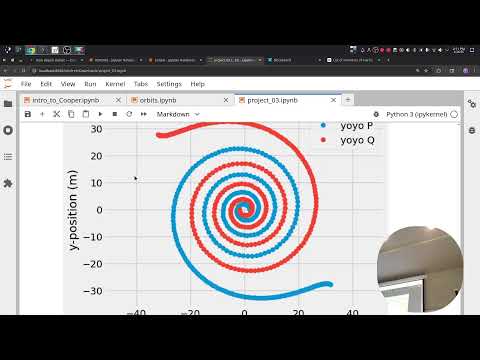
Ryan C. Cooper guides students through the final ME2120 project: designing a yo-yo despinning mechanism by modeling a chosen payload’s geometry, mass, and moment of inertia. The class applies inertia addition and subtraction and the parallel axis theorem, then tests how yo-yo mass and spin rate affect cord length and despin time, including an example where increasing yo-yo mass from 10 g to 0.5 kg reduces required cord from 112 m to 42 m.
Key takeaways
- A payload’s moment of inertia depends on both its geometry and the chosen rotation axis, so the despin model must define the axis before selecting formulas.
- For uniform-density hollow objects, such as a bus-shaped payload, calculate inertia by subtracting the inner shape’s inertia from the outer shape’s inertia about the same axis.
- The parallel axis theorem accounts for an attached component’s offset: combine its own centroidal inertia with the contribution from its center-of-mass distance to the system axis.
- In the rocket example, increasing yo-yo mass from 10 g to 0.5 kg reduced required cord from about 112 m to 42 m, or approximately 7.3 wraps around a 1.85 m radius payload.
- For the idealized despin model, increasing spin rate from 15 rad/s to 150 rad/s reduces despin time but does not change the required cord length.
- Recording yo-yo mass, initial spin rate, cord length, and despin time in a table makes design tradeoffs and modeling errors easier to identify.
Chapters
- The final project models a payload that is spinning in space and needs to be despun.
- Students choose an object and specify its mass, dimensions, geometry, and rotation axis.
- The model uses the payload’s moment of inertia to explore yo-yo mass, cord length, and despin time tradeoffs.
- Possible payloads range from a car to a brick or satellite, with dimensions approximated from the chosen shape.
- A Python notebook can use the selected mass and dimensions to calculate moment of inertia.
- The model simplifies real objects into geometric shapes, so students should state assumptions such as treating a payload as a cuboid.
- A hollow bus can be approximated as a large cuboid minus a smaller cuboid representing its interior.
- For a uniform-density cuboid, mass follows density times volume, and inertia about a central axis uses a form such as M/12 times the sum of the relevant squared dimensions.
- Moments of inertia can be added or subtracted only when they are referenced to the same rotation axis.
- A satellite dish, antenna, or other component mounted away from a payload’s center of mass contributes additional inertia.
- The parallel axis theorem combines a component’s own rotational inertia with the effect of its center of mass being offset from the system axis.
- For a solid cylinder rotating about a transverse centroidal axis, use I = m/12(3r² + L²), then account for its offset from the payload axis.
- Students identify which axis the payload is tumbling around before selecting an inertia formula.
- A payload made from a main block plus an arm-mounted dish can be modeled by combining the block’s inertia with the dish’s inertia and its offset.
- The project does not require perfect geometric detail; the important step is to use consistent axes and document simplifying assumptions.
- A class example models a large rocket-like payload with an inertia on the order of 600,000 kg-scale input and starts with 10 g yo-yos.
- At an initial rotation rate of 15 rad/s, the small yo-yos require about 112 m of cord and take roughly four seconds to approach zero spin.
- The model’s calculated final speed is a design value, but the plotted trajectory may need a longer simulation window to show the full despin process.
- Increasing yo-yo mass from 10 g to 0.5 kg cuts the example cord length from about 112 m to 42 m.
- With a rocket radius near 1.85 m, 42 m of cord corresponds to roughly 7.3 wraps around the payload.
- Designers can increase yo-yo mass further to target a single wrap and reduce the risk of cord catching on itself.
- Students compare their block, antenna, and dish models, checking which distance measures the offset to each component’s center of mass.
- Unit consistency matters when entering mass and dimensions into the Python/Jupyter notebook; errors can produce implausible results.
- The instructor treats unexpected plots and failed runs as useful checks that reveal incorrect assumptions or inputs.
- Students are encouraged to log yo-yo mass, rotation rate, cord length, and despin time in an experiment table.
- Comparing 15 rad/s with 150 rad/s shows that higher spin rate decreases despin time while the ideal required cord length remains unchanged.
- The final assigned project is followed by a work session next week, giving students time to connect course concepts to careers, hobbies, and interests.
Transcript excerpt
0:29 Cool. I was just checking that we actually have like Nano Hub for running Jupiter. It looks like we're up and running. Um on Wednesday, we started looking at project 4. or designing this yo-yo despinning mechanism. Um, and here I was looking at a car flying through space corkcrewing and trying to stop that spin. So, today first thing to do is pick a payload like anything that that you would want. Not that you would want but and yeah anything anything that you can imagine like as a payload that you're
1:16 sending to space you need to despin it. Um so what is its moment of inertia? What axis is it spinning on? And then then from there we can start designing like all right how long do these chords need to be? How big do the masses need to be? What is the tradeoff between like chord length mass? um time that it takes to spin to spin down all of that. Um so coming in down here all the way at module 4 coming into hot to the end of the semester feels good to get here right I'll just kernel restart run all I was building like a table for like
2:08 lessons learned So, as you're setting up your Python variables, choose a mass, choose what dimensions it has, what kind of geometry is your payload actually going to be, and figure out what that like you'll have your own capital I like what is that moment of inertia. So that's where we're starting for today. >> Quantum.
3:04 >> Oh, I finished it. >> Oh, you finished your paper. presentation. >> Yeah. >> Really? >> Yeah. >> Oh, take this one. >> Yeah. >> All right. Maybe. >> Yeah. >> Yeah. I was looking to see.
This is the start of the transcript. Save this video free for the whole transcript, searchable and time-coded.
Related notes
Summary, takeaways, and chapters were generated by AI from the video's transcript and may contain errors. The video belongs to its creator, Professor Ryan C. Cooper.