Getting started with Module_05 project
 Watch on YouTube →
Overview
Ryan C. Cooper shows how to begin a Module 5 dynamics project by turning a specific idea, a bicycle power calculator, into a note-card plan with a free-body diagram and governing equations. He models power input as pedal torque times angular speed and power demands from drag, rolling resistance, and climbing a slope, then asks students to identify forces, motion constraints, and a possible product direction before building.
Key takeaways
- A useful first step for a dynamics project is to fit the idea, free-body diagram, and governing equations onto a note card before beginning implementation.
- For the bicycle power calculator, power can be modeled as force times speed, so each force opposing motion contributes a force-times-velocity term.
- The uphill power requirement is mg sin(alpha) times velocity, where alpha is the slope angle.
- The model separates pedal power input, torque times angular speed, from power required to overcome drag, rolling resistance, and gravity on a climb.
- A bicycle’s motion constraint is rolling along a surface, and the diagram should distinguish rolling resistance from static friction that maintains rolling.
- A possible product is a website that lets users explore how rolling resistance, drag coefficient, and area affect the power required to ride.
Chapters
- Cooper suggests beginning the Module 5 dynamics project with a note card rather than jumping straight into implementation.
- The initial project goal is to apply dynamics, likely using a free-body diagram alongside kinematics and kinetics.
- He proposes a bicycle power calculator as a concrete example and starts from the relationship between power, force, and speed.
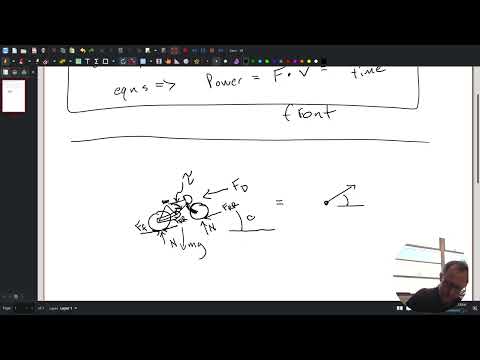
- The bicycle diagram includes road normal forces, aerodynamic drag, and rolling resistance at the tires.
- Cooper distinguishes rolling resistance from static friction at the tire-road contact, noting that static friction maintains rolling without doing work in the model.
- Pedaling supplies torque, while the road’s forward friction force helps propel the bicycle; the diagram can also include gravity when the bike travels uphill.
- The input term is torque multiplied by cadence expressed as angular speed in radians per second, giving power in newton-metres per second.
- The output terms include drag force times velocity, rolling-resistance force times velocity, and the uphill contribution mg sin(alpha) times velocity.
- Before developing the project, students should identify the forces, where acceleration occurs, and motion constraints such as a bicycle rolling along a surface.
- Cooper suggests turning the model into a website that compares parameters such as rolling resistance, drag coefficient, and area; students should bring an initial idea within the next day or two.
Transcript excerpt
0:02 Hey, welcome back. Today is too nice. So, because the weather's so nice, let's get the project started. Stop by outside of chemistry engineering building, or sorry, the chemistry building. I'll be at the tables out there. I'll follow up with like exactly where I am. Um but we want to get started on module five. And we can do that with just a note card, same way that we've started couple of different things. So, let's say so I'll walk you through a specific example, cuz a lot of times rather than talking about like general things, it helps to talk about something specific and then look at what are the general things happening from there. So, getting started with project with
0:50 the final project module five, goal is apply some kind of dynamics process. So, main thing that we've done every single time is draw free body diagram. So, probably we'll need a free body diagram. Then maybe we'll need some kinematics and uh and describing those kinetics. Um but let's say I'm getting started. I'm just going to pretend like I have a little note card here. So, this is the the front of my note card. All right, so I'm going to create bike power. I want to make a bike power calculator. So, the things that are going to go into my bike power,
1:41 so my equations are going to be like power equals force times uh ooh, not time. Force times speed. Cuz force times distance going to give me a um how much work. So, the change in work over time is power. So, if I want to figure out how much power I'm using on my bike, then my main thing that I need to know is force times speed. So, if I know how fast I'm
This is the start of the transcript. Save this video free for the whole transcript, searchable and time-coded.
Related notes
Summary, takeaways, and chapters were generated by AI from the video's transcript and may contain errors. The video belongs to its creator, Professor Ryan C. Cooper.