ME2120 - Dynamics
 Watch on YouTube →
Overview
Ryan C. Cooper uses an elevator emergency-braking case to connect free-body diagrams, kinetic diagrams, constant-acceleration kinematics, and friction. The class distinguishes motion descriptions from their causes, examines why friction equal to the elevator’s weight only prevents further acceleration, and develops rough design estimates using an assumed 1,400 kg elevator.
Key takeaways
- Friction equal to an elevator’s weight gives zero net force and zero acceleration, so a falling elevator continues falling at its existing speed rather than stopping.
- A braking design needs a defined stopping time or distance because an instantaneous stop implies infinite acceleration and therefore infinite force.
- Kinematics describes elevator height, velocity, and acceleration; kinetics explains those quantities through forces such as gravity and brake friction.
- The work-energy relation can estimate the elevator’s speed after a free-fall distance, providing an initial condition for the braking calculation.
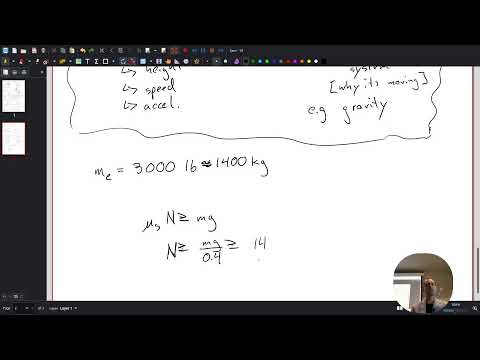
- For the class’s rough 1,400 kg elevator estimate, weight is about 14,000 N; a friction coefficient near 0.4 implies a normal force around 34,000 to 35,000 N for friction near the weight.
- Static friction can hold the elevator after it stops, but kinetic friction governs the sliding braking phase and is generally lower.
Chapters
- Cooper recommends chapter 1 and tutorials 2.1, 2.2, and 2.3 for reviewing forces and acceleration.
- Example 93 is suggested for understanding how rigid-body rotation changes mechanics equations.
- The class returns to an open-ended elevator-braking case from applied mechanics.
- The elevator model includes its downward weight, upward friction from brake pads, and opposing normal forces at the two ends.
- The design question is how much brake force can stop the elevator without pushing it sideways or damaging the beam.
- Cooper asks students to determine the net force direction and magnitude from the force vectors.
- Unlike a statics diagram, a dynamics problem usually has a nonzero net force because the body accelerates.
- Cooper introduces a kinetic diagram alongside the free-body diagram, connecting them through Newton’s second law, F = ma.
- If upward friction equals the elevator’s weight, net force and acceleration are zero, so an already-falling elevator continues at constant speed.
- A braking target needs a stopping criterion, such as a maximum distance traveled or a maximum stopping time.
- The calculation requires an initial velocity and a final velocity of zero, plus either a time interval or a displacement.
- The elevator must first move after a cable failure before a motion-triggered braking system can recognize the emergency.
- Cooper separates the motion calculation from the force calculation: first choose the desired stopping motion, then use F = ma to find its force.
- For constant acceleration, the relevant kinematic variables are initial and final velocity, elapsed time, and displacement.
- An instantaneous stop would imply infinite acceleration and infinite force, so a practical design must allow nonzero braking time or distance.
- The class connects the constant-acceleration relation to work and kinetic energy: net force acting through a distance changes kinetic energy.
- For a falling elevator, gravitational potential energy can estimate the speed reached after a specified drop distance.
- That estimated speed supplies the initial-velocity value needed to size the braking stop.
- Cooper explains that engineering case problems often omit values such as elevator mass, requiring research, estimates, and stated assumptions.
- Static friction can hold the elevator once it stops, while kinetic friction acts during sliding and is generally lower than static friction.
- A braking force must exceed the elevator’s weight during deceleration; matching the weight alone produces zero acceleration, not a stop.
- Kinematics describes how the elevator moves through position, velocity, and acceleration, such as its height and speed.
- Kinetics explains why it moves by identifying causes such as gravity and brake friction.
- Newton’s second law links the two, but keeping motion descriptions and force causes separate makes the solution easier to organize.
- With constant brake forces, F = ma gives constant acceleration, making constant-acceleration kinematics a reasonable starting model.
- Students can either select a stopping acceleration and calculate force or set a friction limit and calculate the resulting motion.
- Case-problem submissions should show where numerical inputs come from, with equations, estimates, and graphs used to support the result.
- The class adopts approximately 1,400 kg as a rough elevator-mass estimate, corresponding to a weight near 14,000 N.
- Using an approximate friction coefficient of 0.4 gives a normal-force estimate near 34,000 to 35,000 N to produce friction comparable to the elevator’s weight.
- The sign convention must match the chosen acceleration direction: if upward is positive, upward friction is positive and downward weight is negative.
- The kinetic diagram establishes the acceleration direction, while the free-body diagram identifies the forces that produce it.
Transcript excerpt
0:08 Hallelujah. Do we have microphones? >> Should be streaming. I can
1:36 Okay, >> welcome back. >> Hey, welcome back. >> We're here. How was the weekend? >> Nice to have Fridays back, right? Nice honor. So, honor section. We've been like meeting on Fridays kind of like break down play by play what's going on. How do we get that first down next time? But the rest of the class, Friday afternoon, it's free. Is this the last class of the day for some people? >> No. No. For some? Yes. Last. Last. One more. It's nice if it's like Friday by noon like go celebrate, go for a hike. Today the weather is beautiful,
2:25 too. Like I've been stuck inside all day, but I really just want to go ride my bike for hours one day. I'll get there. Okay. So, checking in for reading kind of work. Uh right now, if you've read chapter one from this Kasen and Paley book, that's a great place to be. Um some other things that would help for kind of working through this case problem is um looking at this tutorial like 2.1 2.2 2.3 talking about like forces and acceleration and then also like um this one like looking at rigid like what does a rigid body do to
3:13 your equations? What h what's different when you consider a rigid body and if it's if you don't really care about rotation then there's no difference it's the same equation. So these are some so chapter 1 tutorial 2.1 2.2 2.3 and then in this example 93 those are some good references for kind of working on this case problem right now. Sound good? giving us like some things to hold on to as we're working. [snorts] Last time in applied d applied mechanics
This is the start of the transcript. Save this video free for the whole transcript, searchable and time-coded.
Related notes
Summary, takeaways, and chapters were generated by AI from the video's transcript and may contain errors. The video belongs to its creator, Professor Ryan C. Cooper.