ME2120 - Dynamics
 Watch on YouTube →
Overview
Ryan C. Cooper connects ME2120 Dynamics to transferable engineering skills, including solving underspecified problems, simplifying real systems with free-body diagrams, and communicating technical work to recruiters. The class then begins a kinematics case study of a mirrored four-bar gripper, using pin and sliding constraints to establish one degree of freedom and starting a geometry-based analysis of how actuator motion controls the gripper.
Key takeaways
- A free-body diagram is a practical engineering communication tool: it reduces a complicated assembly, such as an elevator, to bodies, connections, and forces that teams can analyze.
- A degree of freedom is the number of independent quantities needed to specify a system's state; the gripper has one because its slot position determines the linked finger positions.
- A fixed pin keeps connected link points coincident while permitting rotation, whereas a sliding pin constrains motion across its slot but permits travel along it.
- Changing linkage dimensions alters the relationship between actuator travel and gripper motion, but preserving the same links and constraints preserves the degree-of-freedom count.
- For constrained mechanisms, determine degrees of freedom and geometry before using force equations; kinematics establishes how position, velocity, and acceleration relate.
- Assignments can be revised without resubmission penalties, and students can request reasonable extensions by communicating their needs.
Chapters
- Cooper frames the module transition as practice in tackling complex, uncertain problems rather than only learning equations.
- The elevator safety case required students to identify relevant physics, including springs, dampers, braking mechanisms, and a counterweight.
- Students can describe this work to career-fair recruiters as applying fundamental physics while making justified assumptions about real systems.
- Cooper says assignments can be resubmitted without penalty, and late work is accepted without penalty when students communicate their needs.
- An incomplete submission, such as scanned notes with a plan to revise in three days, can still receive feedback.
- Free-body diagrams are presented as a shared starting language for engineers, supporting later work in finite-element analysis, CFD, and control.
- The case study models a gripper built from two mirrored four-bar linkages that keep opposing plates parallel as they move.
- A slotted actuator moves the mechanism and compresses a spring; the analysis asks both how the fingers move and what force is needed.
- A screw is one possible actuator because it provides mechanical advantage and can hold a set position.
- A fixed pin makes connected links share a point while still allowing them to rotate relative to one another.
- A sliding pin constrains motion in one direction while allowing the pin to travel along its slot in another direction.
- The lower gripper linkage mirrors the upper one, so the two sides move together unless a component fails.
- Cooper identifies the gripper as a one-degree-of-freedom system: specifying the slot position determines the other linked positions.
- The general definition is the number of quantities needed to specify the system's state, such as the gripper separation.
- The train analogy illustrates the idea: one distance along a fixed track identifies position even when the route curves.
- Adding independent motion, such as moving the entire gripper up and down or rotating it out of plane, adds degrees of freedom.
- Removing the slotted coupling would let the two fingers move independently and require two motors for coordinated actuation.
- Changing link lengths changes the motion geometry, but does not by itself change the degree-of-freedom count if the links and pins remain connected in the same way.
- The design question is how far the slot must travel to move the gripper from open to closed, and whether that relationship is linear.
- Cooper lays out the general sequence: identify degrees of freedom, determine constrained motion and geometry, then analyze forces.
- Position, velocity, and acceleration follow from the motion constraints; a free-body diagram alone cannot establish the linkage's geometric relationship.
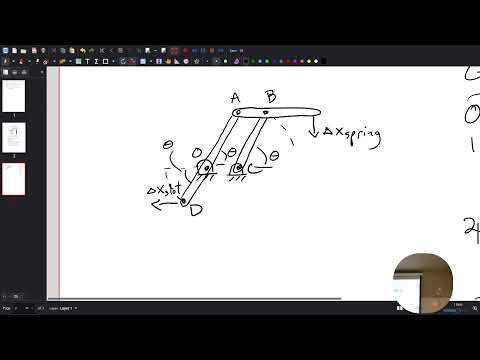
- Cooper simplifies the diagram by removing the mirrored side and the slot, then labels linkage points O, A, B, C, and D.
- When the actuator-side points move left, point D also moves upward because the connected links constrain its path.
- Tracking a representative linkage point is sufficient to infer gripper-finger displacement when the connection geometry is known.
- The linkage is labeled with lengths L and spacing D; the parallelogram keeps opposite links at the same angle.
- These geometric relationships provide the starting point for calculating how slot displacement maps to gripper motion.
- Cooper leaves the derivation unfinished for students to consider before the next class.
- Cooper closes by encouraging students to attend the STEM career fair and meet potential employers.
- The remaining audio consists of an indistinct post-class conversation about a course situation and a professor; it adds no clear dynamics content.
Transcript excerpt
0:23 for Okay, welcome back. Today is STEM career fair. So, is everyone going or has planning to some somewhere in the day is STEM career fair? All right. Excellent. So one of my questions for we're transitioning from module one kind of introducing what are we getting ourselves into with applied mechanics 2. Module two we're jumping into like
1:14 moving constrained systems. So moving parts all connected together. What are the forces involved? What kind of motion are we like? How do we define motion? That kind of stuff. So this is a good pausing point to say what are we getting out of this class? What kind of skills are actually transferable other than just like now I can have an academic position where I teach other people about dynamics because there's more to it than that, right? We're practicing something. Any ideas right off the bat like what you've had to deal with for the past couple of weeks, >> unique problems, creative solutions.
2:09 Those are those are nice like uh I'm a creative problem or unique and creative problem solver like a LinkedIn sort of post it would work but spec so let's dive down into like what made it unique and creative like what was what was different here so we're like unique and creative problem solvers What was like unique or creative? What did you have to deal with? Nobody knows what goes on in this
2:57 classroom. I don't know if you knew that. Like everything you do here, it's like it leaves with you and whoever you're sitting next to. Like you could leave the classroom and be like that was freaking crazy, but that's it. Like that no one knows what you went through to get out of this class. So it's up to you
This is the start of the transcript. Save this video free for the whole transcript, searchable and time-coded.
Related notes
Summary, takeaways, and chapters were generated by AI from the video's transcript and may contain errors. The video belongs to its creator, Professor Ryan C. Cooper.