ME2120 - Dynamics
 Watch on YouTube →
Overview
In ME2120, Professor Ryan C. Cooper develops a spring-mass-damper model for stopping an elevator counterweight after a cable failure, explaining why the time-varying acceleration requires an equation of motion rather than constant-acceleration kinematics. He connects the equation to its time-dependent solution, reviews exponential trial solutions and characteristic roots, and uses initial conditions and qualitative response plots to discuss choosing spring stiffness and damping.
Key takeaways
- A spring-mass-damper landing system needs a differential equation because spring force varies with displacement and damper force varies with velocity, so acceleration is not constant.
- Without damping, a mass attached to a spring oscillates indefinitely at natural angular frequency √(k/m); the damper is what dissipates energy and lets the motion settle.
- Solving for x(t) provides position, velocity, and acceleration at any time, and also gives spring force kx and damper force b ẋ.
- For the full linear model, the characteristic equation m s² + b s + k = 0 determines whether the transient oscillates as it decays.
- A worst-case five-story fall, estimated at about 12 to 15 feet per story, can be converted to an initial speed with v₀ = √(2gh) for the landing-system analysis.
- Either an oscillatory or non-oscillatory response may be acceptable for the proposed platform, provided damping brings the counterweight to rest.
Chapters
- Professor Ryan C. Cooper explains a revised lecture-stream setup that shows a copy of his screen.
- For Case Study 1, students can submit scanned class notes as a PDF through HuskyCT.
- The submission text box should briefly state the analysis conclusions, assumptions, and any remaining questions, rather than leaving reviewers to interpret up to 10 pages of notes.
- Constant-acceleration kinematics do not describe the full landing event because spring force changes with compression.
- Gravity is approximately constant near Earth's surface, while spring force follows displacement and damper force follows velocity.
- The spring-mass-damper equation of motion captures these changing forces and the resulting acceleration.
- For a mass and spring without damping, the motion is sinusoidal and continues rather than settling.
- The undamped equation, m ẍ + kx = 0, has a natural angular frequency ωₙ = √(k/m).
- The persistent bouncing explains why a damper is needed in a landing platform or suspension system.
- Knowing x(t) gives position at any time and allows velocity and acceleration to be found by differentiation.
- Position also determines spring force through kx, while velocity determines damper force through b ẋ.
- The solution makes it possible to evaluate motion at a specified time and estimate quantities such as maximum displacement.
- Cooper introduces the trial form x = A e^(st) for linear differential equations involving x and its time derivatives.
- Substituting the trial form into m ẍ + kx = 0 produces the characteristic equation m s² + k = 0.
- Imaginary characteristic roots yield sinusoidal motion, with the oscillation frequency set by √(k/m).
- Adding a damper introduces the velocity term b ẋ into the motion equation.
- For the damper-only case, the characteristic equation has a zero root and a decaying exponential root, giving a constant component plus a transient.
- The exponential transient illustrates how damping reduces motion over time instead of allowing perpetual oscillation.
- The full model combines inertia, spring stiffness k, damping coefficient b, and a constant gravitational force mg.
- The characteristic equation for the homogeneous response is m s² + b s + k = 0, so its roots determine whether the transient oscillates as it decays.
- The response can be separated into a transient solution and a particular solution for constant forcing; damping dissipates energy while stiffness sets the oscillation scale.
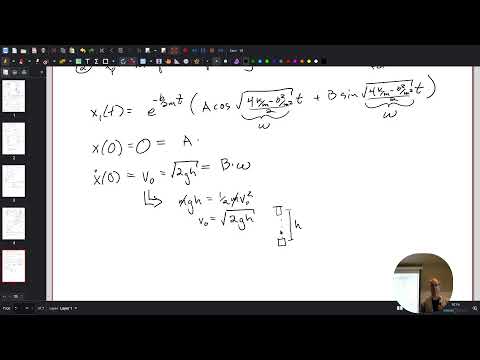
- The example starts with an uncompressed spring, so the initial displacement is x(0) = 0.
- The initial velocity comes from the counterweight's fall; Cooper discusses a worst case of five stories at roughly 12 to 15 feet per story.
- A free-fall estimate, v₀ = √(2gh), supplies an initial speed for solving the initial-value problem.
- For the preliminary design goal of selecting b and k, Cooper sets aside the constant-force particular solution and focuses on the transient response.
- Cooper considers plotting x(t) for different b and k values, mentioning Desmos, Excel, Google Sheets, and Python as possible tools.
- The qualitative response may bounce while decaying or return without visible oscillation; either can work if the system eventually stops.
- The lecture closes by asking students to submit their paper notes and supporting analysis through HuskyCT.
Transcript excerpt
0:10 And then all All right. >> So many cords for like a wireless for a wireless laptop. There's a lot of wires that I have to deal with. >> Hello back.
1:01 >> All right, welcome back. >> We're trying I'm trying a different setup like getting rid of the YouTube streams. We'll just look directly at a copy of one of my screens and I have the YouTube stream on a different screen. See how it goes. So far, tried it out this morning. seemed pretty good and someone even sat at the Benton coffee shop watching one of the lecture streams. She's like, "Yeah, it was great. It's good. Everything's better with a cup of coffee, right?" Okay, so we're wrapping up our first case problem today. Um, and so some people came up on Wednesday asking about like, "Hey, are these notes
1:51 okay? Like, can I turn this in?" Um, that that's fine. just taking what we've done in class and sort of packaging that like make a scan and PDF copy of it. Only extra part that I would say is in husky CT when we are I guess it would help to look at it right courses. This is us student preview. case study one coming in view instructions and
2:40 so in here in the submission text box this is where I would add like a description of what these notes are actually saying or even like what are the main what are the main points of the of the analysis of like this question asked for breaking force breaking force was this assuming this this and this and it asked for stopping like how to stop the counterwe here's some here's what'll happen to the counterwe and here's the spring and the damper that I chose uh so
This is the start of the transcript. Save this video free for the whole transcript, searchable and time-coded.
Related notes
Summary, takeaways, and chapters were generated by AI from the video's transcript and may contain errors. The video belongs to its creator, Professor Ryan C. Cooper.