ME2120 - 001
 Watch on YouTube →
Overview
Ryan C. Cooper analyzes a ball-bearing speed bump using impulse-momentum diagrams, resolving motion into components parallel and perpendicular to each surface. For a 2 m/s ball, two 45° ramps ideally reduce the horizontal exit speed to about 1 m/s, while rounding the bump and requiring a nonnegative normal force gives a minimum top radius of about 0.20 m at 1.41 m/s.
Key takeaways
- With zero restitution, a frictionless impact against a fixed surface removes the velocity component normal to that surface while leaving the parallel component unchanged.
- For a 2 m/s ball striking a 45° face, the retained along-slope speed is 2 cos 45° = √2 m/s, approximately 1.41 m/s.
- Two ideal 45° surface changes each reduce the relevant speed component by 1/√2, so the combined reduction is one half: 2 m/s becomes about 1 m/s.
- A ball following a convex crest remains in contact only if the normal force is nonnegative, which requires r ≥ v²/g at the top.
- At 1.41 m/s, the minimum crest radius from the contact condition is approximately 0.20 m; a smaller radius could make the ball leave the surface.
- Impulse-momentum analysis treats the collision interval as very short, making the bump’s normal impulse dominant over gravity’s impulse during impact.
Chapters
- The design objective is to slow a ball bearing from 2 m/s so it travels half the distance and exits at about 1 m/s.
- Early design discussion considers how a bump’s shape and impact behavior affect the ball.
- The class distinguishes motion perpendicular to a wall, which can change during impact, from motion parallel to it.
- A ball launched horizontally from a given height takes the same time to hit the ground regardless of its forward speed.
- Changing horizontal velocity affects how far the ball travels, not the time it takes to fall through a fixed vertical distance.
- The discussion frames the design as a way to change the ball’s speed before it reaches the bucket.
- Cooper models the first face as a constant 45° slope, or π/4, so its horizontal and vertical components are equal.
- The ball’s velocity is resolved into components parallel and perpendicular to the speed bump.
- The rigid bump can apply an impulsive normal force, while its parallel component of impulse is zero.
- The bump is treated as having effectively infinite mass, so it does not move appreciably when struck.
- The coefficient of restitution describes how much of the perpendicular impact velocity is retained as a bounce.
- With zero restitution, the ball has no outgoing velocity perpendicular to the surface and instead travels along the slope.
- A nonzero restitution could send the ball away from the surface, but Cooper expects a speed-bump design to produce little or no bounce.
- During the short impact interval, the bump’s large normal impulse dominates gravity and other ordinary forces.
- Gravity contributes negligible impulse over an idealized zero-duration collision because its force is multiplied by a very small time interval.
- The parallel velocity component remains unchanged because the surface supplies no parallel impulse.
- The impact equations connect the change in perpendicular momentum to the normal impulse.
- A 2 m/s incoming velocity at 45° has a component along the slope of 2 cos 45°, or √2 m/s, about 1.41 m/s.
- With zero restitution, the ball leaves the first impact moving along the 45° face at approximately 1.41 m/s.
- The result is an intermediate reduction from 2 m/s, but the ball still needs a second surface change to exit horizontally.
- Cooper models the bump as a 45° ascent followed by a 45° descent, initially treating the ball as staying in contact with both faces.
- At the second face, the same impulse-momentum method redirects the ball from motion along the slope to horizontal motion.
- The horizontal exit speed is about 1.41 cos 45°, approximately 1 m/s.
- The triangular profile is a calculation model; it can later be rounded to avoid an impractically sharp peak.
- Each ideal 45° change multiplies the relevant speed component by 1/√2.
- Two such changes multiply speed by (1/√2)² = 1/2, matching the 2 m/s to 1 m/s target.
- Cooper notes that other angles can produce different reductions; for example, two 30° changes were discussed as a possible quarter-speed design.
- Impulse-momentum diagrams can also analyze familiar collisions such as pool balls striking one another.
- A sharp crest requires the ball to follow a tight curve and may cause it to leave the intended path.
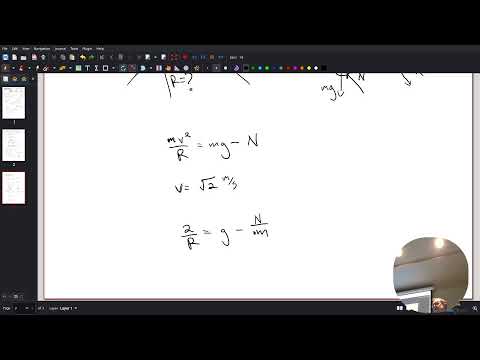
- At the top of a rounded bump, the forces are gravity downward and the surface’s normal force upward.
- The required centripetal acceleration is v²/r; if the speed is too high for the available normal force, the ball loses contact.
- A larger radius reduces the centripetal-force demand and makes the profile less ramp-like.
- At the crest, the normal force per unit mass is g − v²/r; maintaining contact requires this value to be at least zero.
- Using the approximately 1.41 m/s speed at the top gives r ≥ v²/g ≈ 2/9.81 ≈ 0.20 m.
- The 0.20 m value is a minimum top radius under the stated speed assumption; a larger radius also keeps the ball in contact.
- Cooper contrasts curved bumps with drop-style barriers such as cattle grates, whose suitability depends on the site’s design constraints.
Transcript excerpt
1:20 Okay, welcome back. So, goal for today is wrap up speed bump design of figuring out how to slow down these ball bearings as they're going across the table, get them to land in the bucket that's half the distance. We want them moving half the speed as they leave our table. What did we come up with for ideas for speed bumps? How are we doing so far? Let me check in, see what people are up to, and then we'll we'll go from there. Okay. Yeah, that's a good good thing
3:27 to think about. It should Yeah. So, depending on like how steep it is, like if it was a 90° wall, if you hit it, then it would care like if it's e = 0, then it'll hit the wall and stick. Anything less than that, it'll hit the wall and bounce off. Yeah. And so, like if you're depending on the speed of the ball, the size of the ball, the size of the speed of the All right. Yeah. So, and the main thing is kind of breaking down parallel to the wall. There's no force being applied. So, in that direction, whatever speed you have it forward, you'll still have
4:15 that. That coefficient of restitution is saying how much you're going to bounce because of the speed of the ball. It's a jump. Yeah. Is it going to apply? Uh honestly, I think Oh, okay. All right. Is he on Friday? I I have to catch up for the classes cuz I didn't have the time that day. Yeah. Okay. I'm trying to join a group, but Okay. So, I couldn't join it. And it just says it's not full. And I can't join. What happened? I don't know.
5:09 Well, if you show the members, Is it
This is the start of the transcript. Save this video free for the whole transcript, searchable and time-coded.
In this course
Related notes
Summary, takeaways, and chapters were generated by AI from the video's transcript and may contain errors. The video belongs to its creator, Professor Ryan C. Cooper.