Lecture 8 26
 Watch on YouTube →
Overview
An undergraduate robotics lecture builds from vectors and unit-vector decomposition to coordinate transformations used in kinematics. It derives the 3D rotation matrix about Z by projecting a rotated frame onto a fixed frame, then applies these ideas to a 2-DOF prismatic-revolute robot and the 3-revolute-joint Dobot Magician.
Key takeaways
- A vector such as 3i + 4j has magnitude 5, and dividing it by 5 produces the direction-only unit vector (3/5)i + (4/5)j.
- Direction cosines let a robot's moving link direction be expressed in a fixed frame, converting d n̂ into the planar position (d cos θ, d sin θ).
- The Z-axis rotation matrix follows from projecting the new axes onto the old axes: [[cos θ, −sin θ, 0], [sin θ, cos θ, 0], [0, 0, 1]].
- Right-hand coordinate conventions determine rotation signs, while sequential frame transformations connect the inertial base to coordinate frames attached to robot links.
- The Dobot Magician's three revolute joints and fixed link lengths provide the inputs for forward kinematics, which maps θ1, θ2, and θ3 to end-effector position px, py, and pz.
Chapters
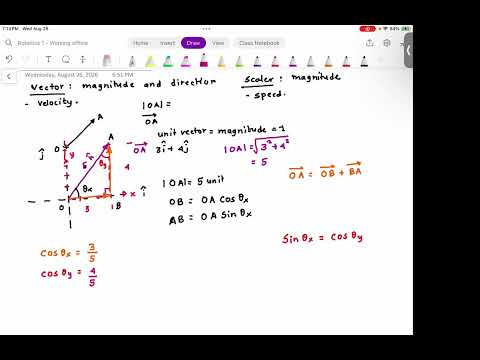
- A vector requires both magnitude and direction, illustrated by choosing a direction as well as a distance to reach the student union from ISTB 12.
- A scalar has magnitude without direction; velocity is given as a vector example and speed as a scalar example.
- Acceleration is treated as a vector under current convention, though the lecture notes older texts sometimes described rate of change of speed as scalar acceleration.
- The vector from O to A has components of 3 units along x and 4 units along y, written as 3i + 4j.
- The unit vectors i and j each have magnitude 1 and encode the positive x and y directions.
- Pythagoras gives the magnitude of OA as √(3² + 4²) = 5.
- For the 3-4-5 triangle, the x projection is 5 cos θx = 3 and the y projection is 5 sin θx = 4.
- The complementary angle θy satisfies θx + θy = 90°, so sin θx = cos θy.
- The vector OA is the sum of its component vectors, OB + BA, with the intermediate point B canceling in the combined displacement.
- A unit vector is obtained by dividing a vector by its magnitude, so n̂ = OA / |OA|.
- For OA = 3i + 4j with magnitude 5, n̂ = (3/5)i + (4/5)j.
- The coefficients 3/5 and 4/5 are direction cosines, expressing the angles between the vector and the fixed x and y axes.
- A planar robot combines a prismatic joint, which extends by distance d, with a revolute joint that changes angle θ.
- Its end-effector position is px = d cos θ and py = d sin θ, giving forward kinematics from joint values θ and d.
- The position vector can be written in the fixed basis as OE = px i + py j, or along the robot's moving direction as d n̂.
- The inertial frame uses fixed unit vectors i and j, while n̂ is attached to the robot and moves as its orientation changes.
- Converting d n̂ into fixed-frame components uses n̂ = cos θ i + sin θ j.
- This conversion illustrates coordinate transformation: expressing a vector tied to a moving robot link in a fixed reference frame.
- The lecture introduces an original frame x0, y0 and a rotated frame x1, y1 separated by angle θ.
- In three dimensions, each frame includes x, y, and z axes, with the rotation about Z leaving the z axes aligned.
- The goal is to express the new frame's axes in the old frame so later robot-link positions can be transformed consistently.
- Robotics uses right-handed coordinate frames, with the thumb, index finger, and middle finger indicating x, y, and z.
- The right-hand rule assigns angular sign: curl fingers along the rotation and read the thumb direction as the positive axis.
- Frame relationships are built sequentially, from frame 0 to frame 1, then frame 1 to frame 2 as additional robot links are added.
- Projection of x1 and y1 onto x0 gives x0 = x1 cos θ − y1 sin θ; the y1 projection is negative because it points along negative x0.
- Projection onto y0 gives y0 = x1 sin θ + y1 cos θ, with both components positive for the illustrated rotation.
- Because the rotation is about Z, z0 and z1 align, so their relationship is z0 = z1.
- The projection equations become a matrix relation between old-frame and new-frame components.
- The rotation matrix about Z is [[cos θ, −sin θ, 0], [sin θ, cos θ, 0], [0, 0, 1]].
- The lecture emphasizes careful sign assignment and identifies this frame-to-frame rotation as a recurring tool in forward and inverse kinematics.
- The rotation matrix can also be assembled directly by projecting each new axis, x1, y1, and z1, onto each old axis, x0, y0, and z0.
- This projection table reproduces the Z-rotation matrix, including cos θ, sin θ, −sin θ, and the unchanged z component.
- The same method can derive rotation matrices about X and Y; the lecture assigns those derivations as quiz practice.
- A kinematic diagram simplifies robot geometry into revolute joints labeled R and prismatic joints labeled P, with axes showing rotation or extension.
- The Dobot Magician is described as having three revolute joints arranged perpendicular, perpendicular-to-parallel in sequence: the first axis is perpendicular to the second and parallel to the third.
- Forward kinematics uses joint angles θ1, θ2, and θ3 plus fixed link lengths to calculate end-effector coordinates px, py, and pz in the inertial frame.
- At about 60:18, the lecture begins switching to digital-twin software and screen sharing, but the transcript ends before any simulation is demonstrated.
Transcript excerpt
0:04 Okay, welcome to robotics 1. Since this is an undergraduate class, I'm going to start with some very basic concepts and uh I trust all of you know this. But I want you to understand that the way easiest way to learn is it's something called as the chain link method which means whatever you know if you add keep on adding links to it that would help you strengthen your understanding. So I'm going to start from the very basic and then we will gradually build upon the the robotics. So step number one, can someone tell me
0:54 what is a vector? >> It's a magnitude given direction. its magnitude and direction. So which means if you are in ISTB 12 and if you need to go to the student union, I can't just tell you that walk five units. You'll never know like which direction to walk. I need to tell you go in the northeast direction, south direction, east direction. So vector I'm going to call this vector O A. Vector is defined by
1:43 the magnitude and vector is given by the direction. So you have O A. Now whenever you see the vector it has a start point and the end point. Vector starting from O going towards A. Everyone understood this? Next thing is scalar. Scalar only has magnitude, no direction. Example of vector is velocity. Example of scalar is speed.
2:36 Now let me ask you a funny question. Which quantity uh there's only one quantity that can be considered as a vector and a scalar depending upon the context. H okay. What is rate of change of velocity? acceleration. What is rate of change of speed? It's also acceleration. So if you refer some old textbooks, you will notice that at one time acceleration was considered to be a
This is the start of the transcript. Save this video free for the whole transcript, searchable and time-coded.
Related notes
Summary, takeaways, and chapters were generated by AI from the video's transcript and may contain errors. The video belongs to its creator, ssredkar.