Lecture 6 Emerging Memories Part 2
Overview
Shimeng Yu explains how selectors and wire-aware circuit design make crossbar memories practical, covering selector mechanisms such as tunnel-oxide barriers and ovonic threshold switches (OTS), and showing why sneak-path suppression and wire resistance determine array size and read margin. He then examines Intel and Micron’s 3D XPoint, a two-tier phase-change memory using GST cells and OTS selectors, whose density and latency fell between DRAM and NAND but whose Optane business ended amid competition and unclear market demand.
Key takeaways
- A crossbar selector must combine high nonlinearity with adequate drive current and endurance; a ratio near 10⁴ suppresses sneak paths much more effectively than the 10 to 100 ratio typical of some IMT selectors.
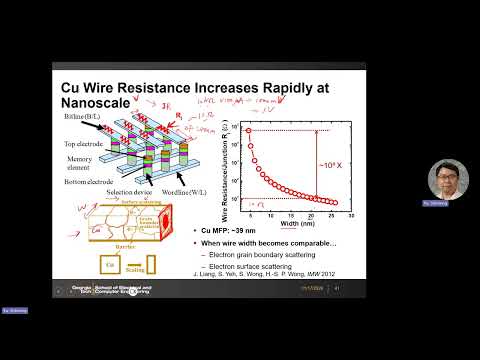
- Wire resistance becomes a system-level limit in large arrays: about 10 ohms per fine-pitch segment can accumulate to roughly 10 kΩ over 1,000 segments and cause a 1 V drop at 100 µA.
- Read margin depends on both cell behavior and array position, so SPICE analysis should compare the farthest, lowest-current on-cell against the highest-current off-cell.
- 3D XPoint paired GST phase-change memory with OTS selectors in a two-tier crossbar and delivered density and latency between DRAM and NAND.
- Optane’s technical performance did not guarantee commercial success: optimized SLC NAND offered a cheaper, higher-capacity alternative, while the storage-class-memory market was still uncertain.
Chapters
- Crossbar arrays need nonlinear current-voltage behavior in each selector to block unintended sneak paths.
- Preferred selector responses include abrupt threshold switching or exponential current growth; a bidirectional response supports either voltage polarity.
- A unidirectional PN diode can suit unipolar memories, which set and reset using one voltage polarity.
- A layered tantalum-oxide and titanium-oxide barrier changes its effective tunneling width with bias, producing exponential current growth in both directions.
- The tunnel-oxide selector can reach a nonlinearity ratio near 10⁴ between full and half select voltage, reducing half-selected-cell current.
- Ovonic threshold switches use disordered chalcogenide materials with traps; electronic excitation turns on additional conduction paths and produces snapback with negative differential resistance.
- Insulator-metal transition materials such as niobium oxide and vanadium oxide switch under electrical heating, then return to the insulating phase when the stimulus is removed.
- IMT selectors typically offer only about 10 to 100 times nonlinearity, which limits crossbar size compared with selectors approaching 10⁴.
- A weak conductive filament can serve as a volatile selector: voltage forms the bridge, and removing voltage lets it dissolve, unlike a nonvolatile RRAM memory state.
- Selector comparisons include nonlinearity ratio, maximum current density in megaamperes per square centimeter, and endurance.
- Below roughly 20 nm wire dimensions, copper resistivity rises due to grain-boundary and surface scattering as the surface-to-volume ratio increases.
- A wire segment near 20 nm may contribute about 10 ohms; across 1,000 segments, roughly 10 kΩ can create a 1 V drop at 100 µA.
- Read-margin analysis compares the lowest selected-cell on-current, often at the far end of the array, with the highest off-current.
- SPICE simulations show that a selector nonlinearity ratio of 1,000 preserves much more access voltage in a 1,000-by-1,000 array than linear cells do.
- Intel and Micron introduced 3D XPoint as a two-deck crosspoint array, with a shared bit line between tiers and one selector plus one memory element per cell.
- Reverse engineering by TechInsights identified phase-change GST, germanium-antimony-telluride, as the memory material and an arsenic-doped chalcogenide OTS as the selector.
- The 16 GB die used approximately 20 nm feature dimensions and achieved around 0.6 to 0.7 Gb/mm² density.
- At launch, 3D XPoint density was about six times contemporary DRAM, around 0.1 to 0.14 Gb/mm², but roughly five to six times below early 3D NAND at 3 to 6 Gb/mm².
- Read and write latencies in the hundreds of nanoseconds were slower than DRAM’s roughly 50 ns row cycle but far faster than NAND’s microsecond reads and millisecond-class writes.
- Intel sold Optane SSDs over PCIe, while Micron marketed the related technology as X100; both targeted storage-class memory between DRAM and flash.
- Intel demonstrated a four-tier version in 2020 by repeating lithography layer by layer, rather than using 3D NAND’s multi-layer channel-hole approach.
- Micron stopped 3D XPoint production in 2020, and Intel cancelled the Optane program in 2022 after difficulty establishing a large market.
- Samsung’s Z-NAND optimized single-level-cell NAND for roughly 1 to 2 microsecond reads, offering lower-cost capacity that narrowed Optane’s advantage.
- Mature NAND benefited from decades of development, manufacturing scale, and cost advantages that made it difficult for a newer memory technology to compete.
- Shimeng Yu notes that demand for memory expansion and interfaces such as CXL could make the market look different, but the applications and AI-driven demand were unclear when Optane was discontinued.
Transcript excerpt
0:02 Today we will continue the discussion on the emerging memory, and we will start from the selector device that we discussed in the last turn. So for the cross array, we do need the selector device to provide the nonlinearity in the IV characteristics. So this is to cut off the sneak paths. And we discussed that for the selector, there are many different types of selector available. And uh we talk about the threshold IV and exponential
0:49 IV. So basically when you look at the current versus voltage, right? Current versus voltage, if you can get something like a abrupt change, this is something we prefer. Or at least we need some like a log scale IV, like a bidirectional diode. And if it's only unidirectional like PN junction, PN diode, then you can have log IV in one direction.
1:37 So this could be useful for the unipolar switching, whether you where you only need one polarity of the voltage to set and reset the memory device. So we will discuss some of the implementation details of different IV characteristics in the following slides. There are different fundamental physical mechanisms that we can use to produce either the threshold threshold IV or the exponential IV. So let's look at the first
2:27 tunnel oxide based selector. So this one if we engineer the oxide barrier being between two electrode then for example here we have three layer like tantalum oxide, tantalum oxide and titanium oxide. So when we have the small voltage then the electrons will see a large tunneling distance. But when we have the large bias, high voltage, we push down the band then the electrons will only see a thin very thin barrier. So the tunneling probability as you know exponentially depend on the tunneling distance.
3:14 The thicker distance versus the
This is the start of the transcript. Save this video free for the whole transcript, searchable and time-coded.
In this course
Related notes
Summary, takeaways, and chapters were generated by AI from the video's transcript and may contain errors. The video belongs to its creator, Shimeng Yu.