Lecture 14: Fractional quantum Hall and square lattice spin liquids
 Watch on YouTube →
Overview
Subir Sachdev connects fractional quantum Hall states to parton mean-field theories, showing how integer-filled parton Landau levels produce the Laughlin 1/3 state, its exchange angle of π/3, and the Jain sequence. He then develops the square-lattice spin-liquid description from bosonic spinons and valence-bond order to fermionic π-flux spinons coupled to an emergent SU(2) gauge field, whose 2+1-dimensional theory resembles a reduced version of QCD and helps organize Néel and valence-bond-solid phases.
Key takeaways
- For three fermionic partons with integer Landau-level fillings n₁, n₂, and n₃, the filling obeys 1/ν = 1/n₁ + 1/n₂ + 1/n₃; n₁ = n₂ = n₃ = 1 gives the Laughlin ν = 1/3 state.
- Projecting three filled-parton Vandermonde wavefunctions onto coincident electron coordinates produces the Laughlin factor ∏ᵢ<ⱼ(zᵢ − zⱼ)³, while the induced Chern-Simons theory gives quasiparticle exchange angle π/3.
- The choice n₁ = n₂ = 1 and n₃ = n generates the Jain sequence ν = n/(2n + 1), including the experimentally prominent 2/5 and 3/7 fractions.
- In a square-lattice valence-bond solid, separating spin defects creates a string of disrupted singlet bonds whose energy grows with separation, providing an intuitive picture of spinon confinement.
- The fermionic π-flux state has massless Dirac spinons, and its particle-hole redundancy enlarges the apparent U(1) gauge symmetry to local SU(2).
- The proposed square-lattice continuum theory has two Dirac flavors coupled to SU(2) in 2+1 dimensions, and its symmetry-constrained confined phases connect the fermionic description to Néel and valence-bond-solid order.
Chapters
0:00
Course Setup and the Correct Chern-Simons Anyon Phase
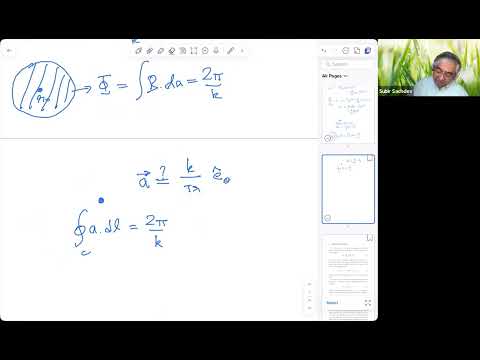
- Sachdev opens with presentation scheduling for December 1, 2, and 3, then corrects a 2π error from the prior discussion.
- For a Chern-Simons term with level k, a particle sources gauge flux 2π/k.
- The resulting exchange angle is π/k, so k = 2 gives semionic statistics with phase ±i.
10:12
Fractional Quantum Hall Filling and the Three-Parton Electron
- The filling fraction ν is the electron count divided by the number of magnetic flux quanta through the sample.
- Sachdev represents a spin-polarized electron as c = f₁f₂f₃, a product of three fermionic partons.
- The physical electron states correspond to all three partons being empty or all three being occupied.
14:14
Two Internal Gauge Fields Enforce the Parton Constraints
- Equal parton densities impose the constraints that identify physical electron states.
- Two independent local phase redundancies follow from the three-parton representation, requiring two internal gauge fields, B₁ and B₂.
- The external electromagnetic vector potential couples to the partons alongside these emergent fields.
17:38
Integer Parton Landau Levels Generate Allowed Hall Fractions
- The three partons experience effective magnetic fields B₁, B₂, and B₃ whose sum equals the physical field B.
- A useful mean-field state occurs when each parton fills an integer number nᵢ of Landau levels, producing a parton excitation gap.
- The density and field constraints give 1/ν = 1/n₁ + 1/n₂ + 1/n₃; integer choices yield odd-denominator fractions.
21:16
Deriving the Laughlin 1/3 Wavefunction and Statistics
- Taking n₁ = n₂ = n₃ = 1 gives ν = 1/3, with one effective flux quantum per parton.
- Each filled parton Landau level contributes a Vandermonde factor; imposing coincident parton coordinates yields the electron factor ∏ᵢ<ⱼ(zᵢ − zⱼ)³.
- Integrating out the gapped partons generates Chern-Simons terms and an exchange angle of π/3 for Laughlin quasiparticles.
27:51
Jain Fractions, Projected Wavefunctions, and Stability
- Choosing n₁ = n₂ = 1 and n₃ = n gives ν = n/(2n + 1), including 1/3, 2/5, and 3/7.
- Allowing negative integer parton fillings also produces the reverse Jain sequence, including n/(2n − 1).
- Jain wavefunctions combine filled-Landau-level factors and are often projected into the electron lowest Landau level.
- Sachdev notes that the Laughlin 1/3 state is stabilized by a pseudopotential Hamiltonian that excludes relative angular momentum one.
34:23
Bosonic Spinons and Néel Order on the Square Lattice
- The bosonic parton theory represents the square-lattice antiferromagnet using spinons coupled to a U(1) gauge field.
- A nonzero spinon condensate produces a nonzero Néel order parameter, the staggered magnetization.
- When the bosonic spinons remain gapped, gauge fluctuations and monopole effects instead lead toward confinement and valence-bond order.
38:17
Why Confinement Produces Valence-Bond-Solid Order
- In a valence-bond solid, spins form spatially ordered singlet bonds, so separating spin defects disrupts the bond pattern.
- The disrupted region acts like a string with energy proportional to its length, confining the two spinons.
- Sachdev compares this linear confinement to the energy cost of separating quarks in quantum chromodynamics.
41:50
Fermionic Spinons in the Square-Lattice π-Flux State
- The fermionic parton construction includes a π flux through each square plaquette when the time-reversal-breaking second-neighbor hopping is set to zero.
- The π-flux mean-field band has massless Dirac points at half filling.
- A U(1) gauge theory of these Dirac spinons is complicated by strong gauge fluctuations and monopole effects.
45:38
Particle-Hole Redundancy Reveals an Emergent SU(2) Gauge Symmetry
- At one fermion per site, the parton representation can be viewed using either particles relative to the empty state or holes relative to the filled state.
- Sachdev packages spin-up and spin-down fermions and their particle-hole partners into a matrix with a reality constraint.
- The redundant representation exposes a local SU(2) gauge freedom that is larger than the initially apparent U(1) phase symmetry.
54:38
Separating Global Spin Rotations from Local Gauge Rotations
- Physical spin rotations act on the spinor index, while the emergent SU(2) gauge rotations act on the particle-hole or number index.
- The two transformations commute because they act on different sides of the parton matrix.
- Spin rotation is a global symmetry shared across lattice sites; the gauge transformation can vary independently from site to site.
59:22
The π-Flux Saddle Point and Lattice SU(2) Gauge Fields
- A saddle point with pure-imaginary hopping and π flux preserves the full SU(2) gauge structure.
- The hopping links are promoted to SU(2) matrices whose site-dependent transformations cancel those of the partons.
- This lattice gauge construction provides a symmetry-consistent framework for studying fluctuations around the π-flux state.
1:07:00
Two Dirac Flavors and the Connection to QCD
- The continuum square-lattice theory contains Nf = 2 massless Dirac fermions coupled to an SU(2) gauge field in 2+1 dimensions.
- Sachdev compares this structure with QCD, which has three light quark flavors coupled to an SU(3) gauge field in 3+1 dimensions.
- The comparison motivates questions about whether the 2+1-dimensional SU(2) theory confines and what phases its confined states represent.
1:11:06
Confinement, Néel and Valence-Bond Phases, and Superconductivity
- Anomaly and symmetry arguments associated with work by Wang, Senthil, and collaborators constrain the confined phases of the SU(2) theory.
- The resulting phase structure matches the Néel and valence-bond-solid states also obtained from the bosonic spinon approach.
- Sachdev presents the agreement between bosonic and fermionic descriptions as a useful unification and previews applying the SU(2) gauge structure to high-temperature superconductivity.
Summary, takeaways, and chapters were generated by AI from the video's transcript and may contain errors. The video belongs to its creator, Subir Sachdev.