Lecture 16: Electron Hubbard model
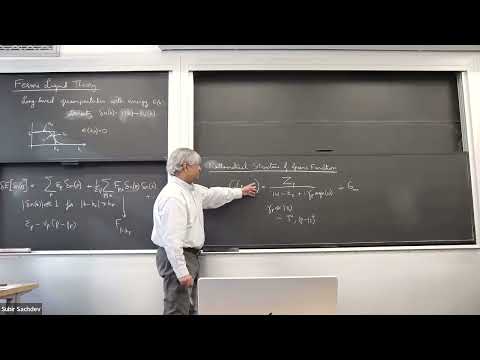 Watch on YouTube →
Overview
Subir Sachdev closes the Fermi liquid discussion by explaining Landau’s quasiparticle energy functional, the Green-function pole on the second sheet, and how the quasiparticle residue Z appears as a jump in the zero-temperature electron momentum distribution. He then introduces the electron Hubbard model and derives its strong-coupling limit: at one electron per site, virtual hopping generates antiferromagnetic superexchange with J = 4t²/U, connecting the Hubbard model to spin systems and cuprate physics.
Key takeaways
- Landau Fermi liquid theory can remain valid even when the quasiparticle residue Z is very small, provided the quasiparticle pole stays close to the real-frequency axis and its decay rate remains small.
- At zero temperature, the jump in the bare-electron momentum distribution n(k) at the Fermi surface equals Z; at finite temperature, thermal broadening removes the discontinuity.
- The Hubbard interaction at half filling produces antiferromagnetism through virtual hopping, not the direct parallel-spin preference associated with Hund’s rule.
- For the two-site Hubbard model with t much smaller than U, second-order hopping lowers the singlet relative to the triplet by 4t²/U, giving J = 4t²/U.
- At one electron per site and large U, the square-lattice Hubbard model reduces to an antiferromagnetic spin model, providing a microscopic link to the insulating parent compounds of cuprate superconductors.
Chapters
- Sachdev sets up the transition from Landau Fermi liquid theory to the electron Hubbard model and superconductivity.
- The longer-term course goal is to use these models to understand high-temperature superconductors and cuprates.
- Landau theory describes low-energy metal excitations as long-lived quasiparticles near the Fermi surface.
- The distribution change δn(k) counts particles above the Fermi surface and holes below it in one framework.
- The quasiparticle dispersion vanishes at the Fermi momentum, while the interaction function f(k,p) contributes at quadratic order in δn.
- For an isotropic Fermi surface, the Landau interaction can be expanded in angular momentum components.
- Thermal particle and hole contributions cancel the constant interaction term in the specific heat calculation.
- The Fermi liquid specific heat keeps its usual form with the electron mass replaced by an effective mass, while compressibility receives Landau interaction corrections.
- The single-particle Green function is expressed through a spectral density that is nonnegative.
- Analyticity in the upper and lower complex-frequency half-planes relates retarded, advanced, and Matsubara Green functions.
- Sachdev uses the spectral representation to describe how quasiparticle structure appears near the Fermi surface.
- The quasiparticle decay rate is small near the Fermi surface and scales quadratically with energy or temperature.
- The apparent pole is not on the physical Green-function sheet; it appears after analytic continuation through the real-axis branch cut.
- A pole close to the real-frequency axis is the defining low-energy feature behind Fermi liquid behavior.
- The pole residue Z measures the overlap between a bare electron and its dressed quasiparticle.
- A small positive Z, as in heavy-fermion metals, does not by itself invalidate Fermi liquid theory if the quasiparticle remains long-lived.
- At zero temperature, the bare-electron momentum distribution n(k) has a jump of size Z at the Fermi surface.
- Finite temperature rounds the jump in n(k), so the discontinuity is strictly a zero-temperature diagnostic.
- In one dimension, Z vanishes and the momentum distribution instead has a nonanalytic feature at the Fermi momentum.
- Sachdev identifies the Fermi surface and long-lived excitations as central to the low-energy description of ordinary metals.
- Sachdev introduces a mean-field treatment of the electron Hubbard model that points toward d-wave superconductivity.
- He notes that this treatment captures the overdoped regime but does not fully explain the cuprates.
- Upcoming topics include the Kondo effect and heavy-fermion phases, followed by connections back to cuprate experiments.
- The square-lattice Hubbard model combines electron hopping t with on-site repulsion U n↑n↓.
- The long-range Coulomb interaction is simplified to an on-site repulsion, a model introduced in the 1960s that remains difficult to solve.
- The fermion sign problem obstructs generic-density Monte Carlo, while tensor-network methods face challenges representing Fermi surfaces and their entanglement.
- At zero hopping, sufficiently negative chemical potential gives an empty lattice, while sufficiently positive chemical potential gives two electrons per site.
- Between those limits, the system has one electron per site and is insulating when U is large.
- Unlike a spinless boson insulator, the half-filled electron state has 2^N spin configurations at strictly infinite U.
- At one electron per site, the low-energy subspace contains an up or down spin on each site, so its effective Hamiltonian must be written using spin operators.
- The Hubbard interaction is spin-rotation invariant even though n↑n↓ does not make that symmetry obvious.
- Spin rotation and time-reversal symmetry constrain the leading effective interaction to pairwise exchange, with higher-order terms including four-spin ring exchange.
- For two neighboring singly occupied sites, parallel spins cannot hop onto the same site because of the Pauli exclusion principle.
- Antiparallel spins can virtually form a doubly occupied site, then return, lowering their energy through second-order perturbation theory.
- This mechanism makes the exchange antiferromagnetic, contrasting with the parallel-spin preference in the usual Hund-rule picture.
- To calculate exchange at order t²/U, Sachdev reduces the lattice problem to two neighboring sites because a two-hop process must return to the low-energy manifold.
- The fixed two-electron sector contains four singly occupied spin states and two doubly occupied configurations with energy U.
- Fermionic state ordering matters: exchanging creation operators changes signs in the hopping matrix elements.
- The two-site Hamiltonian has six states in the two-electron sector, but spin and reflection symmetries separate several exact eigenstates.
- The three triplet states remain at energy zero, while an odd-parity singlet has energy U and decouples from the hopping sector.
- These symmetry reductions leave a 2×2 matrix coupling the remaining singlet to a doubly occupied state.
- Diagonalizing the remaining 2×2 block gives energies U/2 ± √(U²/4 + 4t²).
- For t much smaller than U, the lower singlet shifts by approximately −4t²/U, while the triplet stays at zero energy.
- Matching the singlet-triplet splitting to J S₁·S₂ yields the antiferromagnetic superexchange J = 4t²/U.
- At large U and one electron per site, the Hubbard model becomes a spin model with nearest-neighbor exchange J = 4t²/U.
- On the square lattice, the resulting spin system has long-range antiferromagnetic order, matching the parent insulating state of cuprates such as lanthanum cuprate.
- Sachdev closes by pointing toward doping, superconductivity, and the next discussion of the Kondo model.
Transcript excerpt
1:40 Okay. So, uh let's get started. Um so, we I want to finish up the discussion of your liquid theory u and then go on to discussion of the hubard model and superc conductivity. um at least as a mean field theory and uh eventually we want to understand uh something about high temperature superconductors and that discussion by the end of the course. Okay. So for now I want to finish discussion of fmy liquid theory which is the uh canonical theory of all metals. Uh and the bottom line is that metals behave uh almost like free electrons even though they have strong coolum
2:28 interactions. Um and the main effect of the coolum interactions in the end is to first modify the dispersion of these electrons and second you also have to include uh this landown interaction. So the way you think about the low energy theory of a metal in liquid theory is that there are first of all the scattering of the excitations it's very weak near the fmy level but this is something you can already see from the energy constraint and per golden rule uh and because the scattering is very weak uh you can in fill liquid theory you assume they're essentially infinitely long there so anything coming from the scattering of particles
3:15 is a correction to form a liquid period. So you have some infinitely long lived of positive particles each have some momentum K and above the firmy level they have uh a negative charge and below the firm level they have positive charge. So there's some dispersion EFK and EFK vanishes at the FY momentum. Uh and so you imagine you're perturbing the system somehow and there's a finite density somewhat dynamically significant density of exitations. So that's what we call delta n of k uh
This is the start of the transcript. Save this video free for the whole transcript, searchable and time-coded.
Related notes
Summary, takeaways, and chapters were generated by AI from the video's transcript and may contain errors. The video belongs to its creator, Subir Sachdev.