Lecture 17: t-J model and d-wave superconductivity
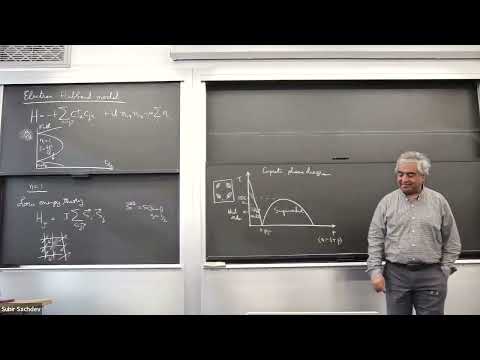 Watch on YouTube →
Overview
Subir Sachdev connects the strong-coupling Hubbard model to the doped t-J model, explaining how the no-double-occupancy constraint, antiferromagnetic exchange, and hole motion set up a theory of cuprate superconductivity. He develops a slave-particle mean-field picture in which holon condensation yields a renormalized electron hopping and the superexchange term favors spin-singlet pairing, providing a route toward d-wave order while leaving the origin of cuprates' high transition temperatures unresolved.
Key takeaways
- At strong coupling, the Hubbard model at one particle per site reduces to an antiferromagnetic spin model with superexchange J = 4t²/U.
- The doped t-J model combines projected hopping at order t with spin exchange at order t²/U, while forbidding double occupancy on every site.
- In the slave-particle representation, cα = fαh† and the constraint Σα f†αfα + h†h = 1; holon condensation at density p renormalizes hopping to roughly tp.
- Antiferromagnetic superexchange lowers the energy of nearest-neighbor spin singlets, providing a pairing interaction; on-site repulsion favors pairing that avoids on-site amplitude.
- Holon condensation lets paired partons carry electric charge, distinguishing the superconducting mean-field state from a neutral spin liquid.
- The mean-field t-J construction offers a route to d-wave superconductivity but does not explain why cuprate transition temperatures can approach 100 K.
Chapters
- At one particle per site and U much greater than t, the Hubbard model becomes a Mott insulator with spin-1/2 moments and exchange J = 4t²/U.
- On the square lattice, the nearest-neighbor antiferromagnetic Heisenberg model is associated with Néel order; triangular-lattice behavior can change when higher-order ring exchange becomes important.
- Changing the density closes the Mott charge gap, and small hole doping can preserve Néel order in a metallic spin-density-wave state.
- For hole concentrations around 0.05 in cuprates, the ordered background produces small Fermi pockets rather than the large Fermi surface of an ordinary metal.
- In materials such as YBCO and bismuth-based cuprates, superconductivity reaches roughly 100 K, a striking contrast with the neighboring antiferromagnetic insulator.
- Sachdev identifies the high transition temperature as an open problem: proximity to the Mott insulator is widely considered important, but its quantitative effect remains unexplained.
- At higher doping, magnetic order disappears and the Fermi surface becomes a large hole-like contour consistent with the Luttinger count.
- Near optimal doping, around p = 0.18, superconductivity remains robust; by roughly p = 0.3, the phase diagram approaches a more conventional metallic regime.
- In conventional metals, lattice vibrations provide an attractive interaction between electrons near the Fermi surface, as described by BCS theory.
- In helium-3, nearly ferromagnetic spin fluctuations favor parallel-spin, spin-triplet pairing; antiferromagnetic fluctuations instead favor spin-singlet pairing in heavy-fermion systems.
- For U much greater than t, the low-energy Hilbert space excludes doubly occupied sites but allows empty sites, leaving three allowed states per site.
- The resulting t-J model retains superexchange at order t²/U and adds projected electron hopping at order t, making it a natural model for doped cuprates.
- The t-J constraint requires the electron number on each site to be at most one, so ordinary hopping must be projected to prevent transitions into doubly occupied states.
- The exchange term acts only when neighboring sites carry spins; hopping can move an electron into a neighboring hole without leaving the allowed low-energy space.
- Sachdev represents the spin-up and spin-down states with fermionic spinons f and the empty-site state with a bosonic holon h.
- The local condition becomes Σα f†iαfiα + h†ihi = 1, and the electron operator is represented as cα = fαh†.
- In the parton formulation, spin operators are built from spinons, while electron hopping combines holon motion with spinon operators.
- The representation replaces awkward projection operators with a local constraint that can be treated using gauge-theory methods, including the CP1 and fermionic spin-liquid formulations.
- For hole density p, the mean-field approximation assumes the bosonic holon condenses, with its condensate amplitude set by √p.
- Because cα = fαh†, holon condensation makes the spinon behave like an electron in the simplified low-energy description and gives the electron quasiparticle weight a factor proportional to p.
- Replacing the holon operators by their condensate values reduces the hopping amplitude from t to approximately tp.
- The reduction captures the scarcity of holes: most attempted electron hops are blocked by the no-double-occupancy constraint, increasing the effective quasiparticle mass.
- A Pauli-matrix identity rewrites the spin-exchange interaction in terms of singlet-pair operators plus density terms.
- The singlet channel gains energy from antiferromagnetic exchange, giving a nearest-neighbor pairing tendency with an attractive scale set by J.
- The exchange interaction favors opposite-spin electrons in a spin singlet, whose spin wavefunction is antisymmetric under particle exchange.
- Fermion antisymmetry then requires an even-parity orbital wavefunction; strong on-site repulsion suppresses on-site pairing and makes non-onsite, including d-wave, pairing relevant.
- The mean-field decoupling introduces a complex pairing amplitude Δij on each bond and replaces the interacting pair term with a quadratic pairing Hamiltonian.
- Assuming translation symmetry reduces the unknowns; candidate self-consistent solutions must be compared by their ground-state energies to identify the lowest-energy saddle point.
- After holon condensation, the paired fermions carry physical electric charge, so a nonzero pairing amplitude Δ supports superconductivity rather than a neutral spin-liquid state.
- Sachdev says this mean-field framework captures useful features away from the Mott-insulating regime but is too simple to explain the high-Tc region; the detailed d-wave selection is left for the next lecture.
Transcript excerpt
0:16 Okay. So, uh let's continue with our discussion on the Hard model. And of course, we won't read any firm conclusions because that's still a topic of great research especially on the square lice where it is believed to be the the basic model describing high temperature super activity. Um and then uh but so we're going to take a little detour after talking about some very basic facts uh and talk about the condo model which is a model very well understood uh which was the focus of great attention over the last 30 40 years and uh then we'll come back eventually towards the end of the pro
1:04 okay so u we talked about the limit when u is much bigger than t. Uh oh. Yeah. Okay. Then if you put a equals z then as a function of the chemical potential you can either have no particles at all or you can have lots of as many particles that you can take two particles per site. Uh so these are exact states and they're completely trivial. The interesting regime is when you have one particle per site uh that then you have what's sometimes called a mod insulator. Uh but unlike the mod insulator of bzons there now there's a spin degeneracy and last time we showed how the spin degeneracy was lifted uh by an exchange coupling
1:55 antif exchange coupling sometimes called super exchange which is given by this value. Okay. So, so now we have to uh do two more things. Uh one is we have an effective Hamiltonian where in the model insulator at n= 1 the low energy theory. um is call it x subj someone neighbors the spins si sj and these are spinner I have so s i squ it's s + one of s=
This is the start of the transcript. Save this video free for the whole transcript, searchable and time-coded.
Related notes
Summary, takeaways, and chapters were generated by AI from the video's transcript and may contain errors. The video belongs to its creator, Subir Sachdev.