Lecture 15: Fermi Liquid Theory
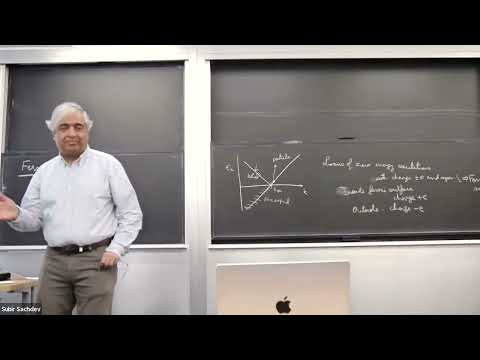 Watch on YouTube →
Overview
Subir Sachdev introduces Landau Fermi liquid theory as a framework for ordinary metals, explaining how a Fermi surface and long-lived particle and hole excitations survive interactions. He connects Luttinger’s theorem, the energy-dependent quasiparticle lifetime, effective-mass renormalization, and Landau interaction parameters to observable responses, including the specific heat and photoemission spectrum.
Key takeaways
- In Landau Fermi liquid theory, interactions preserve a Fermi surface of zero-energy excitations and long-lived particle and hole quasiparticles, even though they renormalize their dispersion.
- Luttinger’s theorem fixes the Fermi volume from total electron density rather than interaction strength, connecting low-energy excitations to the full particle count.
- Pauli blocking and restricted phase space produce a quasiparticle decay rate proportional to energy squared at zero temperature in dimensions two and higher.
- The effective mass m* captures interaction-driven changes to the quasiparticle velocity, while Landau parameters describe additional shifts caused by changes in the distribution of nearby excitations.
- Thermal particle-hole symmetry cancels the Landau interaction contribution to the low-temperature specific heat, but not to compressibility.
- Photoemission measures the electron Green’s function, whose quasiparticle pole has weight Z and a narrow width near the Fermi surface, alongside an incoherent background.
Chapters
- Sachdev shifts the course from insulating spin and boson systems to metals with gapless charge excitations and to superconductors.
- He plans to connect spin-liquid ideas to cuprate superconductivity, a long-standing link he says is becoming clearer.
- Course presentations are scheduled for December 1, 2, and 3, with students asked to submit tentative titles.
- Drude modeled metals as mobile particles that collide with impurities, but his classical model predicted the wrong electronic specific heat.
- In 1931, Sommerfeld applied Fermi statistics to electrons, explaining why the low-temperature specific heat of a metal vanishes rather than remaining constant.
- Landau later formalized why electron interactions can often be treated as corrections to this basic picture.
- Sachdev writes the free-electron Hamiltonian using creation operators C†(k,α) and the dispersion ε(k), with the chemical potential absorbed into the energy.
- At zero temperature, states with energy below the chemical potential are occupied and states above it are empty.
- The Fermi surface is the momentum-space locus where the excitation energy vanishes; it is codimension one, such as a line in two dimensions or a surface in three.
- Adding an electron just outside the Fermi surface creates a particle excitation with charge −e; removing one just inside creates a hole with charge +e.
- Both types carry spin one-half and can have arbitrarily small excitation energy near the Fermi surface.
- Landau Fermi liquid theory’s central claim is that these particle-like and hole-like excitations persist when interactions are present.
- Luttinger’s theorem states that the volume enclosed by the Fermi surface is fixed by the total electron density, independent of interaction strength.
- For free electrons, counting occupied momentum states gives the connection directly, including a factor of two for spin.
- The theorem links a low-energy feature, zero-energy excitations at the Fermi surface, to the total particle count, including electrons far below it.
- Sachdev relates Fermi-volume constraints to translation symmetry and global particle-number conservation, comparing their role to Lieb-Schultz-Mattis-type constraints.
- A superfluid can evade the number-conservation constraint by breaking U(1) symmetry, while a Mott insulator has no Fermi surface.
- He describes a possible two-dimensional Bose metal in which bosons fractionalize into emergent fermions that form a Fermi surface.
- An excited electron can scatter by creating a particle-hole pair, but the final states must satisfy energy conservation and Pauli exclusion.
- As the excitation approaches the Fermi surface, fewer final states are available, so its scattering rate decreases.
- A quasiparticle is well defined when its lifetime is much greater than ℏ divided by its excitation energy; a width comparable to the energy signals non-Fermi-liquid behavior.
- For a Hubbard interaction, Sachdev applies Fermi’s golden rule to scattering with matrix element proportional to U and includes occupation factors f(E) and 1−f(E) for allowed initial and final states.
- Dropping momentum constraints gives an upper estimate of the scattering rate while retaining energy conservation and the density of states near the Fermi level.
- The resulting rate scales as excitation energy squared at zero temperature and as T² at the Fermi level, leaving quasiparticles sharp near the surface.
- In two and higher dimensions, the quasiparticle decay rate robustly scales as energy squared, with possible logarithmic corrections in some cases.
- In one dimension, momentum conservation strongly restricts scattering and a naive golden-rule rate can scale linearly with energy.
- A linear rate is not parametrically smaller than the excitation energy, so the long-lived quasiparticle condition underlying Fermi liquid theory fails.
- Near a point P₀ on the Fermi surface, the quasiparticle energy varies approximately as vF times the momentum displacement normal to the surface.
- The Fermi velocity is related to an interaction-dependent effective mass m*, which can vary with position or direction on an anisotropic Fermi surface.
- The same dispersion crosses zero at the surface, so particle and hole excitations share the same local effective mass.
- Long quasiparticle lifetimes suppress scattering but do not remove average interaction effects: each excitation still feels the mean field of the others.
- Sachdev represents changes in the distribution using δn(p) = n(p) − n₀(p), which is negative for holes inside the Fermi surface and positive for particles outside.
- Landau interaction parameters F(p,k) encode how changes in occupation near different points on the Fermi surface shift the energy.
- The energy change includes a term linear in δn(p), set by the renormalized quasiparticle dispersion.
- Landau adds a quadratic interaction term involving F(p,k)δn(p)δn(k), which remains relevant even at low temperature.
- Because thermal excitations occupy a momentum shell of width proportional to T around the Fermi surface, both terms contribute at order T² to the energy.
- Landau parameters and m* modify the compressibility, which measures how density responds to a change in chemical potential.
- At low temperature, the specific heat is linear in T and follows the Sommerfeld form determined by the density of states at the Fermi level, including m*.
- Thermal particle and hole contributions are symmetric: δn(E) is odd across the Fermi level, so its normal-momentum integral vanishes in the Landau interaction correction to specific heat.
- A quasiparticle is a dressed excitation: an added electron together with a surrounding cloud of particle-hole pairs, not simply a bare electron.
- Photoemission ejects a bare electron, so its measured intensity depends on the overlap between the electron and the quasiparticle.
- The quasiparticle contribution to the electron Green’s function carries a spectral weight Z, while additional processes contribute incoherent spectral weight.
- Sachdev sketches the Dyson form of the electron Green’s function, with the self-energy encoding interaction effects.
- In a Fermi liquid, the Green’s function contains a quasiparticle pole plus an incoherent background; the pole’s width represents the inverse lifetime.
- The width vanishes quadratically with distance in energy from the Fermi surface, matching the golden-rule result and keeping the pole sharp.
Transcript excerpt
0:23 Okay, so we're going to enter new phase in the course now. Uh uh before I get to that, so I hope you've seen the pages uh uh the sign-up sheet for your presentation. That'll be the main thing your grade is based on. Uh and I'll reach out and uh Okay, just put a tentative title there and then we can discuss it further, okay? Uh and that'll be on December 1st, 2nd, and 3rd, I think. Yeah. Uh try to figure out the room. All right. Uh So, we've been talking about essentially uh all along insulators uh
1:10 with spin systems or bosons uh and uh you you know, found phases of broken symmetry and then you've also found all these exotic phases with fractionalization. I mean, I would include fractional quantum Hall insulator materials states as something like insulators because they have a the gap to charge excitations. Uh but now we want to get to a whole new regime uh which is the vast majority of quantum materials uh which are metals uh which have gapless charge excitations uh and also superconductors. And there you know, many new phenomena that will appear there. Uh but of course, uh we'll be use what we've learned from
1:57 uh at various points I plan to get by the end of the course to to the cuprate superconductors and some very recent work. Where we are using ideas from spin liquids to understand aspects of the super cuprate superconductors. The connection between spin liquids and high temperature superconductivity is a very old one. But It has never really been clearly established. But I think now it's the the connection is becoming much clearer. So that's kind of what I want to get to. All right, so let's start at the very beginning then
This is the start of the transcript. Save this video free for the whole transcript, searchable and time-coded.
Related notes
Summary, takeaways, and chapters were generated by AI from the video's transcript and may contain errors. The video belongs to its creator, Subir Sachdev.