Lecture 18: Conservation laws - Part 2
Overview
The lecture builds a general conservation-law framework from accounting for accumulation, boundary fluxes, and sources, then converts the integral balance into a local differential equation using the divergence theorem and the arbitrary-control-volume argument. It applies the framework to mass, energy, and momentum, deriving the continuity equation, a simplified heat equation, and the Navier-Stokes momentum equations while explaining flux signs, constitutive laws, incompressibility, and pressure as an implicit constraint.
Key takeaways
- Conservation applies to additive totals such as mass, momentum, and total energy; local quantities such as density and temperature appear in the equations because they represent those totals per unit volume or through constitutive assumptions.
- The general local balance is ∂φ/∂t + div J − s = 0, derived by converting the boundary-flux integral with the divergence theorem and requiring the balance to hold for every control volume.
- For a single-component fluid with no mass diffusion or mass source, J = ρu gives continuity, ∂ρ/∂t + div(ρu) = 0; constant density then implies div u = 0.
- Fourier heat conduction contributes a diffusive flux −k∇T, and constant conductivity turns its divergence into k∇²T, recovering familiar heat-transfer equations under appropriate assumptions.
- Momentum transport requires the full velocity vector to advect each momentum component, while viscous diffusion involves gradients across all spatial directions; confusing the transported component with its direction of transport leads to incorrect expansions.
- In incompressible Navier-Stokes flow, pressure is not given a separate time-evolution equation; the divergence-free constraint is used to determine pressure alongside the coupled velocity equations.
Chapters
- Mass, momentum, and total energy can be counted across parts of a system, so their totals add.
- Temperature, pressure, density, and velocity are not conserved totals; kinetic and internal energy can change form.
- Temperature equations still follow from energy conservation when assumptions connect energy to temperature.
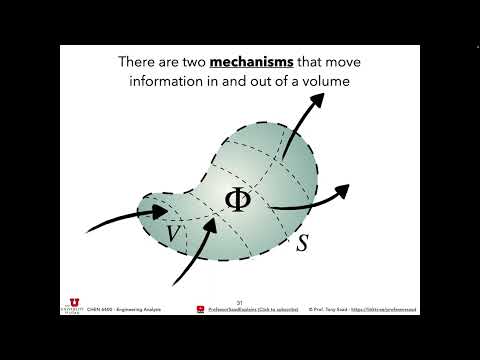
- For an open region, the rate of change of a conserved quantity equals inflow minus outflow plus sources minus sinks.
- Fluid velocity transports quantities through the boundary by advection; without fluid motion, the advective contribution vanishes.
- The balance applies to mass, momentum, or energy, provided each is counted consistently.
- The total quantity is the volume integral of its local amount per unit volume.
- Mass per unit volume is density, momentum per unit volume is ρu, and total energy per unit volume is ρe₀.
- The conserved totals are mass, momentum, and energy, even though their local densities are the fields used in equations.
- Advection represents transport by the bulk fluid velocity, illustrated by a fan carrying incense through a room.
- Diffusion represents molecular-scale transfer associated with gradients, as when ink spreads through still water.
- Stirring can make advection dominate; the lecture also notes that bulk motion can stretch material and increase the area available for diffusion.
- Flux is the rate at which a quantity crosses a unit area, so its units are quantity per area per time.
- The general advective flux is velocity multiplied by the transported quantity per unit volume.
- A diffusive flux generally has the form −K∇f(φ), where the constitutive relation specifies the transported field and coefficient.
- Mass advection uses ρu and has units of kilograms per square meter per second.
- Momentum advection transports ρu using the full velocity vector, giving momentum per area per time.
- Newtonian momentum diffusion includes −μ∇u, while heat diffusion uses Fourier’s law, −k∇T; their units must match the corresponding advective flux.
- Both advective and diffusive fluxes are vectors with x, y, and z components.
- The total flux J combines advective transport, such as uφ, with the relevant diffusive constitutive term.
- For x-momentum, the transported component can still move in all three spatial directions.
- Integrating J·n over a control surface sums the normal component of flux across the entire boundary.
- Tangential flux does not cross the boundary; the outward unit normal isolates the entering or leaving component.
- The balance uses −∮J·n dS: outward flow has positive J·n and reduces what remains inside, while inward flow contributes positively.
- A source term represents production or removal that is not captured by boundary advection or diffusion.
- Sources are commonly expressed per unit volume per unit time, allowing their volume integral to match the flux and accumulation rates.
- Examples include reactions, gravity in momentum balances, radiation, or viscous dissipation in an energy balance.
- The integral form is useful for whole-system accounting, such as total tank flow or force from water leaving a hose.
- Local fields are needed to model spatial patterns, such as how a wildfire and its smoke evolve within a forest.
- The differential form provides pointwise rates and gradients rather than only total boundary and source accounting.
- Assume the conserved field is smooth and use a fixed control volume to move the time derivative inside the volume integral.
- Apply the divergence theorem to convert the surface flux integral into a volume integral of div J.
- Because the resulting integral is zero for any chosen volume, its integrand must vanish, yielding ∂φ/∂t + div J − s = 0.
- For a single-component fluid, mass has no diffusive flux in this model and no source term, so J = ρu.
- The local mass balance becomes ∂ρ/∂t + div(ρu) = 0, the continuity equation.
- For constant-density flow, this reduces to div u = 0, the incompressibility condition.
- For a single-phase, calorically perfect, incompressible material with negligible viscous heating and cp approximately equal to cv, energy density can be written ρcpT.
- The energy balance combines advection, heat diffusion, and a source term; Fourier conduction contributes k∇²T when conductivity is constant.
- The one-dimensional steady heat-transfer equation is a special case, while retaining time dependence gives the familiar diffusion form ∂T/∂t = α∂²T/∂x² under suitable assumptions.
- The x-momentum density is ρu; the fluid velocity vector advects it in x, y, and z, while Newtonian diffusion includes −μ∇u.
- The x-momentum balance also includes the pressure-gradient force −∂p/∂x and gravitational source ρgₓ.
- The gradient of u has x, y, and z derivatives even though u represents only the x component of momentum.
- With constant density and viscosity, the three momentum balances simplify to velocity equations; together with div u = 0, they form the incompressible Navier-Stokes system.
- The three momentum equations determine u, v, and w, while the divergence constraint supplies the condition used to compute pressure rather than a separate pressure evolution equation.
- The equations are generally difficult to solve analytically, motivating numerical methods for partial differential equations.
Transcript excerpt
0:02 Let's begin. We're still talking about the great conservation laws and more specifically just a general idea of how we approach uh developing equations for conservation laws. We didn't say specifically mass, momentum and energy, but we talked generally about the idea of a conserved quantity. And we went through a few quantities by way of example. uh discussing what are the requirements for a quantity to be conserved and why we like that and the primary concept is that a conserved quantity is countable. You can count it, you can add it, it's additive that allows us to track it. Correct? So mass for example is a conserved quantity. And
0:50 the example I gave, if you have a bucket or a basket or your volume, you put an object of mass one, then the total mass is mass one. If you put mass one and mass two, then the total mass is m1 plus m_sub_2. But you can do that with temperature. If you put if you take a a system and you put object one at temperature t1, the temperature is t1. If you put two objects at t1, this total temperature is not 2 t1. it's still T1, right? So T the temperature, pressure, they're not conserved quantities. And I gave a list here um of what what is generally conserved, what's generally not conserved. Mass is um so it mass is conserved and the quantity also has to be extensive. Um that's what makes it
1:40 scale with the system and be additive. Um density is not extensive by def. So by definition, it's not conserved. Momentum is extensive. You can add it. It's for the full system and then it's conserved. Velocity is not extensive. So if you put two balls moving each at U1 together then the total speed is not 2 *
This is the start of the transcript. Save this video free for the whole transcript, searchable and time-coded.
In this course
Related notes
Summary, takeaways, and chapters were generated by AI from the video's transcript and may contain errors. The video belongs to its creator, Professor Saad Explains.