lecture 18: conservation laws 1
Overview
The lecture connects vector calculus integral theorems to conservation laws, deriving the gradient theorem and divergence theorem and checking both on a rectangle where the results are 8i + 6j and 8. It then defines continuum-scale properties using molecular averages and the Knudsen number, before showing why conservation applies to additive extensive quantities such as mass, momentum, and total energy and leads to open-system balance equations.
Key takeaways
- The gradient theorem converts a volume integral of grad φ into a boundary integral of φ n dS; for φ = x² + y² on the stated rectangle, both evaluations give 8i + 6j.
- The divergence theorem equates integrated divergence inside a volume with outward flux across its boundary; for u = 2x i + 2y j, both sides equal 8.
- Continuum equations assume properties are meaningful as molecular averages, and Kn = λ/L indicates whether the scale separation is adequate.
- Conservation is defined for the total amount of a quantity in an isolated system, not as constancy at every point within it.
- A conserved quantity must be additive and therefore extensive, but extensiveness alone does not guarantee conservation; kinetic energy is an example of an extensive quantity that can change form.
- Open-system balances extend conservation accounting to flows and internal sources: accumulation equals inflow minus outflow plus generation minus consumption.
Chapters
- The lecture shifts from gradients, divergence, and curl to integrals of vector fields.
- Professor Saad frames integral theorems as mathematical tools that will become useful when deriving practical conservation equations.
- Vector integrals need direction information, unlike scalar integrals; the unit normal supplies that direction.
- A unit normal has magnitude 1 and points perpendicular to a line or surface, supplying direction without changing magnitude.
- For a closed domain, the outward unit normal points away from the volume at every boundary point.
- Surface integrals use a surface element such as dS, paired with the normal vector to represent an oriented patch.
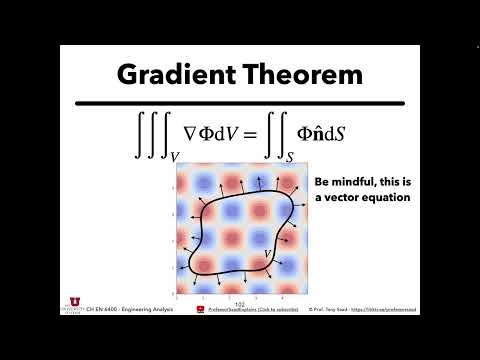
- The gradient theorem states that the volume integral of grad φ equals the boundary integral of φ n dS.
- The left side is a vector integral over the interior, while the right side depends only on scalar-field values at the boundary.
- Because both sides are vectors, the equality represents separate component equations in 2D or 3D.
- For φ = x² + y², the gradient is 2x i + 2y j.
- Over the rectangle x = 1 to 3 and y = 1 to 2, integrating the gradient through unit depth gives 8i + 6j.
- The rectangular region makes the volume calculation straightforward while illustrating the theorem's vector result.
- The rectangle's outward normals are i, j, -i, and -j on its four sides.
- On each side, φ is evaluated using the coordinate held constant there, and dS becomes the differential along that edge.
- Adding the four boundary integrals reproduces 8i + 6j, matching the volume integral.
- The divergence theorem equates the volume integral of div u with the boundary integral of u · n dS.
- Both sides are scalars: divergence is scalar-valued, and the dot product with the normal extracts outward flow.
- The theorem links net outflow through a closed surface to the divergence distributed inside the volume.
- For u = 2x i + 2y j, div u = 2 + 2 = 4 throughout the rectangle.
- The rectangle has area 2 and unit depth, so the volume integral is 4 × 2 = 8.
- The four side fluxes combine as 6 + 8 - 2 - 4 = 8, verifying the divergence theorem.
- Cylindrical coordinates use e_r, e_θ, and e_z; e_r and e_θ change direction with position, while e_z remains aligned with k.
- The Cartesian-to-cylindrical identities include i = cos θ e_r - sin θ e_θ and j = sin θ e_r + cos θ e_θ.
- Since the cylindrical basis varies with θ, derivatives must include d e_r/dθ = e_θ and d e_θ/dθ = -e_r.
- The angular component of the cylindrical nabla operator carries a 1/r factor because θ is dimensionless.
- Conservation laws provide the foundation for transport modeling in fields such as chemical and mechanical engineering.
- The core transported quantities are mass, momentum, and energy, connected respectively to mass conservation, Newton's second law, and the first law of thermodynamics.
- A fluid flow is represented by a velocity field u = (u, v, w), alongside properties such as density ρ, pressure p, temperature T, and viscosity.
- A continuum-scale value of density, velocity, or pressure represents an average over a small volume, not a measurement of one molecule.
- That averaging volume must be large enough to contain many molecules but small enough to support differential analysis.
- At very small sample volumes, molecular counts fluctuate; at larger volumes, averaging eventually stabilizes before the sample spans regions with different properties.
- The Knudsen number is Kn = λ/L, the molecular mean free path divided by a system's characteristic length.
- A 10 nm nanochannel with a 0.1 nm mean free path has Kn = 0.01, supporting the continuum assumption.
- In a vacuum-insulated cup, a 1 mm mean free path and 1 mm gap give Kn near 1, so continuum equations are not appropriate.
- When Kn is at least 1, the lecture advises using a different modeling framework.
- A quantity is conserved if its total amount does not change over time in an isolated system.
- An isolated system exchanges neither mass nor energy; a closed system excludes mass transfer but may still exchange energy.
- For discrete components, conservation is written as d/dt of the total quantity equals zero, such as total mass or total momentum.
- A candidate conserved quantity must be additive and countable; mass and momentum can be summed across components, but temperature and velocity cannot.
- Extensive properties scale with system size: 2 L of water has twice the mass and energy of 1 L at the same conditions.
- Density, temperature, and pressure are intensive properties and do not scale with the amount of material.
- Extensiveness is necessary but not sufficient for conservation: total energy is conserved, while kinetic energy alone can transform into potential energy.
- Opening the system boundary allows conserved quantities to enter and leave, so accounting tracks their inflow and outflow.
- The general balance is accumulation = entering - leaving + generation - consumption.
- Mass, momentum, and energy can be counted across a boundary; temperature cannot be balanced directly, so a temperature equation is derived from energy conservation.
- The lecture ends by setting up the integral formulation that will be continued in the next class.
Transcript excerpt
0:00 Let's begin. Last time we finished with the vector one part of vector calculus where we looked at vector vector vector operations and operations with the nabla operator or the del operator. We looked gradients of scalar, divergence of vector field, curl of a vector field, divergence of a gradient and so on. Next we want to tie those operations to the other part of vector calculus which has to do with integrals. Integrating vector fields. All right? And [snorts] the reason we do that I like I like to approach teaching by
0:49 showing you how to drive first and then we dig into the car. As much as I can, um I like the inductive approach where you just observe things and we try to make a theory or come up with a hypo understand deeper understanding of what happens. But in some cases we have to learn how how the engine operates before we drive the car and this is an example. We need to look at these integral theorems just to be exposed to the math, but then it's going to become really clear why we did that when we apply them to the practical case, okay? And this is a situation this these few lectures the vector calculus are um an example of that um where we have to do the deductive approach, introduce the theory and then apply it.
1:36 Uh the next step is the integral um integral vector calculus. But before we do that, we need to do to do have a small to define something that's going to be relevant for um integrals. When you're integrating a scalar quantity you know the direction. You're integrating over a volume, over an area. Um you know, there's there's no direction per se. Okay, there's no
This is the start of the transcript. Save this video free for the whole transcript, searchable and time-coded.
In this course
Related notes
Summary, takeaways, and chapters were generated by AI from the video's transcript and may contain errors. The video belongs to its creator, Professor Saad Explains.