Lec5 part1 Chp2 M2001 Summer26 Application of Quadratic, Vertical & Horizontal Asymptote,
Overview
Shahera Jannah reviews quadratic vertices, transformations, intercepts, and real-world optimization, then explains polynomial degree, leading coefficients, end behavior, turning points, and how root multiplicity shapes graph crossings. The class also revisits quiz topics including perpendicular lines, domains, inverse functions, and even or odd functions before introducing rational-function domains and vertical and horizontal asymptotes.
Key takeaways
- For a quadratic with a maximum or minimum, find the vertex using x = -b/(2a), then substitute that x-value into the function; h(t) = -16t² + 22t + 45 reaches about 52.56 feet.
- A polynomial's degree and leading coefficient determine end behavior: even-degree ends point the same way, while odd-degree ends point opposite ways.
- A degree-n polynomial has at most n - 1 turning points, but it may have fewer; use that bound to reject impossible graph choices.
- Root multiplicity predicts x-axis behavior: odd multiplicities cross, even multiplicities touch and turn, and larger multiplicities flatten the graph near the root.
- For a domain combining √(x + 5) with denominator x(x - 1), enforce both x ≥ -5 and x ≠ 0, 1, producing [-5, 0) ∪ (0, 1) ∪ (1, ∞).
- For rational functions, denominator zeros determine excluded domain values, and zeros remaining in the simplified denominator identify vertical asymptotes; horizontal asymptotes are approached y-values as x tends toward either infinity.
Chapters
- Quiz 1 grades are posted, and Quiz 2 is scheduled for the following week.
- The class discusses Exam 1 coverage and notes that Wednesday's material will be on a later exam.
- Chapter 1 Mark 2 is due by midnight, and Shahera Jannah recommends reviewing green examples for the exam.
- An upward-opening parabola has a minimum at its vertex; a downward-opening parabola has a maximum.
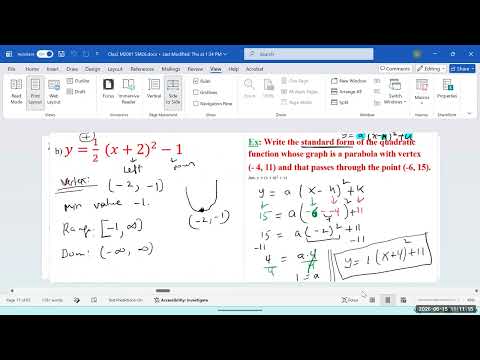
- Vertex form shows the vertex directly as (h, k), with the horizontal sign read oppositely from the expression inside the square.
- For general form ax² + bx + c, find the vertex's x-coordinate using -b/(2a), then substitute that value to find y.
- A negative multiplier reflects a parabola across the x-axis; a constant outside the square shifts it up or down.
- Horizontal shifts reverse the sign inside the squared expression, while a whole-number scale factor makes the parabola narrower and a fraction makes it wider.
- Find polynomial x-intercepts by setting y = 0 and factoring; for rational expressions, simplify first and use the remaining numerator.
- To construct a quadratic from a vertex and another point, substitute both into vertex form and solve for the leading coefficient.
- The projectile model is h(t) = -16t² + 22t + 45, where t is time in seconds and h is height in feet.
- Because the coefficient of t² is -16, the parabola opens downward, so its maximum height occurs at the vertex.
- Using -b/(2a) gives t = 11/16 seconds; substituting into h(t) gives about 52.56 feet, rounded to the nearest hundredth.
- For a question asking when the projectile reaches the ground, set h(t) = 0 instead of finding the vertex.
- The profit example asks for a maximum, so the relevant point is the vertex, found with -b/(2a).
- The class substitutes the vertex's x-coordinate into the profit function to calculate its y-value.
- The computed result is approximately -$136 to the nearest integer, prompting a check for an equation or arithmetic typo.
- A negative profit represents a loss, so an unexpected result should be verified before being accepted.
- A polynomial has variable exponents that are nonnegative whole numbers; negative and fractional exponents do not qualify.
- Expanded polynomials are commonly arranged from highest exponent to lowest, with the constant term last.
- The example 2x⁷ - x⁹⁹ + 5x⁶ has degree 99, even though its highest-power term is not written first.
- In expanded form, the degree is the greatest exponent, and the term containing it is the leading term.
- For 2x⁷ - x⁹⁹ + 5x⁶, the leading term is -x⁹⁹ and the leading coefficient is -1.
- In factored form, add the exponents contributed by all variable factors to find the degree.
- For a factored polynomial, multiply the factors' numerical coefficients, accounting for any powers on those factors, to find the leading coefficient.
- A turning point is where a graph changes from increasing to decreasing or from decreasing to increasing.
- A local maximum or minimum compares the point with nearby values, not necessarily with the entire graph.
- A polynomial of degree n can have at most n - 1 turning points; a quadratic can have at most one.
- For an even degree with a positive leading coefficient, both ends rise; with a negative leading coefficient, both ends fall.
- For an odd degree with a positive leading coefficient, the left end falls and the right end rises.
- For an odd degree with a negative leading coefficient, the left end rises and the right end falls.
- The class uses x² and x³ as reference shapes to infer the ends of higher-degree polynomials.
- The notation describes the y-direction as x approaches negative infinity on the left and positive infinity on the right.
- A degree-3 polynomial with positive leading coefficient has left-down, right-up behavior and at most 2 turning points.
- A degree-6 polynomial with negative leading coefficient has both ends down and at most 5 turning points.
- A degree-4 polynomial with positive leading coefficient has both ends up and can have at most 3 turning points.
- For -9x² + x⁴, the highest-degree term is positive x⁴, so both ends rise and the graph can have at most 3 turning points.
- Factoring out x² reveals that the graph touches rather than crosses the x-axis at x = 0.
- For a degree-4 graph with a negative leading coefficient, eliminate choices whose ends rise, then compare turning points and x-intercepts.
- A graph can have fewer turning points than its degree permits, so the n - 1 rule gives a maximum rather than a guaranteed count.
- In a factored polynomial, the exponent on a factor gives the multiplicity of its corresponding root.
- An odd multiplicity means the graph crosses the x-axis; multiplicity 1 crosses directly, while multiplicity 3 flattens near the crossing.
- An even multiplicity means the graph touches the x-axis and turns back instead of crossing.
- The example distinguishes roots from factors, including x + 1 = 0 giving the root x = -1.
- For x(x + 1)²(x + 2)³(x - 3)⁴, the roots are 0, -1, -2, and 3, with multiplicities 1, 2, 3, and 4.
- Adding those multiplicities gives degree 10; the positive leading coefficient means both ends rise.
- The sketch crosses directly at 0, touches and turns at -1 and 3, and flattens while crossing at -2.
- Comparing the sketch with the graph confirms that end behavior and multiplicity predict crossings, though not the exact heights of turning points.
- The quiz review warns that exam questions may rearrange information to make a familiar problem less obvious.
- For 9x + 3y = 5, rewrite in standard form to identify a slope of -3; a perpendicular line has slope 1/3.
- Using the point (-1, 2) in point-slope form and converting to slope-intercept form gives y = (1/3)x + 7/3.
- The class emphasizes recognizing the perpendicular slope as the negative reciprocal.
- For a domain involving √(x + 5) divided by x(x - 1), the radicand requires x ≥ -5.
- The denominator cannot be zero, so x = 0 and x = 1 must be excluded.
- Combining the restrictions gives [-5, 0) ∪ (0, 1) ∪ (1, ∞).
- Use brackets for an allowed endpoint such as -5, and parentheses for excluded values and infinity.
- For f(x) = (5x + 3)/(1 - 2x), first write y = f(x), then swap x and y.
- Clear the denominator in x = (5y + 3)/(1 - 2y) to obtain x - 2xy = 5y + 3.
- Collect y-terms and factor to get x - 3 = y(5 + 2x).
- The inverse is f⁻¹(x) = (x - 3)/(2x + 5), with the numerator's order preserved.
- To test evenness, compare f(-x) with f(x); equality means the function is even.
- If the function is not even, compare f(-x) with -f(x); equality means it is odd.
- The example -6x³ - x - 1 is neither: its constant term prevents it from being odd, and f(-x) differs from f(x).
- The example x⁴ - 8x² + 5 is even because substituting -x leaves every term unchanged.
- For a function combining even and odd powers, such as (x²)/(x³ + 1), test f(-x) and -f(x) rather than relying only on its terms.
- A negative sign in -f(x) applies to the entire function, not just one term.
- The class recommends studying quiz problems and green examples in the notes for the exam.
- Even-or-odd classification is also expected to appear with later topics, including trigonometry.
- After the even-and-odd review, the class takes a short break before starting rational functions.
- Students are given time to copy three pages of notes before the rational-function explanation begins.
- A rational function's denominator cannot equal zero, so denominator zeros must be excluded from its domain.
- Those excluded x-values can correspond to vertical asymptotes, where the graph breaks into separate pieces.
- For 1/(x + 1), x = -1 makes the denominator zero and separates the graph into left and right portions.
- The class introduces simplifying first, then setting the simplified denominator equal to zero to find vertical asymptotes.
- A vertical asymptote is written as x = a, where a is a zero of the denominator after simplification.
- For 1/(x + 1), the vertical asymptote is x = -1, and the domain excludes -1.
- The allowed domain is written with open intervals on either side of the excluded value: (-∞, -1) ∪ (-1, ∞).
- As x approaches a vertical asymptote, y-values head toward positive infinity or negative infinity.
- A horizontal asymptote is a horizontal boundary written as y = a number.
- It describes a value that y approaches as x tends toward positive infinity, negative infinity, or both.
- The class illustrates horizontal boundaries using graphs that approach a fixed height and an exponential-graph example.
- The explanation ends just as the method for calculating horizontal asymptotes is about to begin.
Transcript excerpt
0:18 Good morning everyone. How are you guys doing today? It's so cold here, right? I'm so cold even though I'm wearing a jacket and I'm also so sleepy. What are you guys doing today? >> I posted the grade for um quiz one. Did you notice that on bright space since it was a fast quiz? So probably didn't know how I would grade or you can study well. So you have one more chance your quiz two which will be next week. So this week test say you're going to have your exam one. Next week test
1:07 you're going to have your quiz too and the exam one uh tomorrow we'll decide up to which materials the exam should be and then Wednesday's material will be the second exam not in the first exam. Okay. And so far we finished chapter in chapter one and almost half of chapter two almost. And tonight by midnight you have your chapter one mark two. So please do them with as high score as possible especially if your quiz grade wasn't uh so great. Okay. Any question before I start from
1:55 anyone? I'm going to give you quiz back on mobile and then we'll go over the quiz. Any questions? Any comments, concern, complaint? Nothing yet. Okay. So, let me refresh your memory with the materials we learned before uh the weekend. Last week we started chapter two where we discussed um uh quadratic and all about quadratic. So and also some polomial with higher
2:44 degree than quadratic. So for a quadratic the most import one of the most important thing is the vortex. So we have vertex either as a maximum or as a minimum y value. If we have an upside down parabola, we have a maximum y value at the vertex. And if if you have a
This is the start of the transcript. Save this video free for the whole transcript, searchable and time-coded.
In this course
Related notes
Summary, takeaways, and chapters were generated by AI from the video's transcript and may contain errors. The video belongs to its creator, Shahera Jannah's Math World! 😁😎.