Lec5 part2 Chp2 M2001 Summer26 Application of Quadratic, Vertical & Horizontal Asymptote,
 Watch on YouTube →
Overview
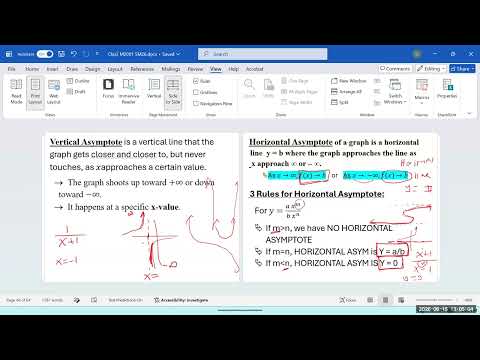
Rational-function asymptotes are found by comparing numerator and denominator degrees for horizontal asymptotes, and simplifying the denominator before solving for vertical asymptotes. Worked examples apply the degree rules and interpret a graph with a vertical asymptote at x = -5, which also divides the domain.
Key takeaways
- For a rational function with numerator degree less than denominator degree, the horizontal asymptote is y = 0.
- When numerator and denominator degrees are equal, divide their leading coefficients to get the horizontal asymptote.
- A numerator degree greater than the denominator degree means there is no horizontal asymptote, though the function may have another type of asymptotic behavior.
- To find vertical asymptotes, simplify the rational expression first, then solve where the remaining denominator equals zero.
- A vertical asymptote at x = -5 divides the real-number domain into (-∞, -5) and (-5, ∞).
- A horizontal asymptote describes end behavior and can be crossed at finite x-values.
Chapters
- Compare the highest polynomial degree in the numerator with the highest degree in the denominator.
- If the numerator degree is greater, there is no horizontal asymptote; if the denominator degree is greater, the horizontal asymptote is y = 0.
- If the degrees are equal, the horizontal asymptote is the ratio of the leading coefficients.
- For vertical asymptotes, simplify the rational expression and set the simplified denominator equal to zero.
- For (x + 1)/(x² - 1), the denominator has the higher degree, so the horizontal asymptote is y = 0.
- Examples distinguish y = 0 when the denominator degree is higher, y = 2/5 when degrees match, and no horizontal asymptote when the numerator degree is higher.
- When the leading terms are 3x² and 10x, their quotient behaves like 3x/10, which does not approach a constant horizontal value.
- A graph can approach a horizontal asymptote as x tends toward positive or negative infinity, and may cross it at finite x-values.
- The graph breaks at x = -5, so that x-value is excluded from the domain.
- The domain is (-∞, -5) ∪ (-5, ∞), with separate graph portions on either side of the break.
- The vertical asymptote is the line x = -5; vertical asymptotes are expressed as x equals a number.
Transcript excerpt
0:00 That's easy. You don't need to do any math, any hard math. The simpler way of finding horizontal asymptote is by memorizing three things. The degree of the polynomial, you look at the numerator and denominator. The degree of the polynomial, okay? Means the highest degree. The highest degree in the numerator versus highest degree in the denominator. If the highest degree in the numerator is bigger than highest degree in the denominator, then there is no horizontal asymptote. Means our graph goes on forever. For example, there is no horizontal asymptote because the line is going on forever. Or this one. There is no horizontal asymptote. The
0:47 line goes on forever. So, if you numerator is bigger, there's no asymptote. But, if the denominator is bigger, then your asymptote is y = 0. It's a specific number, y = 0. Always. For example, if you have, let's say, x + 1 over x squared minus 1. See, the square is bigger than 1. So, we have a horizontal asymptote at y = 0. And then the third scenario. What if none of them are bigger? They're same. If the numerator and denominator have the same highest degree, then our asymptote is y equals their
1:36 coefficients. Whatever coefficient you have on the numerator divided by whatever coefficient of the denominator. So, the ratio of the leading coefficients is the horizontal asymptote if we have the same degree on the numerator and denominator. So, for horizontal asymptote, memorize the three rule. For vertical asymptote, simplify denominator equals zero. They will ask you. Find vertical asymptote. Find horizontal asymptote. So anytime they ask you something, how do you find them? For horizontal asymptote, you look at the three rules. If they ask you to find the vertical
2:22 asymptote, you look at the vertical
This is the start of the transcript. Save this video free for the whole transcript, searchable and time-coded.
In this course
Related notes
Summary, takeaways, and chapters were generated by AI from the video's transcript and may contain errors. The video belongs to its creator, Shahera Jannah's Math World! 😁😎.