Lec3 Chp1 M2001 Summer26 Transformation, Composite & Inverse Functions
Overview
Shahera Jannah reviews key Chapter 1 material for M2001, moving from the difference quotient to transformations, composite functions, decomposition, and inverses. Worked examples show how to calculate a difference quotient, identify shifts and reflections, evaluate compositions with equations or graphs, and find inverse functions by swapping x and y; the class is also reminded about the quiz and homework deadlines.
Key takeaways
- For f(x) = 2x² - 3x + 4, the difference quotient [f(x + h) - f(x)]/h simplifies to 4x + 2h - 3.
- Horizontal shifts use the opposite sign inside the function: x + 2 shifts a graph left 2, while x - 2 shifts it right 2; outside additions shift vertically in the sign's direction.
- To evaluate f(g(a)), compute g(a) first and then apply f to that result; reversing the order can change the answer, as f(g(2)) = 66 while g(f(2)) = 30 in the worked example.
- A graph has an inverse function only if it is one-to-one; after verifying it is a function with the vertical line test, use the horizontal line test to check one-to-one behavior.
- To calculate f⁻¹(x) algebraically, express f(x) as y, interchange x and y, and solve for y; for f(x) = (6x + 1)/(1 - 7x), the inverse is (x - 1)/(6 + 7x).
Chapters
- Quiz 1 is scheduled for the beginning of the next class and will cover material completed through the current lecture.
- Chapter 1 homework is due Monday at midnight.
- A y-intercept is found by setting x to 0, but expressions such as x + 1/x are undefined there because they divide by zero.
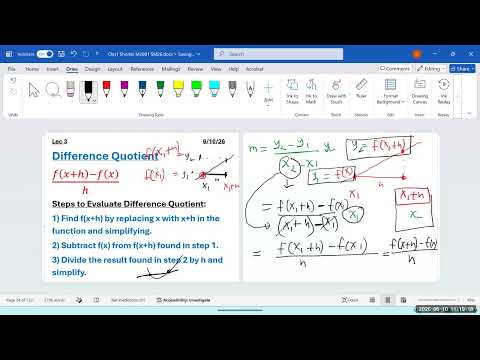
- The difference quotient expresses the slope between two points on a function's graph.
- Represent the second input as x₁ + h, where h is the horizontal distance from the first input x₁.
- The corresponding outputs are f(x₁) and f(x₁ + h), giving the quotient [f(x₁ + h) - f(x₁)]/h.
- Substitute x₂ = x₁ + h into the two-point slope formula, (y₂ - y₁)/(x₂ - x₁).
- Since x₂ - x₁ = h, and the y-values are f(x₁ + h) and f(x₁), the slope becomes [f(x₁ + h) - f(x₁)]/h.
- The same formula is commonly written [f(x + h) - f(x)]/h.
- For f(x) = 2x² - 3x + 4, replace each occurrence of x with x + h to form f(x + h).
- Keep parentheses around x + h before applying powers, so the squared term is (x + h)².
- Subtract the original f(x) from f(x + h), then divide the simplified result by h.
- Expand (x + h)² as x² + 2xh + h², or multiply the binomials directly.
- Distribute the leading coefficient and subtract the entire original function, changing each sign inside f(x).
- For f(x) = 2x² - 3x + 4, cancel matching terms and divide the remaining numerator by h to get 4x + 2h - 3.
- A second class example practices replacing x with x + h and canceling terms after subtracting the original function.
- A simplified difference quotient can still contain x and h; it becomes a numerical slope when the relevant input and step size are specified.
- The expression is related to the derivative definition in calculus, but the class stops before taking a limit.
- The review identifies linear, absolute value, square root, quadratic, cubic, and reciprocal functions as standard graph families.
- The absolute value graph has a V-shaped vertex at the origin, while y = x² has a parabolic vertex there.
- The square root graph begins at (0, 0), and y = 1/x has two branches with the axes as asymptotes.
- An exponential function has the variable in the exponent, as in a·bˣ; its unshifted graph passes through (0, 1).
- A logarithmic function reverses an exponential relationship and its standard graph passes through (1, 0).
- The standard exponential graph has a horizontal asymptote at y = 0, while the standard logarithmic graph has a vertical asymptote at x = 0.
- Adding a constant outside f(x), as in f(x) + 2, moves the graph up 2 units; subtracting 2 moves it down.
- Changes inside the input move the graph horizontally in the opposite direction from the sign.
- For y = (x + 2)² the parabola shifts left 2 units, while y = (x - 2)² shifts right 2.
- A negative multiplier outside a function, -f(x), reflects its graph across the x-axis.
- Replacing x with -x, as in f(-x), reflects the graph across the y-axis; an even function such as x² is unchanged by this reflection.
- For a vertical multiplier with absolute value greater than 1, a parabola becomes narrower; a multiplier between 0 and 1 makes it wider.
- The examples identify a parabola moved up 2 units as x² + 2 and one moved right 2 units as (x - 2)².
- An upside-down parabola is represented by -x², a reflection across the x-axis.
- A square root graph reflected across the y-axis can be written √(-x), with a domain restricted to x ≤ 0.
- For an x-axis reflection, keep each x-coordinate and reverse the sign of its y-coordinate.
- For a y-axis reflection, keep each y-coordinate and reverse the sign of its x-coordinate.
- The graph exercises use a mirror-line visualization to transfer recognizable points such as intercepts across the appropriate axis.
- Combined transformations can be applied one at a time, such as reflecting across the x-axis before shifting a graph.
- For logarithmic graphs, use the standard point (1, 0) to assess horizontal and vertical shifts; the worked multiple-choice example selects a graph shifted left 2 and up 3.
- For exponential graphs, compare the standard point (0, 1) and the horizontal asymptote to eliminate choices with incorrect shifts.
- The class applies an x-axis reflection by turning a W-shaped portion of a graph into an upside-down counterpart.
- A subsequent shift right 1 changes each plotted x-coordinate by adding 1.
- A separate example shifts a reflected graph down 1, changing each y-coordinate by subtracting 1.
- For an original function y = x, moving the graph left 2 and up 5 gives y = (x + 2) + 5.
- The inside shift controls horizontal movement, while the outside addition controls vertical movement.
- The class takes a short break before beginning composite functions.
- A composite function places the output of one function inside another, like a nested expression.
- For f(g(x)), g is the inner function and f is the outer function.
- The class illustrates nesting with a square root and a quadratic expression such as x² + 1.
- The notation f∘g means f(g(x)), so the rightmost function g is applied first.
- To compute f(g(x)), replace every x in the outer function f with the entire expression for g(x).
- For a nesting such as f(g(h(x))), begin with h(x), then substitute its result into g, and finally into f.
- A worked composition substitutes an inner quadratic into an outer linear expression and then combines like terms.
- For example, if f(x) = 2x - 2 and g(x) = -x² + 1, then f(g(x)) = -2x².
- Simplify when requested, and use parentheses to preserve the full inner expression during substitution.
- With g(x) = 2x + 2, first calculate g(2) = 6.
- For f(x) = x² + 5x, substitute 6 to get f(6) = 36 + 30 = 66.
- Evaluating the inner function first avoids having to write a full composite formula.
- For f(x) = x² + 5x and g(x) = 2x + 2, calculating g(f(2)) starts with f(2) = 14.
- Then g(14) = 30, which differs from f(g(2)) = 66.
- Function composition is generally not commutative: f(g(x)) and g(f(x)) need not match.
- For f(g(3)), first read g(3) from the graph by locating the filled point at x = 3.
- The example uses the closed point with y-value 5 rather than an open circle, then evaluates f(5).
- A graph can supply an inner function's output even when no equation for that function is given.
- To find f(g(2)), read g(2) from the graph of g, then use that output as the input on the graph of f.
- In the worked example, g(2) = 5 and f(5) = 7, so f(g(2)) = 7.
- The evaluation procedure works whether a problem supplies two equations, an equation and a graph, or two graphs.
- Decomposition reverses composition by identifying inner and outer functions whose nesting produces a given expression.
- For h(x) = √(2x² - 6), one valid choice is g(x) = 2x² - 6 and f(x) = √x.
- Different choices can produce valid decompositions, such as g(x) = x² and f(x) = √(2x - 6).
- For f(x) = x² - 3 and g(x) = 5x, the result 25x² - 3 matches f(g(x)), with g placed inside f.
- If g(x) = x + 4 and f(g(x)) = (x + 4)⁶, then the outer function is f(x) = x⁶.
- The lecture closes the composition section by noting that Chapter 1 homework includes decomposition practice.
- Two functions are inverses when composing them in either order returns the input: f(g(x)) = x and g(f(x)) = x.
- An inverse swaps the original function's domain and range.
- The notation f⁻¹(x) denotes an inverse function, not the reciprocal 1/f(x); parentheses around the whole function raised to -1 indicate a reciprocal.
- A function has an inverse function when it is one-to-one, meaning distinct inputs do not share the same output.
- Use the vertical line test first to check whether a graph is a function, then the horizontal line test to check whether it is one-to-one.
- A horizontal line crossing a graph more than once shows that the function is not one-to-one.
- A point (a, b) on a function becomes (b, a) on its inverse, so inverse graphs reflect across y = x.
- The inverse of the standard square root graph is the nonnegative portion of y = x².
- The exponential and logarithmic parent functions are inverses, as are x³ and the cube root function.
- To find an inverse formula, write f(x) as y, swap x and y, then solve the resulting equation for y.
- For f(x) = (6x + 1)/(1 - 7x), swapping variables and solving gives f⁻¹(x) = (x - 1)/(6 + 7x).
- Shahera Jannah reminds students that the next class begins with a Chapter 1 quiz and that the homework is due Monday at midnight.
Transcript excerpt
0:15 Morning everyone. How are you guys doing today? Good. It's so nice to see you guys again so soon. Just a reminder that tomorrow you're going to have your quiz number one at the beginning of class. Try not to be late. If I am late, you're lucky. But if you are late, then you are unlucky. You know, if you are late, but I am early, then it's a good thing. So try to be early. Whether I'm early or not, it doesn't matter. Uh I'm going to give the quiz at the beginning of the class. I didn't make the quiz yet. Today I'm going to decide uh the quiz will be uh based on which materials. So we are going to finish our lectures today and then we will see how much we finish from
1:02 day one to day three which is today and then your quiz will be based on those materials. Any question before you start? Any comments, concern, complaint? Are you guys doing the homework? Great. Great. So, homework one do chapter one due Monday midnight. >> Y for y intercept you said every x you see in your equation set them equals to zero and the constant is a y intercept. Mhm. 0 comma y value.
1:53 >> Now uh we do have some undefined when the graph doesn't cross the x y axis. >> So those case is when you have zero in the denominator. For example, if you have something like let me do it real quick. Um let's say you have x + 1 /x and you are trying to find out what's the y intercept here. So when you find the y intercept we have 0 + 1 / 0 right. Anytime you're dividing by zero is automatically undefined. That means
This is the start of the transcript. Save this video free for the whole transcript, searchable and time-coded.
In this course
Related notes
Summary, takeaways, and chapters were generated by AI from the video's transcript and may contain errors. The video belongs to its creator, Shahera Jannah's Math World! 😁😎.