Lec19 Chp3 Log M2001 Simplifying-Expanding-Single Log, Solving Log Equations
Overview
Shahera Jannah teaches logarithm simplification, expansion, conversion to a single logarithm, change of base, and several methods for solving logarithmic equations. The lesson emphasizes matching log bases, converting between logarithmic and exponential forms, and checking every solution by confirming that each logarithm's argument is positive.
Key takeaways
- A logarithm's argument must be strictly positive; check every candidate solution by substituting it into every original argument, rather than accepting or rejecting it based only on whether x is positive or negative.
- To expand a logarithm, split products into sums and quotients into differences, then move exponents in front as coefficients; addition or subtraction inside an argument cannot be split.
- To write one single logarithm, reverse those rules: add log terms by multiplying arguments, subtract them by dividing arguments, and turn coefficients into exponents.
- For a logarithm with a base other than 10, change of base gives log base b of a = log(a)/log(b); using ln(a)/ln(b) produces the same value when both logs use ln.
- For a logarithmic equation with one log on each side, cancel by equating arguments only when the bases match and there are no extra operations outside the logs.
- When one side contains multiple logarithms, combine them into one log before converting to exponential form or using the one-to-one property.
Chapters
- Shahera Jannah reviews logarithms as the inverse operation of exponentials, allowing conversion between logarithmic and exponential forms.
- A logarithm's argument must be positive, so log(0) and logarithms of negative arguments are undefined in the real numbers.
- Log graphs have an x-intercept at 1 and a vertical asymptote; exponential graphs have a y-intercept at 1 and a horizontal asymptote.
- To find a logarithmic function's domain, set its argument greater than zero and solve; for ln(12 - 3x), require 12 - 3x > 0.
- Find a vertical asymptote by setting the log argument equal to zero, then use the argument's positive region to determine the domain.
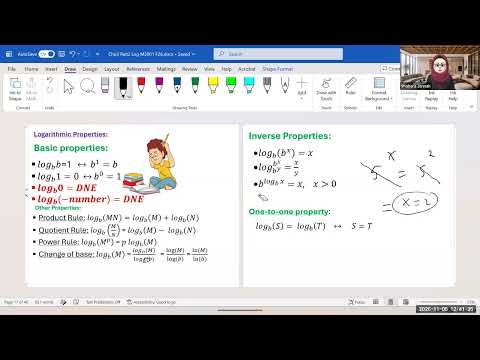
- The product rule turns a product inside a log into a sum, the quotient rule turns division into subtraction, and the power rule brings exponents down as coefficients.
- The one-to-one property requires matching log bases and logs with no extra operations outside them.
- An unmarked log has base 10, so log(100) becomes log base 10 of 10 squared and simplifies to 2.
- The useful strategy is to rewrite the argument as a power of the logarithm's base, rather than as an unrelated product such as 50 times 2.
- When the base and the argument's underlying number match, the logarithm returns the exponent.
- Rewrite 1/81 as 3 to the negative fourth power to simplify log base 3 of 1/81 to negative 4.
- Use the inverse relationship between a base and its logarithm: 3 raised to log base 3 of 4x simplifies to 4x.
- For nested expressions, first expose the matching base and argument; do not leave a logarithm in the final answer when the inverse property removes it.
- A power such as 10 to the negative third power immediately gives log base 10 of that quantity as negative 3.
- Rewrite the fifth root of e as e to the one-fifth power, then use ln(e to the one-fifth) = 1/5.
- The inverse relationship between ln and e works when they are directly paired, with no intervening operation.
- For log(ab/cd), expand to log(a) + log(b) - log(c) - log(d).
- Every numerator factor receives a positive log term, and every denominator factor receives a negative log term.
- When subtracting a grouped expression such as log(c) + log(d), distribute the negative sign to both terms.
- For log base 2 of 2x divided by 3y squared, expand the factors while preserving numerator and denominator signs.
- Simplify log base 2 of 2 to 1, and bring the exponent on y down to obtain a term of negative 2 log base 2 of y.
- Keep separate logarithms of unrelated arguments, such as x and 3, unless another valid rule combines them.
- Expand log(4wx cubed divided by y squared times square root of z) into five log terms, one for each factor.
- The numerator terms log(4), log(w), and log(x cubed) are positive; the denominator terms for y and z are negative.
- Rewrite square root of z as z to the one-half power, then apply the power rule to get 3 log(x), negative 2 log(y), and negative one-half log(z).
- A cube root becomes an exponent of one-third, while denominator radicals such as a square root become fractional powers before expansion.
- A factor such as (x + 1) to the one-third power contributes one-third log(x + 1), but the sum x + 1 cannot be split into separate logarithms.
- The product and quotient rules do not allow splitting addition or subtraction inside a logarithm.
- To combine several logs into one, turn addition of logs into multiplication of their arguments and subtraction into division.
- A positive coefficient becomes an exponent on its argument; for example, 3 log(x) becomes log(x cubed).
- A negative log term places its argument in the denominator, so the sign is represented by position rather than carried into the argument.
- Evaluate log base 5 of 479 by changing it to log(479) divided by log(5), yielding approximately 3.83.
- The same quotient can use natural logs: ln(479) divided by ln(5) gives the same result.
- Use the same log type in both numerator and denominator; the lesson demonstrates that mixing log and ln is not the change-of-base formula.
- For an equation with one logarithm on one side and a number on the other, convert the logarithm to exponential form.
- For multiple logs on one side, first combine them into one logarithm; for one log on each side, use the one-to-one property when its conditions are met.
- Check proposed solutions in the original arguments, because a zero or negative argument makes a real logarithm undefined.
- For ln(2x - 3) = 6, use the implicit base e to rewrite the equation as 2x - 3 = e to the sixth power.
- Solve the resulting algebraic equation to get x = (e to the sixth power + 3)/2, approximately 203.29.
- For a requested decimal place, calculate the full value first and then identify or round the specified digit.
- Convert log(x + 1) = 1 into x + 1 = 10, giving x = 9.
- For log(1/(x + 1)) = -1, rewrite the reciprocal as a negative power or convert directly to 1/(x + 1) = 10 to the negative first power.
- Shahera Jannah recommends exponential form as a direct route from a single logarithm to an algebraic equation.
- For log base 4 of x plus log base 4 of x - 6 equaling 2, combine the left side as log base 4 of x(x - 6).
- Convert to exponential form, giving x squared - 6x = 16, then factor x squared - 6x - 16 = 0 to obtain candidates 8 and negative 2.
- Keep x = 8 because both original arguments are positive; reject x = -2 because log(x) would have a negative argument.
- For log base 2 of (1 - x) minus log base 2 of (x + 3) equal to 1, combine the logs as log base 2 of (1 - x)/(x + 3).
- Convert to exponential form and solve (1 - x)/(x + 3) = 2 to get x = -5/3.
- Check the original arguments: 1 - x and x + 3 are both positive at x = -5/3, so the solution is valid despite being negative.
- Logs with the same base can be matched by setting their arguments equal only when each side contains a single log and no extra coefficient or operation outside it.
- Move a coefficient into the argument as an exponent before applying the one-to-one property.
- The lesson's clean example, log(x + 6) = log(2x + 4), reduces to x + 6 = 2x + 4 and gives x = 2, with positive arguments.
- When one side has multiple logs and the other has one, combine the multiple terms into a single log before equating arguments.
- In the population application, 550 = 34 ln(t) + 520 simplifies to ln(t) = 30/34.
- Convert to exponential form to get t = e to the power 30/34, approximately 2.42; e is a base, not a multiplier.
- The planned mini-exam includes a log domain question, a graph with a vertical asymptote and transformations, and a simplification problem.
- Other announced topics are expanding logs, rewriting a single log, change of base with a calculator, and one logarithmic-equation scenario.
- The class is told to bring a calculator and expects about seven questions in roughly 30 minutes.
Transcript excerpt
0:02 Good morning. How are you guys doing today? I'm okay. I was actually okay until she told she asked me how is your cough and I must coughing all the time. You need happens I don't know whether it happened to you or not but anytime if someone ask me how are you feeling, I feel worse. That's a bad thing. for me. >> [laughter] >> That could be another reason. This room is so cold. So probably it has some type of pollen or something like thing that hurting my throat. I have two things my seasonal allergy when season changes fall to winter fall to spring or spring to fall
0:49 I start coughing because my throat aches a lot. And now I also have acid reflux which is really annoying. And it takes a really long time for acid reflux to get um to calm down a bit. I already suffered one month. I still have much more to go. more days. Okay, so in our last class after the exam we
1:37 started log and we did a few things on log. We learned um log is an inverse of exponential. So we can convert log to exponential, exponential to log anytime we need them. And we learned um the domain of the log is the range of the exponential and domain of the exponential is the range of the log. Uh we also learned about logarithmic graph. Every log graph goes through the x-intercept one. While every exponential graph goes to the y-intercept one. Also, the bigger the base, the more narrower it gets or the closer
2:26 it gets to the x- axis. And if your base is more than one, uh if your base is uh between uh between zero to one or the fractions and
This is the start of the transcript. Save this video free for the whole transcript, searchable and time-coded.
In this course
Related notes
Summary, takeaways, and chapters were generated by AI from the video's transcript and may contain errors. The video belongs to its creator, Shahera Jannah's Math World! 😁😎.