Lec4 Chp1& 2 M2001 Summer26 Piecewise & Quadratic function, Vertex, XY Intercepts, Vertext Form
 Watch on YouTube →
Overview
Shahera Jannah reviews piecewise-defined functions, then develops quadratic functions through their graphs, intercepts, vertices, axis of symmetry, and vertex form. The lesson emphasizes choosing a formula from its domain, using factoring to find zeros, and finding a vertex from general form with x = -b/(2a), while connecting a parabola's direction and vertex to its range and maximum or minimum.
Key takeaways
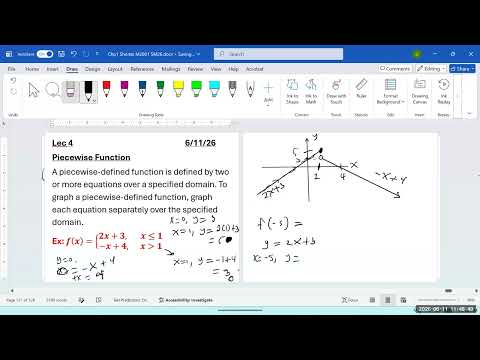
- For the piecewise example 2x + 3 when x ≤ 1 and -x + 4 when x > 1, x = 1 belongs only to the first rule: plot a closed point at (1, 5) and an open point at (1, 3).
- In vertex form y = a(x - h)² + k, the vertex is (h, k), the symmetry axis is x = h, and the inside sign reverses when identifying h.
- For a quadratic in general form, the vertex x-coordinate is -b/(2a); substitute that x-value back into the function to obtain the vertex y-coordinate.
- A quadratic's domain is always (-∞, ∞), while its range begins or ends at the vertex's y-coordinate depending on whether a is positive or negative.
- Before finding rational-function x-intercepts, factor and simplify while preserving denominator restrictions; valid intercepts must make the numerator zero without making the denominator zero.
- For y = -x² + bx - 25 to have maximum 56, the coefficient can be either b = 18 or b = -18.
Chapters
- Shahera Jannah says the exam is one week away and identifies examples, ABC exercises, and calculator questions marked green in the lecture notes as the main study guide.
- She notes that the posted notes on Brightspace distinguish green material from other examples.
- A piecewise-defined function combines two or more equations, each assigned to a specific domain.
- The opening example uses 2x + 3 for x ≤ 1 and -x + 4 for x > 1, so each rule applies only on its stated side of the breakpoint.
- At the breakpoint x = 1, the rule 2x + 3 gives y = 5 and includes equality, so its endpoint is a closed circle at (1, 5).
- The rule -x + 4 would give y = 3 at x = 1, but its domain excludes 1, so mark an open circle at (1, 3).
- Draw both rule segments on the same coordinate plane and follow each equation only across its assigned domain.
- For -x + 4, setting y = 0 gives the x-intercept (4, 0); for 2x + 3, setting x = 0 gives the y-intercept (0, 3).
- To evaluate f(-5), use 2x + 3 because -5 ≤ 1, giving -7; to evaluate f(5), use -x + 4 because 5 > 1, giving -1.
- Two known points, such as (0, 3) and (1, 5), help sketch the first linear piece.
- At a domain boundary, calculate the y-value from the rule on each side, even if one side excludes the boundary.
- For a piecewise function with multiple breakpoints, compare the neighboring rules at every boundary to place included endpoints and holes accurately.
- Read the graph using the domain: values at or below 1 use the left rule, while values above 1 use the right rule.
- The next exercise has three rules, a cubic, a line, and a parabola, with domain breaks at x = 1 and x = 3.
- For an expression combining f(-2), f(0), and f(5), first select the rule whose domain contains each input.
- Evaluate each function value separately, then apply the indicated addition or subtraction.
- Shahera Jannah concludes the piecewise-function topic and says graph matching is a likely homework task, while exam questions may ask for function values at specified inputs.
- Chapter 1 homework is due Monday at midnight, with additional chapters and assignments approaching.
- A polynomial is quadratic when its highest power of x is 2, as in y = x² or y = ax² + bx + c.
- Quadratic graphs are parabolas that open upward or downward.
- The vertex identifies the minimum of an upward-opening parabola or the maximum of a downward-opening parabola.
- A parabola is symmetric about a vertical axis that passes through its vertex; in general, that axis is not necessarily the y-axis.
- The axis of symmetry has an equation of the form x = a constant, equal to the vertex's x-coordinate.
- The x-intercepts and y-intercept describe where the graph crosses the coordinate axes.
- Vertex form is y = a(x - h)² + k, with vertex (h, k) and axis of symmetry x = h.
- For y = (x - 2)² + 3, the vertex is (2, 3); for y = (x + 2)² + 3, it is (-2, 3).
- The sign inside the parentheses reverses when reading the vertex's x-coordinate, while the outside constant gives its y-coordinate.
- General form is y = ax² + bx + c; its constant c gives the y-intercept (0, c).
- Find the vertex's x-coordinate with x = -b/(2a), then substitute that value into the function to find the y-coordinate.
- Vertex form makes the vertex visible, while general form makes the y-intercept immediate.
- The sign of a in y = ax² + bx + c determines direction: a > 0 opens upward and a < 0 opens downward.
- Every quadratic parabola has domain (-∞, ∞); its range depends on the vertex's y-coordinate.
- An upward parabola with vertex y-coordinate k has range [k, ∞), while a downward parabola has range (-∞, k].
- In a(x - h)² + k, h shifts the graph horizontally with the opposite sign, while k shifts it vertically in the indicated direction.
- A negative a reflects the parabola across the x-axis; |a| greater than 1 makes it narrower, while 0 < |a| < 1 makes it wider.
- The class sketches examples by applying the reflection and shifts to the parent graph y = x².
- For a y-intercept, set x = 0; in general form y = ax² + bx + c, the result is c.
- For an x-intercept, set y = 0 and solve for x; in vertex form this produces an equation involving a(x - h)² + k.
- When solving a quadratic, try factoring first; if factoring does not work, completing the square or the quadratic formula may be needed.
- The terms x-intercept, root, and zero all refer to an x-value where y = 0.
- For x² - 5x + 4 = 0, factoring gives (x - 1)(x - 4) = 0, so the roots are 1 and 4.
- For a product equal to zero, set each factor equal to zero; direct factoring looks for factors that multiply to the constant and combine to the middle coefficient.
- For x⁴ - x³ - 20x², first factor out the greatest common factor x², then factor x² - x - 20 as (x - 5)(x + 4).
- The resulting real zeros are x = 0, x = 5, and x = -4; a fourth-degree polynomial is not a quadratic merely because it can be factored.
- For x⁴ - 8x² - 9, treat x² as a repeated quantity: (x² - 9)(x² + 1) = 0, giving real zeros ±3 and complex zeros ±i.
- For a rational function, factor the numerator and denominator before solving for x-intercepts.
- Cancel common factors where permitted, then set the simplified numerator equal to zero while checking that the denominator is not zero.
- A value excluded by the denominator is not a valid x-intercept, even if it appears as a numerator zero before simplification.
- For y = √(10 - x²), set y = 0 to find x-intercepts, then square both sides to obtain x² = 10.
- The solutions are x = ±√10, so the intercepts are (-√10, 0) and (√10, 0).
- When solving an equation x² = c, include both positive and negative roots; the principal square root symbol itself denotes the nonnegative root.
- Using x = -b/(2a), the vertex's x-coordinate is 3; substitution gives vertex (3, 1) and axis of symmetry x = 3.
- Since a = -1, the parabola opens downward, has maximum y-value 1, and has range (-∞, 1].
- Factoring -x² + 6x - 8 gives roots 2 and 4, and setting x = 0 gives y-intercept (0, -8).
- To construct y = a(x - h)² + k, substitute the known vertex (h, k) and a second point into the equation.
- Solve the resulting equation for a, then substitute a, h, and k into vertex form.
- A parabola's leading coefficient is not automatically 1; determine it from the supplied point unless the problem provides it.
- Students work through four exercises involving vertex form and identifying missing equation information.
- The central technique is to distinguish the known vertex coordinates from a second point used to determine the leading coefficient.
- The practice period runs for several minutes before the class returns to review solutions.
- A point described in words, such as a y-intercept, supplies the same coordinate information as an explicitly listed point.
- After finding a, substitute it with h and k into y = a(x - h)² + k.
- The worked review reinforces that a given point must satisfy the final equation rather than assuming a = 1.
- For y = -x² + bx - 25 with maximum value 56, the vertex y-coordinate is 56 and the vertex x-coordinate is b/2.
- Substitution into the function gives 56 = b²/4 - 25, so b² = 324 and b = ±18.
- Both signs satisfy the stated maximum; the corresponding vertex occurs at x = 9 when b = 18 and x = -9 when b = -18.
- The class closes with a reminder that graded work will be posted on Brightspace or returned in class.
Transcript excerpt
0:03 So, how do you feel over the place? Did you guys study enough to go out in this place? No, I'm not feeling. So, your exam will be exactly one week from today and um your study materials will be all the green questions I have in my uh lecture. For example, uh C B C those are return. All those green uh points you see in the lecture notes, study those and you'll be
0:52 fine for the exam. And if you notice uh oops not here this one if you notice in the lecture notes uh that one I posted on bright space it's clearly visible which one are in green and which one are not. For example, here there are so many examples in green and so many are not in green. So whatever I green, make sure you know them very well. For example, here the example is written in green means important and all the example here AB important
1:42 this one is written in green important every example or ABC written in green those are very important so study those for your exam exactly one from today >> highlight green >> highlighter or highlight it doesn't matter when you see the green uh like here calculator in green important anything green any green example like either example or ABC or calculator whatever you see the left start with green it's important for example here this type of example written in
2:29 green the example so these are important uh written in green example important every green example or letter ABC I don't have time to put them together as a review sheet so that's your review sheet how do I go back here okay so I just posted the two lecture notes so if you're using uh the lecture
This is the start of the transcript. Save this video free for the whole transcript, searchable and time-coded.
In this course
Related notes
Summary, takeaways, and chapters were generated by AI from the video's transcript and may contain errors. The video belongs to its creator, Shahera Jannah's Math World! 😁😎.