L8 Control of Force IV
 Watch on YouTube →
Overview
Dr. Chris Black explains why whole-joint strength changes across a movement even when muscle size and activation are unchanged: joint moment arms vary with angle, and contraction speed changes force through the force-velocity relationship. He contrasts concentric and eccentric contractions, connects eccentric force and lower energy cost to crossbridge cycling and elastic connective tissue, then shows how force and velocity combine as power, with fiber type shaping power potential.
Key takeaways
- Joint torque depends on both muscle force and the effective moment arm, so changing leverage across a curl or squat range helps create sticking points even when muscle activation is unchanged.
- During concentric shortening, faster movement produces less force because myosin crossbridges must detach and reset more quickly, leaving fewer attached crossbridges at any instant.
- Eccentric contractions can produce roughly 10 to 20 percent more force than concentric contractions, with elastic connective tissue contributing stored energy as muscles and tendons lengthen.
- Eccentric actions require less crossbridge cycling and energy, which helps explain why descending stairs or running downhill is less fatiguing than ascending.
- Power is force multiplied by velocity, and peak power occurs at an intermediate combination of the two rather than at maximum force or maximum speed alone.
- Fast-twitch type II fibers have greater power potential than slow-twitch type I fibers, contributing to differences in sprinting and jumping capacity.
Chapters
- Sarcomeres produce the most force when actin and myosin overlap optimally; very short or very stretched sarcomeres form fewer productive crossbridges.
- Dr. Chris Black notes that intact human muscles usually operate near the sarcomere's optimal overlap range, so sarcomere length alone does not explain all weakness at particular movement positions.
- Curls and deep squats illustrate that whole-muscle strength varies across range of motion and requires considering joint mechanics.
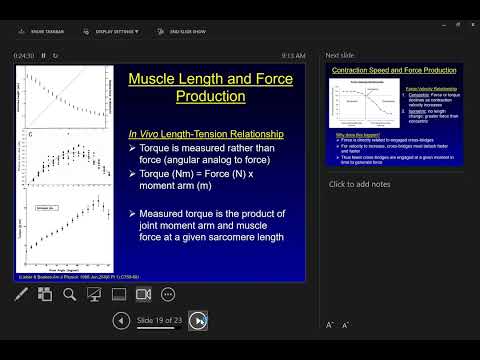
- Joint torque equals force multiplied by the effective moment arm, measured in newton-meters; the tendon applies muscle force to bone at a distance from the joint's rotation axis.
- The patellar tendon attaches to the tibia, and the biceps tendon attaches near the elbow, giving each joint a changing effective lever arm as it rotates.
- A moment arm is generally shorter near the ends of a movement and longer around the middle, helping explain why a curl or squat has weak points.
- A lift's sticking point reflects the weakest position in its range of motion, where the effective lever arm and resulting torque are small.
- Students first curl one backpack quickly, then try curling two; the heavier load makes the concentric movement slower.
- The force-velocity graph places isometric contraction at zero velocity, concentric shortening on the positive-velocity side, and eccentric lengthening on the negative-velocity side.
- The classroom load comparison demonstrates that increasing the force demand reduces the speed of a concentric contraction.
- As concentric shortening velocity increases, the muscle produces less force because fewer crossbridges are attached at any instant.
- To shorten quickly, myosin heads must detach, reset, reattach to actin, and pull again at a faster rate.
- A near-maximal bench press moves slowly because producing very high force requires a slow contraction.
- Muscle size, motor-unit recruitment, firing rate, joint position, and contraction velocity all contribute to the force available in a movement.
- Unlike concentric force, eccentric force does not fall substantially as lengthening velocity increases; the eccentric force-velocity curve plateaus and can rise slightly.
- During eccentric actions, engaged crossbridges do not need to detach and cycle at the same rate as during concentric shortening.
- Eccentric contractions can produce more force than isometric or concentric contractions, allowing a person to lower a load they cannot lift.
- Dr. Black compares tendons, ligaments, and muscle connective tissue to a stretched hair tie: collagen-rich tissues resist stretch and tend to return toward their original length.
- Stored elastic energy during lengthening adds to muscle-generated force, helping explain the lecture's estimate of roughly 10 to 20 percent more eccentric force than concentric force.
- Because eccentric contractions require less crossbridge cycling, they use less energy and cause less fatigue than concentric contractions.
- Downhill running and descending stairs feel easier than going uphill or climbing because these activities rely heavily on energy-efficient eccentric actions.
- Power equals force multiplied by velocity; in human movement, greater power supports faster running, higher jumps, and quicker changes of direction.
- Very high force at very low velocity and very high velocity at very low force both produce little power.
- Dr. Black places peak power output at approximately two-thirds of maximum force and one-third of maximum velocity.
- Plyometric drills such as depth jumps train the nervous system to recruit many motor units and generate force rapidly.
- The power curves discussed compare slow-twitch type I fibers with faster type IIa fibers; type II fibers have substantially greater power potential.
- The lecture notes that type IIx fibers can have even greater power potential, while type IIb is not generally the relevant human muscle-fiber category.
- A high proportion of fast-twitch fibers can support sprinting and jumping ability, while training can improve performance but cannot fully change inherited fiber characteristics.
- A training taper, reducing training volume before performance, can alter power profiles and benefit type II fiber power.
- Fatigue can occur when ATP use during repeated crossbridge cycling exceeds the rate at which metabolism can resupply it; high-intensity efforts have limited duration.
- Aerobic and anaerobic metabolism operate simultaneously, with their relative contributions shifting according to exercise intensity rather than switching on one at a time.
- Dr. Black defines power as force multiplied by the velocity of force generation and explains that both coordinates on the force-velocity curve are needed to calculate it.
- The in-person, pen-and-paper exam will include roughly 25 to 35 multiple-choice questions and several short-answer questions; short-answer material may also appear in multiple-choice form.
Transcript excerpt
0:00 Okay, I've got the Zoom rolling. We're recording. I'll try to make sure that after today that I get the lectures. I owe you guys a couple up on the YouTube channel. Make sure that we're that we're kind of up so you guys can stuff. All right, we left off on Monday talking about the sarccomir length tension relationship and that sarccomir that you're going to get more force when there is a sufficient amount of overlap or an optimal amount of overlap between actin and measin filaments. And then if a sarccomir gets really short, the act all slide by each other and we have no place to overlap. So we get no force or if we stretch the sarcimeir and we pull it way out then there's no overlap that way either. So we get very very little force
0:49 and this tends to mimic what we see in our muscles where we are weaker at very long lengths and very short lengths. Okay, and stronger in the middle. But remember I told you guys of I led you guys to believe in some ways that this is what was going on when in actual practice in our muscles you very rarely ever get anywhere outside of this kind of optimal middle overlap see. So we're going to start today by trying to understand it's not because of the sarcime link tension relationship. What the hell is going on, okay, in our muscles in an intact human that it's going to lead us to be weaker here. Remember we did our curls and we were a little weaker down here, a little
1:37 stronger in the middle, and then relatively strong kind of the top part. Same thing if you were to do like a squat. If I'm going to do I don't know
This is the start of the transcript. Save this video free for the whole transcript, searchable and time-coded.
Related notes
Summary, takeaways, and chapters were generated by AI from the video's transcript and may contain errors. The video belongs to its creator, Exercise Physiology with Dr. Chris Black.