L6 Control of Force II
 Watch on YouTube →
Overview
Chris Black explains how muscle size and architecture set force-producing capacity, while the nervous system controls how much of that capacity is used through motor unit recruitment. He connects Henneman’s size principle, fiber types, and calcium handling to practical examples, including quadriceps recruitment of roughly 80 to 85% in many untrained people versus 95 to 97% after practice, and explains why lifting or cardio should come first based on training priority.
Key takeaways
- Muscle size and cross-sectional area set a major part of force capacity because more contractile material can form more cross-bridges.
- Pennation trades some direct tendon-force efficiency for the ability to pack more fibers into a muscle; that greater physiological cross-sectional area can produce greater total force.
- Henneman’s size principle recruits small, fatigue-resistant Type I motor units before larger Type IIa and Type IIx units, supporting both sustained low-force tasks and high-force efforts.
- Training heavy movements can improve neural access to available muscle: quadriceps recruitment may rise from roughly 80 to 85% in many people to 95 to 97% with practice.
- The active state depends on calcium remaining elevated inside the muscle cell; SERCA-mediated calcium reuptake ends this window for cross-bridge force production.
- For combined cardio and resistance training, do the activity most important to your goals first; the typical interference effect is small, and lifting-first changes fuel use during cardio more than it changes total calories burned.
Chapters
- Chris Black says the order has a small interference effect for most people, so prioritize the activity most important to your goals.
- Doing cardio first can fatigue you and slightly reduce resistance-training work; lifting first can similarly reduce cardio performance.
- Lifting before cardio may increase the proportion of cardio energy coming from fat, but resistance training burns relatively few calories, so the practical effect is small.
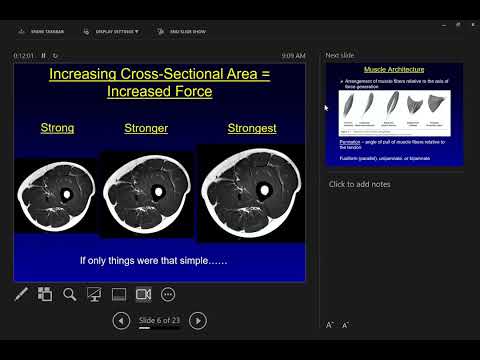
- A larger muscle can contain more active actin and myosin and form more cross-bridges, giving it greater force-producing capacity.
- Cross-sectional area (CSA) describes the area visible when a muscle is cut across; greater CSA generally allows more contractile material to contribute force.
- Chris Black uses MRI cross-sections of his quadriceps to illustrate why muscle size is a useful, though incomplete, predictor of strength.
- Muscle architecture varies with function: the biceps is fusiform, while the hamstrings are longer and more slender and the quadriceps are shorter and thicker.
- In fusiform muscles, fibers run largely parallel to the tendon; in pennate muscles, fibers attach at an angle and their force has a component that does not pull directly along the tendon.
- Chris Black distinguishes unipennate, bipennate, and multipennate arrangements, using the semimembranosus, rectus femoris, and deltoid as examples.
- Pennation lets a muscle pack more fibers into a given anatomical cross-section, increasing physiological cross-sectional area and the number of fibers contributing to force.
- The angled fibers lose some force along the tendon’s direction, but the greater number of fibers can more than compensate; the rectus femoris can pack substantially more fibers than a comparable fusiform arrangement.
- Quadriceps are strongly pennate, while hamstrings tend to be longer and more fusiform; resistance training can also make pennation angles steeper.
- Muscle size sets potential force, but actual force depends on how many motor units are active at a given moment.
- Recruitment occurs when the brain activates alpha motor neurons, which signal muscle fibers through the neuromuscular junction and initiate calcium release and cross-bridge formation.
- Picking up a heavier object requires more active motor units than picking up a light object, even though muscle size has not changed.
- Henneman’s size principle describes the usual recruitment order: small motor units containing slow-twitch Type I fibers activate first, followed by larger units and then Type II fibers.
- As force demand rises, recruitment progresses through Type I and Type IIa units and eventually to large units containing Type IIx fibers.
- The principle applies to isometric and concentric contractions; recruitment during eccentric contractions remains difficult to measure in humans and is less clearly understood.
- The brain estimates the force required from past experience and activates an appropriate set of motor units quickly, rather than adding units through a slow, conscious sequence.
- Many people can recruit about 80 to 85% of their quadriceps during a maximum effort; frequent squatting or knee extensions may raise this to about 95 to 97%.
- People can generally recruit at least 95% of their biceps, while small motor units support precise tasks such as writing and fatigue-resistant activities such as posture and breathing.
- The active state is the period when calcium is elevated inside the muscle cell and cross-bridges can produce force.
- A change in muscle-fiber membrane potential precedes calcium release, which in turn precedes measurable tension; force therefore lags behind the electrical signal.
- Active-state duration depends partly on fiber type and the speed of calcium removal from the cell.
- SERCA, the calcium ATPase in the sarcoplasmic reticulum membrane, pumps calcium back into storage and helps end the active state.
- Slow-twitch fibers have slower calcium uptake and a longer active state; fast-twitch fibers clear calcium faster and have a shorter one.
- In experimental muscle preparations, high caffeine exposure can increase calcium release and inhibit SERCA, but Chris Black stresses that the amount needed for this effect would be roughly equivalent to 100 cups of coffee, not a practical reason to consume extreme caffeine.
Transcript excerpt
0:05 I thought we would start today with a little bit of a little bit of bro science. So I consulted the uh the 13page document on bro science questions and come up with with one we'll do we'll do that one today. Um we've got some other ones. We're trying to match them up as best we can with everything. Um, so there was a question about should I do my cardio before or after I do my weights and does it matter? Um, and so what I what I would say to all anybody anybody do both anybody a real overachiever do both cardio and weights on the same day at least want to acknowledge all of that and all great good for you guys. I'm glad I'm glad y'all are out there overachieving doing
0:52 all the listings. What I would ask is so the the real big picture answer is there's there's probably a small effect of doing one before the other. But for most people that effect is probably not particularly meaningful. So if you guys have a guess which one should you do first? You might want to guess. Sarah, you put your hand up. What? What one do you typically do first? >> You live first. Why do you live first? >> Which one do you care about the most? >> You care about the weights. You care about the party more. Or you're like, I hate them both equally. They are both
1:40 terrible. And I'm just in here because >> I know it's good for me. >> Yeah. >> Okay. Somebody else should put your hand up. Say, >> well, depends if you drive bad or not. You should always broadcast your >> Okay. >> Because of the way your >> the way the glucose goes. Sure. Okay.
This is the start of the transcript. Save this video free for the whole transcript, searchable and time-coded.
Related notes
Summary, takeaways, and chapters were generated by AI from the video's transcript and may contain errors. The video belongs to its creator, Exercise Physiology with Dr. Chris Black.