L5 Fiber Type & Control of Force I
 Watch on YouTube →
Overview
Dr. Chris Black explains how muscle fibers are classified by myosin ATPase and myosin heavy chain, then compares type I, type IIa, and type IIx fibers in metabolism, contraction speed, force, and power. He connects those differences to motor-unit size and introduces five controls on force production: muscle size, recruitment, muscle length, contraction speed, and contraction type, emphasizing why eccentric contractions can produce more force at lower energy cost than concentric contractions.
Key takeaways
- Human muscle fibers are classified using myosin heavy chain and ATPase characteristics: type I fibers are slow and oxidative, while type IIa and IIx fibers contract progressively faster.
- Physical activity tends to shift type IIx fibers toward type IIa, but ordinary training does not generally transform a person's overall type I versus type II distribution.
- Type II fibers generally have higher specific force and shortening velocity than type I fibers, giving them greater power capacity when muscle size is comparable.
- Motor-unit size aligns with fiber type in the lecture's framework: type I units tend to be smallest, type IIa intermediate, and type IIx largest.
- Force production depends on five interacting factors: muscle size, neural recruitment, muscle length, contraction speed, and whether the action is concentric, isometric, or eccentric.
- Eccentric contractions can control more external load than concentric contractions and use less oxygen for comparable work, as illustrated by downhill movement and the opposing-bicycle experiment.
Chapters
- Dr. Chris Black says the class test has shifted from the 21st to the 23rd as the course runs about eight slides behind schedule.
- Early animal experiments isolated muscle fibers, stimulated them between posts, and measured how quickly force rose and relaxed.
- Those measurements produced the original fast-twitch and slow-twitch categories, later investigated in human muscle biopsies.
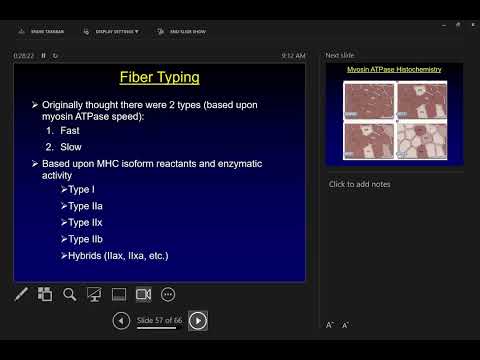
- Histochemistry used ATPase reactions at different pH levels to distinguish fibers according to myosin ATPase activity.
- Succinate dehydrogenase and lactate dehydrogenase staining indicated oxidative and glycolytic enzyme profiles; hexokinase and glycogen staining offered additional metabolic clues.
- Immunohistochemistry uses targeted antibodies to label proteins such as myosin heavy chain, or MHC, as well as glycogen, lipids, and mitochondrial components.
- Type I fibers are slow-twitch and generally have more mitochondria and oxidative enzymes; type II fibers are fast-twitch and include IIa and IIx varieties.
- Type IIa is the slower type II subtype, while IIx is faster and highly fatigable; type IIb fibers are common in some animals but rare in normally ambulatory humans.
- Regular muscular activity tends to shift type IIx fibers toward IIa, while the broad proportion of type I versus type II fibers is largely established early in life.
- Traditional ATPase staining can make fiber types appear differently under acidic or basic conditions, allowing researchers to classify and count fibers.
- Mitochondrial staining typically shows higher density in type I fibers, lower density in type IIx fibers, and intermediate levels in type IIa fibers.
- Maximum shortening velocity follows myosin ATPase speed: type I fibers are slowest, type IIa faster, and type IIx fastest.
- Specific force compares force with fiber size; type IIa and IIx fibers generally produce more force per unit size than type I fibers.
- Because power equals force multiplied by velocity, the faster, higher-force type II fibers have greater power capacity in the comparisons shown.
- Motor units are associated with fiber type: smaller units tend to be type I, intermediate units type IIa, and the largest units type IIx.
- Students listed traits they associate with the strongest person in class, including large muscles, broad shoulders, a bulky build, and posture.
- Dr. Chris Black distinguishes visible body shape from the underlying mechanism: force originates in actin-myosin cross-bridges within muscle fibers.
- Larger muscle can contain more contractile material and cross-bridges, providing a structural basis for greater force capacity.
- The five force controls are muscle size, neural recruitment or activation, muscle length, contraction speed, and contraction type.
- In a biceps curl, the biceps brachii and brachialis act as agonists; the triceps acts as an antagonist that opposes motion and helps stabilize the elbow.
- Synergists assist the agonist with a secondary contribution, while the amount of force produced depends on how the active muscles and cross-bridges are engaged.
- Lifting a backpack in a curl is concentric because the biceps shortens; holding it still is isometric because muscle length stays approximately constant.
- Lowering the backpack is eccentric because the active muscle lengthens while controlling the load.
- Against gravity, a concentric lift requires force slightly greater than the load, an isometric hold matches the opposing force, and a controlled eccentric lowering lets the load descend under restraint.
- Dr. Chris Black explains that people can generally control more weight eccentrically than they can lift concentrically; the lecture gives 110 to 120 pounds lowered under control after a 100-pound lift.
- A 1950 experiment using two bicycles connected by a chain compared forward concentric work with backward eccentric work and found lower oxygen use for eccentric work.
- Walking or running downhill illustrates the same principle: eccentric muscle actions can resist greater forces while requiring less energy than uphill concentric work.
Transcript excerpt
0:04 Okay, we've had a couple of folks ask if we are on track with tests to be on the 21st and um I think we're close. I think we're close. We're like eight slides behind where I where I would like for us to be. Um so the test isn't going to be on the 21st. We're going to be on the 23rd. So, we're we're still tracking about Friday, but we should know I should have a good sense by the end of Monday to give you guys a sense of where we are with that. Okay. All right. We're going to we will finish cognition with the contraction. How do they all turn into their there combination the contractions? Was it okay? Kind of. Sort of. Maybe like yes. Okay. Good. So, we got to finish off talking
0:53 about fiber types. Um, we'll do a little bit of talk here about fiber types and we're going to do a quick repeat of class assignment that I'll give you guys credit for so we can have a little bit of chance that and then we're going to get into talking about what are the things that control force production. Um, and that will hopefully help you guys a little bit as we get into this week's lab. Um there's going to be some other stuff we probably covered until Friday or maybe next Monday. Um some of that stuff. Okay. All right. So, we left off last Wednesday, a week ago. um talking about fiber, talking about the idea of taking out a small piece of muscle out of any one of your muscles and then putting it under a microscope
1:42 and looking at individual characteristics of those individual muscle fibers and then trying to classify them based upon certain things
This is the start of the transcript. Save this video free for the whole transcript, searchable and time-coded.
Related notes
Summary, takeaways, and chapters were generated by AI from the video's transcript and may contain errors. The video belongs to its creator, Exercise Physiology with Dr. Chris Black.