L7 Control of Force III
 Watch on YouTube →
Overview
Dr. Chris Black explains how skeletal muscle controls force through motor-unit recruitment and firing frequency, linking each muscle fiber’s myosin ATPase and SERCA calcium pump to twitch timing and relaxation. He uses twitch curves, needle EMG recordings, force-frequency relationships, and a motor-unit recruitment graph to explain summation, tetanus, and the order of recruitment, then distinguishes sarcomere length-tension effects from the larger causes of strength changes across a joint’s range of motion.
Key takeaways
- SERCA speed shapes the relaxation phase of a twitch: fast-twitch fibers reuptake calcium faster and therefore relax more quickly than slow-twitch fibers.
- Muscle force can be increased in two ways: recruit more motor units or raise the firing frequency of motor units that are already active.
- Repeated action potentials arriving before calcium has been fully reabsorbed create summation; sufficiently frequent stimulation produces fused tetanus and a force plateau.
- Motor-unit recruitment generally proceeds from slow units to type IIa and then type IIx units, while firing rates in active units also rise as force demands increase.
- Sarcomere length affects force through actin-myosin overlap, but normal movements usually keep sarcomeres close to optimal overlap, limiting this mechanism’s contribution to everyday strength changes.
Chapters
- SERCA, the calcium ATPase in the sarcoplasmic reticulum, returns calcium from the intracellular space and helps muscle force fall back to baseline.
- Fast-twitch fibers have faster SERCA activity and relax sooner, while slow-twitch fibers have slower calcium reuptake and more gradual relaxation.
- Voluntary movements require many action potentials, but a lab can deliver one electrical stimulus to measure a muscle twitch.
- A twitch is the force response to one action potential, and its shape varies among muscles such as the eye, first dorsal interosseous, and soleus.
- Time to peak tension measures the rise from zero force to peak force; myosin ATPase speed makes this interval shorter in faster fibers.
- Half-relaxation time measures the decline from peak force to half that value and reflects calcium removal by SERCA.
- The soleus has a slower, more gradual twitch suited to posture, while fast eye muscles reach peak tension more quickly.
- Surface EMG captures activity from many muscle fibers, while a fine-wire needle EMG can record action potentials from an individual motor unit.
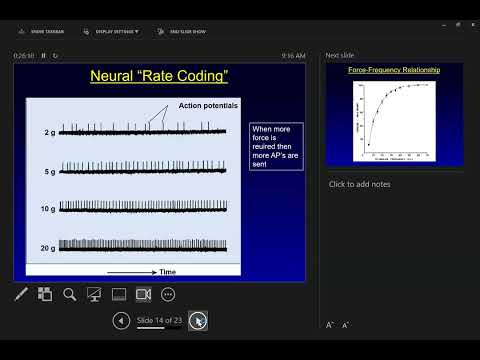
- In first dorsal interosseous recordings, lifting loads of 2, 5, 10, and 20 grams was associated with progressively more action potentials.
- Firing frequency is the number of motor-neuron action potentials sent to a motor unit per second, measured in hertz.
- Force control uses both the number of recruited motor units and the firing frequency of active units.
- Increasing stimulus frequency raises muscle force because action potentials arrive more often within a given period.
- In the illustrated participant, force increased up to roughly 45 to 50 hertz, then showed little additional gain at 60 to 70 hertz.
- The frequency at which force plateaus depends on fiber type, with slow-twitch fibers reaching a plateau at lower firing rates than fast-twitch fibers.
- A second action potential arriving before a twitch fully relaxes releases additional calcium, stacking force responses through summation.
- As stimulation frequency increases, calcium remains elevated for longer and force rises; a wavelike contraction is incomplete tetanus.
- When force becomes sustained and flat, the muscle has reached complete, or fused, tetanus because further stimulation produces little additional force.
- Black gives a broad skeletal-muscle range of about 10 to 30 or 40 action potentials per second for complete tetanus, with the threshold varying by fiber type.
- A needle-EMG study of the first dorsal interosseous plots force against firing frequency, with each line representing one motor unit.
- For small force demands, the nervous system first increases firing in an already active unit before recruiting another unit.
- As force requirements rise, it recruits additional units and increases their firing rates, typically progressing from slow units through type IIa to type IIx.
- The control strategy is to activate only enough motor units and firing frequency to meet the task, even though the nervous system performs this adjustment automatically.
- Students compare curling one backpack with curling two in one hand, noticing that the heavier load becomes difficult at particular points in the movement.
- The demonstration shows that force capacity can change with elbow position even though the muscle’s number of available motor units does not change.
- The class considers sarcomere overlap as a possible explanation for differences in force across the curl range.
- Cross-bridges form when actin and myosin overlap; near-optimal overlap produces the greatest force.
- A sarcomere stretched too far has too little actin-myosin overlap, while an excessively shortened sarcomere also produces less force.
- The resulting length-tension curve is an inverted U, but sarcomeres generally remain near optimal length during ordinary joint motion, so this effect has limited influence on everyday force production.
- Black postpones the fuller explanation of joint-position strength changes and notes that the next class will continue force control and sensorimotor material.
Transcript excerpt
0:02 Good morning. Does Monday after football know which group it was a lot we were talking about there was only downside to that game and that was correct only downside. Okay. So I've got to cut out about five minutes early today. So we're going to go ahead and get started with skip on doing some growth science today. Uh, we're going to keep talking about things that contribute to course production. All right. Things that contribute. You guys get your name tags out, please. I'm still I'm getting closer. I'm working on this. Um, we left off on Friday talking about the active. Okay. Talking about the amount of time it takes for
0:54 an action potential to move, for calcium to get released, right? And then we get it clean. How if we if we change that effectively. Okay. The other thing I want to remind everybody about that we learned on Friday. It's going to be really really important in a few minutes today is about the circuit enzyme. circuit enzyme sits in the sarcoplasmic reticulum and its job is to pull calcium back out of the intracellular space to back into the soplasmic reticulum. So it's the thing that runs as the calcium returns back down to baseline over here. It's the circuit enzyme that runs all of that. And the key thing that's going to be important today is circa and its
1:44 speed of action mimics fighting time. So fast fibers have a fast circuit which means fast twitch fibers can relax or turn off forwards faster. Slow twitch fibers have a slower circuit which means that slope is going to be more gradual and it turns off force production more slope. Okay, you will see in a couple of slides why this is so important. Okay, you'll see why it's so
This is the start of the transcript. Save this video free for the whole transcript, searchable and time-coded.
Related notes
Summary, takeaways, and chapters were generated by AI from the video's transcript and may contain errors. The video belongs to its creator, Exercise Physiology with Dr. Chris Black.