L18 Metabolism V
 Watch on YouTube →
Overview
Dr. Chris Black explains how exercise intensity and ATP turnover regulate energy production across the phosphagen system, glycolysis, the Krebs cycle, and the electron transport chain. He connects these pathways to post-workout nutrition and creatine, then applies them to exercise examples, emphasizing that duration and intensity determine which system predominates and that aerobic training increases mitochondrial capacity and reduces lactate production at a given workload.
Key takeaways
- Creatine supports performance by increasing muscle creatine-phosphate availability, potentially enabling an extra repetition or greater overload; Black cites a 2 to 5% improvement in muscle mass and strength versus placebo.
- The first minutes of exercise can feel harder because glycolysis ramps up faster than the Krebs cycle and electron transport chain, temporarily diverting more pyruvate toward lactate.
- Aerobic training increases mitochondrial capacity, allowing more pyruvate to enter oxidative metabolism and lowering lactate production at the same exercise intensity.
- The predominant energy system depends on intensity and duration, not simply the activity's distance: a nine-minute mile is mainly aerobic, while a 12-second 100-meter sprint relies mostly on creatine phosphate.
- At ordinary submaximal exercise near sea level, oxygen availability is generally not the main constraint on aerobic metabolism; oxygen limitation is more plausible at maximal effort or in low-oxygen conditions.
- Intermittent sports use multiple systems: brief basketball actions draw on glycolysis, recovery periods involve aerobic metabolism, and very short football plays draw on phosphagen energy.
Chapters
- Dr. Chris Black describes a post-resistance-training period, roughly 90 minutes to two hours, when protein can increase muscle protein synthesis.
- Carbohydrates stimulate insulin release, which he says can further support the post-exercise protein-synthesis response.
- Chocolate milk combines protein, fat, and sugar, and its carbohydrate-to-protein ratio resembles that of some commercial recovery drinks.
- Creatine raises muscle creatine phosphate, increasing immediately available phosphagen energy rather than directly stimulating protein synthesis.
- Black estimates a 2 to 5% greater increase in muscle mass and strength versus placebo, assuming a person responds to supplementation.
- About 80% of people are described as responders; increased muscle water can raise lean-mass measurements and make some users feel heavier or bloated.
- Taking creatine with juice or a fizzy drink is not presented as meaningfully improving its effect.
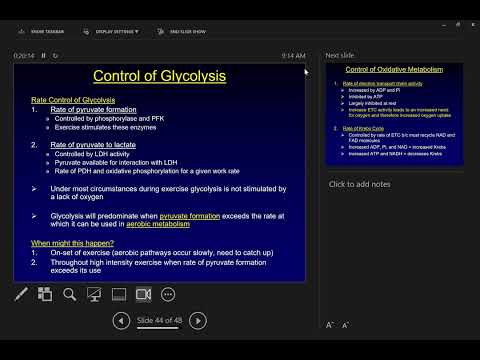
- Phosphorylase releases glucose from glycogen, while phosphofructokinase, or PFK, is identified as glycolysis's rate-limiting enzyme.
- Black frames these controls as helping move glucose toward pyruvate, the central product that can feed further energy pathways.
- Pyruvate dehydrogenase directs pyruvate toward acetyl-CoA and the Krebs cycle; lactate dehydrogenase converts it to lactate.
- ATP turnover into ADP and inorganic phosphate is presented as a broad stimulus for metabolic pathways.
- At exercise onset, glycolysis can accelerate before the Krebs cycle and electron transport chain fully respond, so more pyruvate is temporarily converted to lactate.
- After a few minutes at the same pace, oxidative pathways catch up, lactate production falls, and the effort can feel easier.
- High-intensity efforts, such as heavy lifting or exercise lasting about a minute, can produce pyruvate faster than oxidative metabolism can process it.
- Aerobic training increases mitochondrial capacity, allowing more pyruvate to be oxidized and reducing lactate production at a given workload.
- Black identifies electron transport chain activity as a major constraint on oxidative metabolism because it regenerates NAD and FAD for the Krebs cycle.
- Rising ADP and inorganic phosphate signal ATP use and help stimulate metabolic activity; high ATP availability inhibits it.
- Greater electron transport activity raises oxygen demand, which increases breathing during exercise.
- At submaximal exercise near sea level, oxygen availability generally does not limit aerobic metabolism; limitation may occur at maximum effort or in low-oxygen environments.
- Black summarizes ATP breakdown into ADP and phosphate as a key signal stimulating metabolism across the phosphagen, glycolytic, and oxidative systems.
- Students work in groups to classify activities by their predominant energy system: phosphagen, glycolysis, or aerobic metabolism.
- The exercise is framed as test preparation that requires applying metabolic concepts to scenarios rather than memorizing labels alone.
- A mile taking nine minutes is classified as predominantly aerobic because the pace can be sustained without lactate accumulation forcing an early stop.
- A 15-minute mile walk is also predominantly aerobic; distance alone does not determine the energy system.
- A world-class mile near 3 minutes 45 seconds could rely more heavily on glycolysis because its intensity is much higher.
- A 100-meter sprint in 12 seconds relies primarily on creatine phosphate, with additional glycolytic and aerobic contributions.
- Walking 100 meters in 30 seconds is treated as primarily aerobic overall, although creatine phosphate and glycolysis contribute during the first few steps.
- For a set of eight squats, Black's intended answer is the creatine-phosphate system, assuming the repetitions take roughly 20 seconds.
- The squat example is conditional: repetition speed and total set duration affect how much glycolysis contributes alongside phosphagen energy.
- Basketball combines brief sprints and active plays, which Black associates mainly with glycolysis, with walking and pauses that allow aerobic metabolism to contribute.
- The class describes football plays as short, roughly five- or six-second efforts followed by rest, making the phosphagen system relevant to individual plays.
- Intermittent sports cannot be reduced to one pathway for the entire game; the dominant source changes between bursts of activity and recovery.
Transcript excerpt
0:02 Nobody has a question. Nobody wants to know anything. Nobody wants me to talk about Pilates again or anything else. >> Yes. >> Insulin is in some instances anabolic. Okay. insulin is in some instance event. There is evidence that if you work out, let me rephrase that. Okay, you resistance train and then there's a window of time after you resistance train where you need to try to eat some protein. Okay, to maximize that protein synthesis. Um people used to call it the
0:52 anabolic window. Um, and it's less of a thing than it used to be, but there's a period of time afterwards where if you eat some protein after resistance training, maybe 90 minutes to two hours afterwards, you will get a larger increase in protein synthesis than you would have if you did. One of the things that we know now is that if you will eat that protein and also eat some carbohydrate in that time period, you get an even bigger bump in protein synthesis because the carbohydrates stimulate insulin release and that insulin release functions in some ways like IGF-1 binds onto the receptors that look like the insulin receptor and it pulls fuel into the muscles and provides that fuel for them to run the proteins.
1:41 So, anybody ever take post-workout stuff other than just I'm going to have 4,000 grams of protein powder. Anybody take anything post-workout? >> Come on. >> Sometimes I'll drink like a Gator or chocolate milk. >> Gator or chocolate milk. Okay. Anybody heard about this? Going to have chocolate milk after a workout. Okay. There's real science behind that. Okay. Real science. What is in chocolate milk that makes it like the greatest drink in the history of the world? >> Protein, sugar, right? Chocolate. Okay.
This is the start of the transcript. Save this video free for the whole transcript, searchable and time-coded.
Related notes
Summary, takeaways, and chapters were generated by AI from the video's transcript and may contain errors. The video belongs to its creator, Exercise Physiology with Dr. Chris Black.