Goal Setting That Matters: Roles, SMART Goals & OKRs | WFED 119 | Oct 22, 2026
Overview
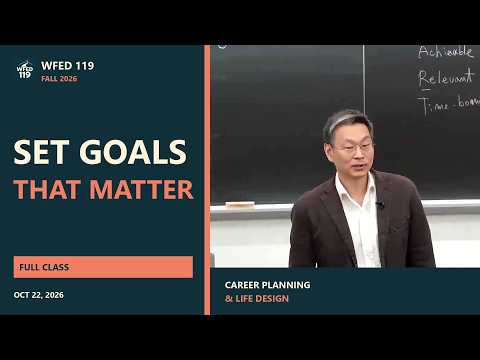
Dr. Yoon presents a role-based approach to setting manageable goals for the next 6 to 12 months, recommending up to seven life roles and no more than two or three goals per role. He connects goals to personal values, mission, and vision through SMART criteria, explains how OKRs link objectives to measurable key results and initiatives, and introduces an activity system for making limited time and energy serve multiple roles at once.
Key takeaways
- Choose up to seven life roles and set no more than two or three goals for each over a 6 to 12 month period to keep commitments manageable.
- Relevance is the key SMART test: personal goals should align with values, mission, and vision, while workplace goals should also support the organization's direction.
- A deadline turns a general intention into a time-bound target and makes it possible to work backward from a future milestone, such as launching a company at age 35.
- In an OKR, an objective states the aim, key results measure progress, and initiatives identify actions; a restaurant could track review ratings and repeat customers to assess satisfaction.
- An activity system can reduce the strain of limited time and energy by identifying core activities that contribute to several roles, such as teaching, research, and service.
- Dr. Yoon's Franklin Planner practice used weekly big rocks to keep priorities across roles visible, a method that can also be adapted to smartphone apps or a home-screen background.
Chapters
- Dr. Yoon frames goal setting as the next step after identifying values, mission, vision, and strategies through SWOT analysis.
- Organizations commonly assign annual or quarterly performance goals, and employees are evaluated against them.
- He contrasts acting as a company's proxy agent with taking the driver's seat to set goals for one's own professional and personal life.
- Students should set goals for the next 6 to 12 months across professional, personal, and community aspects of life.
- Possible roles include student, worker or professional, community member, partner or spouse, son or daughter, and future CEO.
- Donald Super's term leisurite describes a person who pursues leisure, while well-being can include spiritual, physical, emotional, and financial domains.
- The assignment template asks students to select up to seven roles, including well-being or Franklin Covey's Sharpen the Saw domains.
- Set no more than two or three goals for each role to avoid overloading plans and burning out.
- Dr. Yoon describes using a Franklin Planner at LG in Korea, where weekly big rocks kept priorities across roles visible.
- He suggests adapting the practice with a planner, handwritten notes, apps, or a smartphone background.
- Dr. Yoon defines SMART as Specific, Measurable, Achievable or Attainable, Relevant or Realistic, and Time-bound.
- He considers Relevant the most important criterion: goals should connect to personal values, mission statements, and an envisioned future.
- In an organization, professional goals should align with company direction and ideally with employees' personal and professional directions too.
- A deadline creates urgency and supports backward planning from a future milestone, such as starting a company at age 35.
- A student's Roth IRA goal illustrates a specific financial target, with Dr. Yoon citing a $7,500 annual contribution limit in the class example.
- The Roth IRA example also exposes a feasibility condition: contributions require earned income from work.
- To improve a goal such as losing weight, specify an amount and deadline, for example a target to reach by December 31.
- Dr. Yoon cautions that excessive detail can limit options, while achievability and relevance depend on the individual's circumstances.
- Dr. Yoon introduces OKRs, used by companies including Google, as Objectives supported by multiple Key Results.
- For a restaurant seeking higher customer satisfaction, candidate key results include raising review ratings from 3.5 to 4.5 and increasing repeat customers.
- Revenue may be a weaker satisfaction indicator if it does not align clearly with the objective.
- Initiatives are concrete actions linked to key results, such as staff training, improved monitoring, or higher employee pay.
- The OKR process connects an objective to measurable key results, then to initiatives that can be acted on and reviewed.
- Dr. Yoon stresses that key results and initiatives should remain relevant to the objective, using restaurant satisfaction to show how revenue can be a questionable fit.
- The class assignment calls for creating 6 to 12 month goals, with review and updates expected later rather than within the session.
- Dr. Yoon lists his roles and activities, including professor, researcher, inventor, company vice president, writer, startup founder, speaker, curriculum creator, and student adviser.
- An activity system maps important activities, identifies overlaps, and builds core activities that serve more than one role.
- His career-planning work and action learning connect teaching, leadership development, research, theory, and the LifeCraft platform.
- He describes using assessment tools across these activities to generate synergy rather than treating every responsibility as separate.
- A senior professor advised Dr. Yoon before tenure to find activities that could support research, teaching, and service at once.
- Dr. Yoon earned tenure in 2021 after meeting demands that included reputable publications, presentations, strong teaching, and service to the community and profession.
- He recommends creating synergy between activities and building routines that preserve time for relaxation and well-being.
- The session closes with a plan for teams to share progress in a later class and request peer input, including feedback collected through a QR-code survey.
Transcript excerpt
0:24 Okay, um Hello everyone. Hello. >> Hello. >> So, um Usually I don't like to lecture, but I think I probably need to do it uh today. So, um and because there's not much to write, uh you may want to close your laptop. Or, another way is maybe you can pull up um uh the assignment uh goal-setting assignment template. So, if you go to uh Canvas, you can open up uh the assignment page for goal-setting and ELRC, then you will see the goal-setting template. Cuz um the lecture that I'll be giving will be uh following that uh structure.
1:14 Okay, so that might be helpful if you want to take a look at your laptop. Um So far, uh we've covered um your self-understanding, including your values, mission, and maybe vision. What else? You've um come up with some strategies. If you are done with uh SWOT analysis, then um but still probably you are not sure what to target. Right? In order for you make the desired future happen, then you might need to you will need to
2:02 target certain things. You cannot chase everything all the time. Right? So, that's why uh goal setting is needed. Um So, how many of you have uh written goals other than getting 4.0 GPA as you wrote? How many of you have a Yeah, goal setting uh document for this semester or for this year? Raise your hand if you have. Wow. Okay. So, uh that's something that I want you to uh start building. So, when when you work for a company or internal organization, what they will require you to do is to create um yearly goals.
2:51 Or it can be uh quarterly these days. Then, you will be evaluated against uh those goals that you set.
This is the start of the transcript. Save this video free for the whole transcript, searchable and time-coded.
In this course
Related notes
Summary, takeaways, and chapters were generated by AI from the video's transcript and may contain errors. The video belongs to its creator, Career Planning and Life Design.