Turning Ideas Into Action: Student Projects & Hope | WFED 119 | Sep 10, 2026
Overview
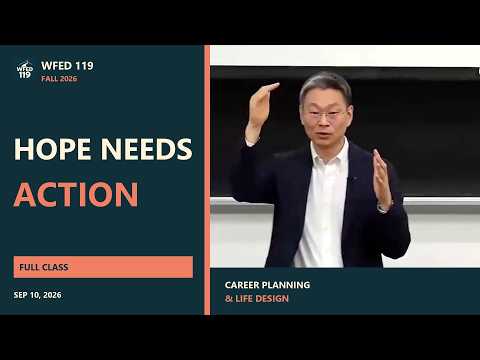
Dr. Yoon connects student-generated Penn State community projects with the Hope-Action approach to career development. The class distinguishes a wish, optimism, and actionable hope, then links self-reflection and self-clarity to envisioning, planning, implementation, and adaptation; student pitches range from mentorship and wellness outreach to career-planning tools and campus kindness projects.
Key takeaways
- Actionable hope combines a goal, multiple pathways for reaching it, and agency to take steps; brainstorming several project options is itself practice in pathways thinking.
- Self-reflection on values, personality, past actions, and outcomes can produce self-clarity, which helps students make choices without being easily diverted by outside circumstances.
- A career vision should cover life roles and decades beyond a job title; WFED 119 turns that vision into a personal blueprint in a short PowerPoint book.
- When plans fail, adaptation can involve revising the goal, changing the plan, or adjusting the action, rather than abandoning progress altogether.
- Hope can be developed and measured over time: students take the Hope-Action Inventory and Hopeful Career State measure this week and again at semester's end.
- The student project brainstorm generated practical campus ideas, including major-based mentoring, wellness-resource outreach, course-review platforms, positive-message QR codes, and support for public speaking.
Chapters
- Dr. Yoon opens with a brief check-in activity and gives students time to enter or review responses.
- Students are invited to look at classmates' answers and use a thumbs-up to signal agreement or resonance.
- Teams review past group projects on the WFED 119 course website, then propose ideas relevant to career planning, life design, health, or wellness.
- Dr. Yoon encourages projects that build skills and engage students, while suggesting teams consider using an AI tool without requiring AI.
- Teams collect multiple ideas in a shared Google Doc for class discussion and possible improvement.
- Group 7 proposes a personality-style quiz to help undecided students identify suitable majors or career directions.
- The same group suggests a phone app that sends a student's location to campus responders, offering an alternative to approaching a physical blue-light station.
- Group 9 pitches an Enneagram-based tool for finding campus activities suited to a group of friends, plus a student review site focused on course content and success tips.
- Group 1 wants to publicize existing campus resources for fitness, mental health, and healthy eating, especially for new students.
- The group also considers sharing budget trackers, study tips, syllabus organizers, and a Google Forms quiz to learn which resources students already know about.
- Group 2 proposes food and toy drives, group study and tutoring sessions, and random acts of kindness to help students feel welcome at Penn State.
- Group 3 proposes matching first-year students with upperclass students in the same major for guidance through university.
- Group 4 suggests anonymous confessions, an interactive mural, a communal boulder for positive messages, and a bonfire where participants discard written worries.
- The bonfire idea includes measuring whether participants feel better afterward, turning a creative activity into a small research project.
- Group 5 pitches a motivational playlist for studying, a platform that surfaces campus or personal updates by interest, and a career planner using a resume and goals to generate tailored advice.
- Group 6 proposes posting positive messages or QR codes around campus so students can encounter encouragement and feel appreciated.
- The group also suggests handing out free snacks or energy drinks during midterms or finals, extending a welcome-week activity to high-stress periods.
- Group 8 suggests helping students organize homework, routines, and schedules, alongside a tracker for spending on items such as food and clothing.
- The group also proposes surveying student coffee consumption and helping students overcome fear of public speaking.
- Across the class pitches, Dr. Yoon encourages teams to record questions and constructive feedback in the shared project document.
- Dr. Yoon introduces Hope-Action theory, developed with colleagues, and describes studying hope and agency in individuals and organizations.
- Students are assigned the Hope-Action Inventory and the Hopeful Career State measure, with the latter available as a nine-item assessment in course materials.
- Dr. Yoon connects the assessments to students' reflection assignments and invites them to review results as a basis for understanding their current career hope.
- Dr. Yoon distinguishes wishing, optimism, and hope, emphasizing that hope is oriented toward action.
- Drawing on Snyder's hope theory, he identifies three components: goals, pathways thinking about multiple ways to reach them, and agency to act.
- The team-project brainstorm serves as a pathways exercise because students generate several possible ways to meet the course goal of completing a meaningful group project.
- Self-reflection includes examining values, desires, personality, past actions, and the outcomes of those actions.
- Self-clarity is the resulting ability to describe who you are, what you value, and what gives your life direction.
- Dr. Yoon says clearer values and priorities can make decisions easier and reduce the tendency to be pulled off course by surrounding events.
- A career construction interview planned for the following week will use students' personal stories to identify life themes.
- Envisioning begins with a clearer sense of mission and values, then considers a desired future beyond choosing a job title.
- Students are asked to consider life across their 20s through their 60s and roles such as student, worker, family member, parent, and leisure-seeker.
- The course culminates in a short book in PowerPoint format that summarizes students' reflections and future vision as a personal blueprint.
- Dr. Yoon notes that plans often fail to unfold as expected and asks students to decide whether goals, plans, or actions need to change.
- Adaptation may mean changing direction when a goal is wrong, revising a plan, or adjusting actions as new information becomes available.
- Treating plans as experiments supports pathways thinking: a sound goal may still have several routes to reach it.
- The group project is designed to practice this process collaboratively and to resemble workplace participation, including expectations for attendance and punctuality.
- The Hopeful Career State score is a snapshot of current career hope, not a permanent judgment of a person's general outlook.
- Students associate hope with motivation, discipline, commitment, attendance, and active participation in schoolwork.
- Dr. Yoon links hope with student engagement and reports that research with college students found engagement associated with higher GPA and greater clarity about the future.
- Future managers can support hope by asking employees what tasks interest them, what they want to continue, and how their strengths can be used.
- Dr. Yoon describes a follow-up study interviewing people nine years after a five-day intensive program; participants said clarified values and a personal blueprint helped them feel grounded even when plans changed.
- Hope-Action research has been conducted in countries including Canada, Korea, Oman, Taiwan, and the United States, and the Hope-Action Inventory has been translated into about 10 languages.
- Students are asked to complete the Hopeful Career State measure and Hope-Action Inventory this week and again at semester's end, answering honestly to track development.
- Upcoming work includes a mentor interview assignment, a research survey sequence offering 5% bonus credit for completing all three surveys, and an in-class career construction interview the following Tuesday.
Transcript excerpt
0:01 That's >> okay. >> Yeah. Hello everyone. Every time I forget about um starting the check-in questions. So today I will make sure to start with checkin but uh let me wait for a few seconds. Yeah. Did you all capture this? Moving on. Okay. >> I will wait maybe 10 more seconds. If
0:56 you didn't catch it, please do so. All right. Okay. Uh moving on. All right. For a while, I will keep it open for a while. All right. Let's go with this. >> [clears throat]
3:52 >> Okay. Yeah. Review other other people's answers. Um if you resonate with any of those but it's very simple answers. So you can give thumbs up. Okay, close this. [clears throat]
5:01 And here I can end this. Okay. >> [clears throat] >> Let me let me change some uh maybe sequence that um that I planned from what I planned. Um so as you know this uh class involves um team project and I wanted us to maximize maybe expression of your annual game types right so it would be helpful if we can maybe uh think about what projects uh you may want to be engaged in or what what project you want to work on throughout
5:49 the semester. So um I encourage you to visit uh for for each group. So encourage you to visit um our course website that maybe you can type sites sites.psd.edu view/workforce at FD119 then if you go there uh there is a there is project section so you can review uh those projects that the previous uh semester or teams have have done. So I want you to review those projects uh with your team members and then brainstorm what kind of project you may you would want to do uh in this
This is the start of the transcript. Save this video free for the whole transcript, searchable and time-coded.
In this course
Related notes
Summary, takeaways, and chapters were generated by AI from the video's transcript and may contain errors. The video belongs to its creator, Career Planning and Life Design.